Welleby’s Plan
The water In the underground water table beneath the town of Welleby is moderately saline— 20,000millkjrarns of salt per liter of water (mg/L), or roughly half as saline as ocean water. To lower the level of the water table and thus prevent agricultural land from being inundated with salt water, the town plans to pump water from the table at a rate of 450kiloliters per day (kL/day) into a large shallow pond, allowing much of the water to evaporate. The town plans to divert 10percent of the water pumped from the water table to supplement Us supply of drinking water, which Is currently piped In from great distances. Due to the water's supply, the town intends to construct a desalination plant to treat the diverted water for use as drinking water.
Desalination Types
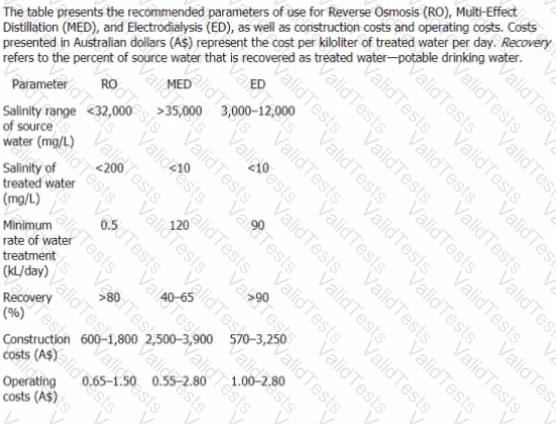
Comparison
Welleby is deciding among the following three desalination methods.
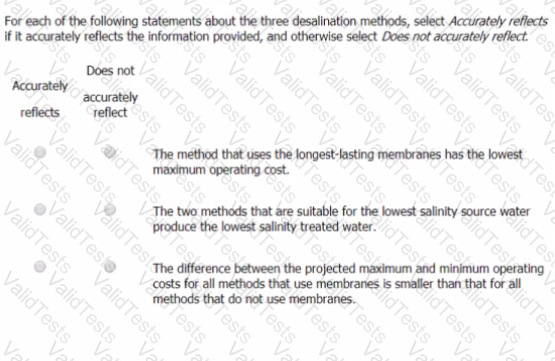
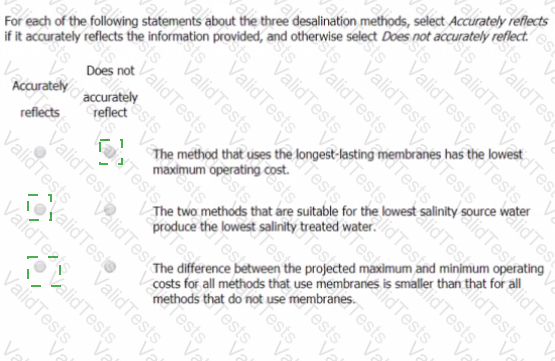
Reverse Osmosis (RO): Water Is pushed through a membrane, leaving salts behind. RO systems can handle a large range of water flow rates and use relatively little energy. However, RO membranes are expensive and must be replaced every 2 to 5 years. There is also a possibility that bacteria can grow on the membrane. Introducing tastes and odors Into the desalinated water.
Multi-Effect Distillation (MED): Saline water Is heated to produce water vapor, from which Is condensed potable fresh water. This process requires large amounts of energy, regardless of the salinity of the source water. It becomes more cost effective as water volumes increase.
Electrodialysis (ED): Electricity is used to selectively move salts through a membrane. Consumption of energy Is directly proportional to the salinity of the water to be treated, so with higher salinities the process rapidly becomes more costly than other methods. ED membranes need to be replaced every 7 to 10years.



Submit