Comprehensive and Detailed In-Depth Explanation:
To verify the correct answer, let's analyze the LSA types in OSPFv3 and how they work in the given topology.
1. Understanding OSPFv3 LSAs in the Figure
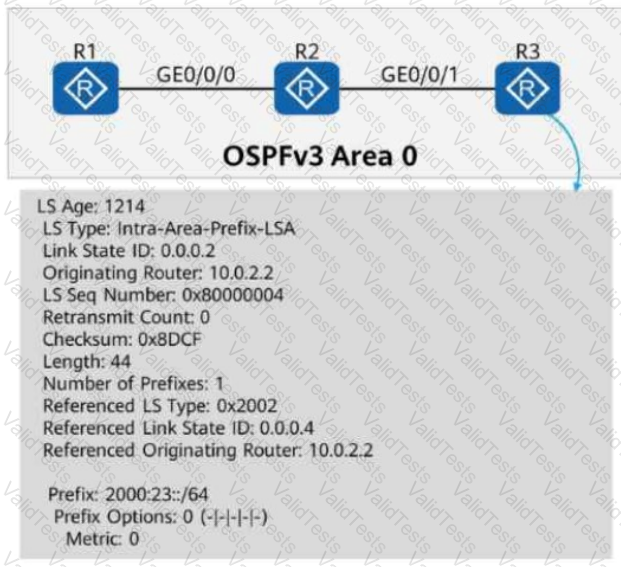
From the command output shown in the image:
LS Type: Intra-Area-Prefix-LSA (Type 9 in OSPFv3).
Originating Router: 10.0.2.2 (R2).
Referenced LS Type: 0x2002, which corresponds to a Network-LSA (Type 2).
Prefix Advertised: 2000:23::/64, which is an IPv6 prefix associated with a network segment.
2. What is an Intra-Area-Prefix LSA (Type 9) in OSPFv3?
In OSPFv3, Type 9 LSAs (Intra-Area-Prefix LSAs) describe IPv6 prefixes associated with either Router-LSAs (Type 1) or Network-LSAs (Type 2).
In multi-access networks (e.g., Ethernet), the DR (Designated Router) generates a Network-LSA (Type 2), which represents the shared network segment.
R2 is likely the DR in this topology, meaning it generates a Network-LSA (Type 2) and an associated Intra-Area-Prefix LSA (Type 9) for the subnet.
3. Analyzing Why the Statement is TRUE
R2 (10.0.2.2) is the originator of the Intra-Area-Prefix LSA (Type 9).
The LSA references a Network-LSA (Type 2), confirming that R2 is the DR for the subnet.
This means the LSA is correctly describing the IPv6 prefix associated with the network.
Since the LSA is visible in R3's LSDB, R3 is learning this information from R2.
All these points confirm that the statement is TRUE.



Submit