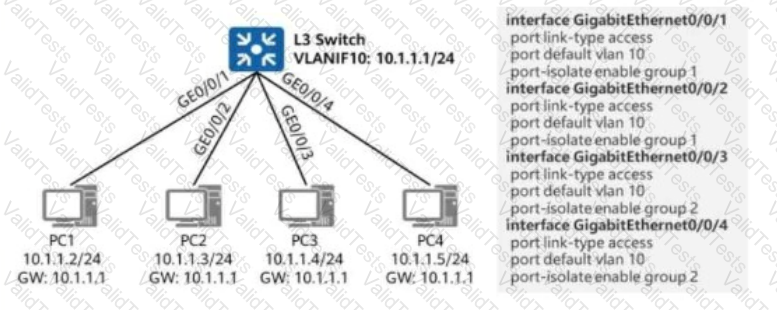
The switch is Layer 3, with VLANIF10 configured as 10.1.1.1/24 (gateway for all PCs).
All PCs are in VLAN 10 and use 10.1.1.1 as the default gateway.
Port isolation is enabled on switch interfaces, dividing them into two groups:
Group 1 (PC1 & PC2): GigabitEthernet0/0/1 and GigabitEthernet0/0/2
Group 2 (PC3 & PC4): GigabitEthernet0/0/3 and GigabitEthernet0/0/4
Port Isolation Behavior:
Ports within the same isolation group CAN communicate with each other.
Ports from different isolation groups CANNOT communicate directly.
All devices CAN still communicate with the L3 switch (10.1.1.1), which acts as the gateway.
Ping Analysis from PC1 (10.1.1.2)
Destination IP
Device
Connected Port
Isolation Group
Ping Result from PC1
10.1.1.3
PC2
GigabitEthernet0/0/2
Group 1
✅ Can Ping
10.1.1.4
PC3
GigabitEthernet0/0/3
Group 2
❌ Cannot Ping
10.1.1.5
PC4
GigabitEthernet0/0/4
Group 2
❌ Cannot Ping
10.1.1.1
L3 Switch (Gateway)
N/A
Not Isolated
✅ Can Ping
Which IPs Cannot be Pinged from PC1?
PC3 (10.1.1.4) and PC4 (10.1.1.5) are in a different isolation group (Group 2), so PC1 cannot reach them directly.
PC2 (10.1.1.3) is in the same isolation group (Group 1), so PC1 can ping it.
PC1 can ping the gateway (10.1.1.1) because the switch is Layer 3 and forwards traffic.
Thus, the correct answers are: A. 10.1.1.3 and D. 10.1.1.4.
Final Conclusion:
✅ PC1 CAN ping:
10.1.1.3 (PC2, same isolation group)
10.1.1.1 (Gateway, L3 Switch)
❌ PC1 CANNOT ping:
10.1.1.4 (PC3, different isolation group)
10.1.1.5 (PC4, different isolation group)
Thus, the correct answer is: A. 10.1.1.3 and D. 10.1.1.4.
[Reference:, HCIP-Datacom-Advanced Routing & Switching Technology V1.0 – Port Isolation and VLAN Behavior, Huawei Official HCIP-Datacom Study Guide – Port Isolation and Layer 3 Switch Configuration, Huawei Documentation on Port Isolation in VLANs, , , , ]
Contribute your Thoughts:
Chosen Answer:
This is a voting comment (?). You can switch to a simple comment. It is better to Upvote an existing comment if you don't have anything to add.



Submit