Comprehensive and Detailed In-Depth Explanation:
To determine the correct answers, we need to analyze OSPFv3 behavior and Inter-Area-Prefix LSAs (Type 3 LSAs).
1. Understanding OSPFv3 Inter-Area-Prefix LSAs (Type 3 LSAs)
Type 3 LSAs (Inter-Area-Prefix LSAs) are generated by an ABR (Area Border Router) to advertise networks between areas.
If a router in one area learns a prefix from another area, it generates a Type 3 LSA to advertise it further.
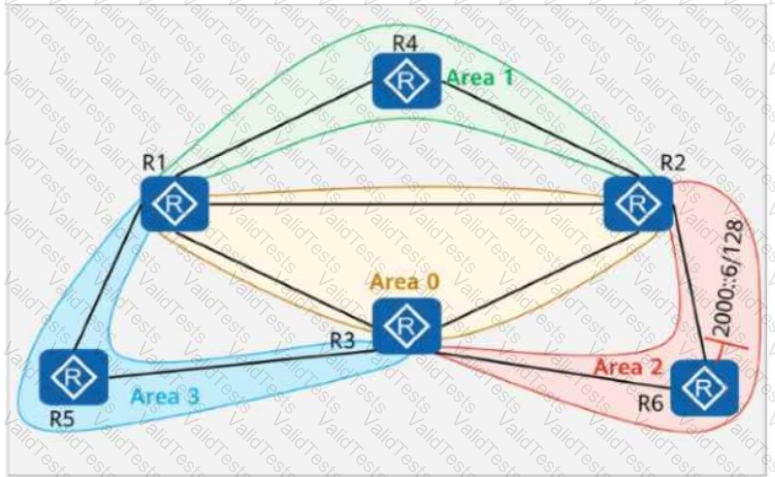
Stub areas (Area 1) do not allow external LSAs, including Type 3 LSAs for external routes.
NSSA areas (Area 3) accept external routes but redistribute them as Type 7 LSAs before being converted to Type 5 LSAs by an NSSA ABR.
2. Analyzing Each Answer Option:
✅ A. "The Inter-Area-Prefix-LSA that is generated by R1 and describes 2000::6/128 exists in Area 0." → TRUE
R6 has 2000::6/128 in Area 2.
R2 is the ABR that brings this prefix into Area 0 as a Type 3 LSA.
R1, being in Area 0, learns this LSA from R2.
Thus, this statement is correct.
❌ B. "The Inter-Area-Prefix-LSA that is generated by R1 and describes 2000::6/128 exists in Area 3." → FALSE
R1 is not an ABR for Area 3, so it does not generate an LSA for 2000::6/128 in Area 3.
Instead, R3 (the ABR between Area 0 and Area 3) would be responsible for propagating routes.
This statement is false.
❌ C. "The Inter-Area-Prefix-LSA that is generated by R2 and describes 2000::6/128 exists in Area 1." → FALSE
Area 1 is a stub area and does not accept external LSAs (including Type 3 LSAs from other areas).
R2 cannot generate and send a Type 3 LSA for 2000::6/128 into Area 1.
This statement is false.
✅ D. "The Inter-Area-Prefix-LSA that is generated by R3 and describes 2000::6/128 exists in Area 2." → TRUE
R3 is an ABR and learns 2000::6/128 from R2 (which originally learned it from R6 in Area 2).
Since Area 2 is a normal (non-stub, non-NSSA) area, Type 3 LSAs are allowed.
R3 generates and advertises this Inter-Area-Prefix-LSA for 2000::6/128 into Area 2.
Thus, this statement is correct.



Submit