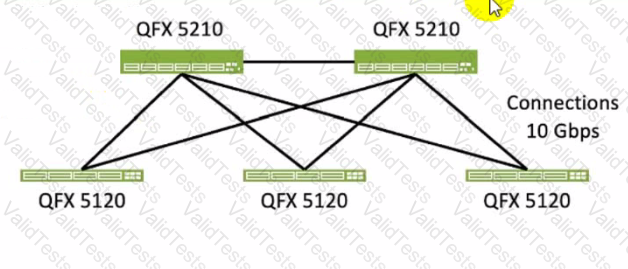
To make the IP fabric a valid IP fabric, the connection between the two spine nodes must be removed. This is because an IP fabric is a network topology that uses a spine-leaf architecture, where the spine devices are only connected to the leaf devices, and the leaf devices are only connected to the spine devices. This creates a non-blocking, high-performance, and scalable network that supports Layer 3 routing protocols such as BGP or OSPF. The connection between the two spine nodes in the exhibit violates the spine-leaf design principle and introduces unnecessary complexity and potential loops in the network. The other options are incorrect because:
A. The IP fabric must consist of only one device model throughout the fabric is wrong because an IP fabric can support different device models as long as they are compatible and interoperable. The exhibit shows two different models of QFX switches, which are both supported by Juniper Networks for IP fabric deployments.
B. The connection between the two spine nodes must be increased to 40 Gbps is wrong because increasing the speed of the connection does not make the IP fabric valid. The connection between the two spine nodes should be removed, as explained above.
C. The IP fabric connections must be increased to a speed greater than 10 Gbps is wrong because the speed of the connections does not affect the validity of theIP fabric. The IP fabric can use any speed that meets the bandwidth and performance requirements of the network. 10 Gbps is a common speed for IP fabric connections, but higher or lower speeds can also be used depending on the network design and devices. References:
IP Fabric Underlay Network Design and Implementation
IP Fabric Overview
IP Fabric: Automated Network Assurance Platform
Contribute your Thoughts:
Chosen Answer:
This is a voting comment (?). You can switch to a simple comment. It is better to Upvote an existing comment if you don't have anything to add.



Submit