Summer Certification Special Limited Time 70% Discount Offer - Ends in 0d 00h 00m 00s - Coupon code: validbest

Pass the Amazon Web Services AWS Certified AI Practitioner AIF-C01 Questions and answers with ValidTests

Exam AIF-C01 All Questions
Exam AIF-C01 Premium Access

View all detail and faqs for the AIF-C01 exam

Viewing page 12 out of 12 pages
Viewing questions 111-120 out of questions
Questions # 111:

A company wants to use a large language model (LLM) to develop a conversational agent. The company needs to prevent the LLM from being manipulated with common prompt engineering techniques to perform undesirable actions or expose sensitive information.

Which action will reduce these risks?

Options:

A.

Create a prompt template that teaches the LLM to detect attack patterns.

B.

Increase the temperature parameter on invocation requests to the LLM.

C.

Avoid using LLMs that are not listed in Amazon SageMaker.

D.

Decrease the number of input tokens on invocations of the LLM.

Questions # 112:

A law firm wants to build an AI application by using large language models (LLMs). The application will read legal documents and extract key points from the documents.

Which solution meets these requirements?

Options:

A.

Build an automatic named entity recognition system.

B.

Create a recommendation engine.

C.

Develop a summarization chatbot.

D.

Develop a multi-language translation system.

Questions # 113:

A company has terabytes of data in a database that the company can use for business analysis. The company wants to build an AI-based application that can build a SQL query from input text that employees provide. The employees have minimal experience with technology.

Which solution meets these requirements?

Options:

A.

Generative pre-trained transformers (GPT)

B.

Residual neural network

C.

Support vector machine

D.

WaveNet

Questions # 114:

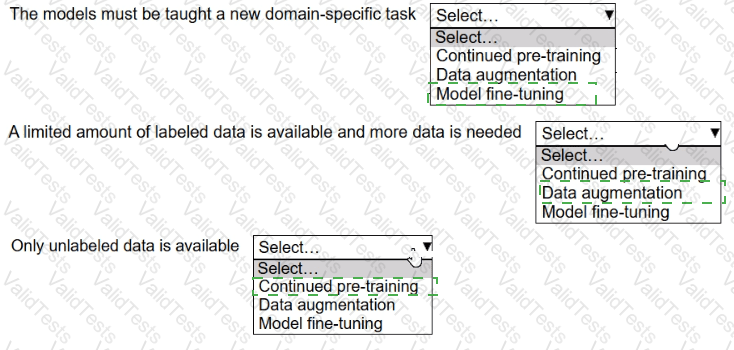
A company wants more customized responses to its generative AI models' prompts.

Select the correct customization methodology from the following list for each use case. Each use case should be selected one time. (Select THREE.)

• Continued pre-training

• Data augmentation

• Model fine-tuning
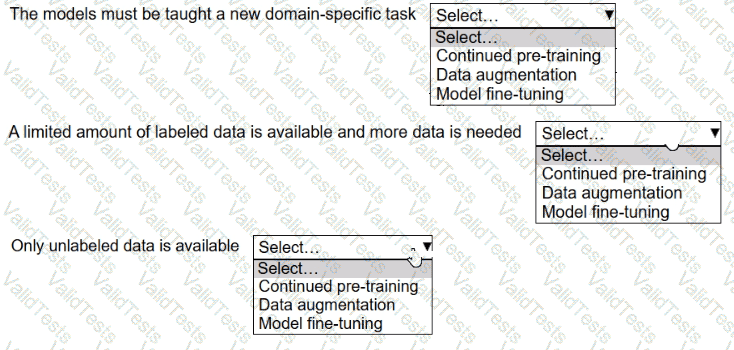
Question # 114

Options:

Questions # 115:

A large retail bank wants to develop an ML system to help the risk management team decide on loan allocations for different demographics.

What must the bank do to develop an unbiased ML model?

Options:

A.

Reduce the size of the training dataset.

B.

Ensure that the ML model predictions are consistent with historical results.

C.

Create a different ML model for each demographic group.

D.

Measure class imbalance on the training dataset. Adapt the training process accordingly.

Questions # 116:

A company wants to keep its foundation model (FM) relevant by using the most recent data. The company wants to implement a model training strategy that includes regular updates to the FM.

Which solution meets these requirements?

Options:

A.

Batch learning

B.

Continuous pre-training

C.

Static training

D.

Latent training

Questions # 117:

In which stage of the generative AI model lifecycle are tests performed to examine the model's accuracy?

Options:

A.

Deployment

B.

Data selection

C.

Fine-tuning

D.

Evaluation

Questions # 118:

What does an F1 score measure in the context of foundation model (FM) performance?

Options:

A.

Model precision and recall

B.

Model speed in generating responses

C.

Financial cost of operating the model

D.

Energy efficiency of the model's computations

Questions # 119:

Which AWS service or feature stores embeddings In a vector database for use with foundation models (FMs) and Retrieval Augmented Generation (RAG)?

Options:

A.

Amazon SageMaker Ground Truth

B.

Amazon OpenSearch Service

C.

Amazon Transcribe

D.

Amazon Textract

Questions # 120:

A company wants to use language models to create an application for inference on edge devices. The inference must have the lowest latency possible.

Which solution will meet these requirements?

Options:

A.

Deploy optimized small language models (SLMs) on edge devices.

B.

Deploy optimized large language models (LLMs) on edge devices.

C.

Incorporate a centralized small language model (SLM) API for asynchronous communication with edge devices.

D.

Incorporate a centralized large language model (LLM) API for asynchronous communication with edge devices.

Viewing page 12 out of 12 pages
Viewing questions 111-120 out of questions