Pre-Summer Special Limited Time 70% Discount Offer - Ends in 0d 00h 00m 00s - Coupon code: validbest

Pass the Appian Senior Developer ACD201 Questions and answers with ValidTests

Exam ACD201 All Questions
Exam ACD201 Premium Access

View all detail and faqs for the ACD201 exam

Viewing page 3 out of 4 pages
Viewing questions 21-30 out of questions
Questions # 21:

An energy company wants to allow the public to be able to report power outages directly and provide supporting documentation in the form of photos and/or videos. The company also requires the reporter's contact details.

How can a developer design and implement this requirement in Appian?

Options:

A.

A portal that interacts with records that stores the name, address, contact information, with a defined folder to store uploaded documents.

B.

A custom version of the Appian mobile app that the user can use to capture details, attached photos, and upload documents.

C.

A site where the user can trigger a process that captures the information including any uploaded files, and uploads everything to an internal Microsoft SharePoint site.

Questions # 22:

You need to connect to an external system using OAuth 2.0: SAML Bearer Assertion Flow authentication type, which requests access to an API on of a signed in user.

This standard has several steps involved with the SAML Bearer Assertion Flow.

Which two steps should you perform to connect to the external system? (Choose two.)

Options:

A.

Use an a!authorizationLink() on the relevant interface.

B.

Confiqure SAML for sinqle siqn-on (SSO).

C.

Generate a service account key in third-party systems.

D.

Register the connection in the third-party system

Questions # 23:

The synced record Task has a self-referential relationship defined in the column parentTaskId. There is a many-to- one record relationship between the id and parentTaskId called parentTask.

For a given task ID, you need to return the task name and the parent task name.

What should you do?

Options:

A.

Use a!queryRecordType() With a filter on the task id, with fields specified to return recordType!Task.name and recordType!Task.parentTask.name.

B.

Create a sync-time custom record field on the Task record called parentName. Specify this field to return in the query field selection.

C.

Use a!queryRecordType() filtered on the task id once to return the task name and parent task ID. Query the record again to return the parent task name.

Questions # 24:

You need to implement a field-level audit functionality on the application data, and then display a log of the changes made over time to the users.

What should you do?

Options:

A.

Create Audit table(s) and create stored procedures on each transaction table to compare and save the modified data.

B.

Create utility process model(s) to insert new version of the modified data for the same record into the transaction tables on modification.

C.

Create Audit table(s) and create triggers on each transaction table to record modifications into the Audit table.

Questions # 25:

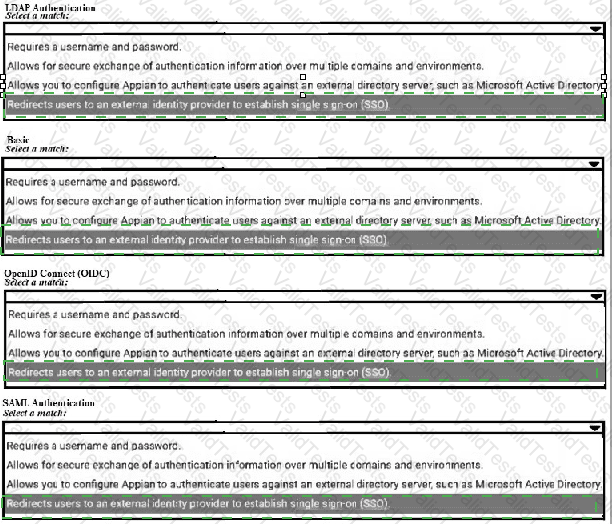
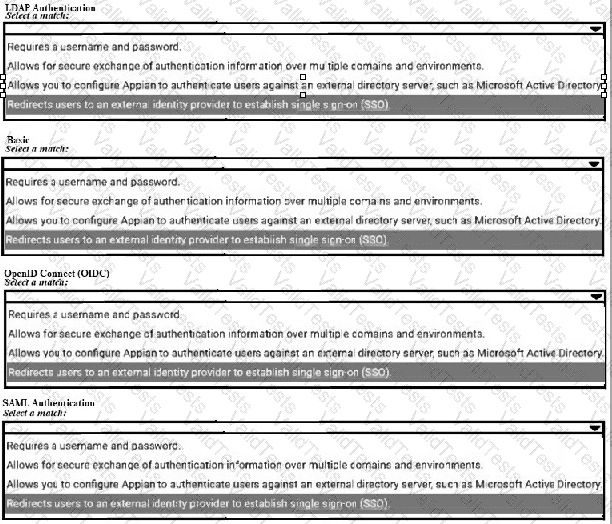
Match each authentication type to the correct authentication characteristic description.

Note: Each description will be used once. To change your responses, you may deselect your response by clicking the blank space at the top of the selection list.
Question # 25

Options:

Questions # 26:

A local variable is reevaluated every time a form loads and you notice subsequent slow performance of the form.

Which two steps could you perform to optimize this? (Choose two.)

Options:

A.

Create a local variable inside with () for faster reevaluation.

B.

Ensure the local variable is refreshed after a specified interval, and nor refreshed when referenced variable are changed.

C.

Avoid executing queries every time a form reevaluates.

D.

Ensure the local variable only updates when a referenced variable is modified or when it's being updated in the saveInto parameter of a component.

Questions # 27:

What are two advantages of database normalization? (Choose two.)

Options:

A.

Enforcing data integrity.

B.

Simplifying query statements to read data.

C.

Minimizing the number of tables that need to be created.

D.

Minimizing data redundancy.

Questions # 28:

In reviewing the process model metrics of your application, you notice a process model with a completion rate of only 10%.

What are two possible reasons for this low completion rate? (Choose two.)

Options:

A.

There are a significant number of instances that are experiencing process errors, which are not being handled by the production support team.

B.

The process contains at least one User Input Task with no exceptions or escalations, and users do not complete the task.

C.

There are a high number of smart service nodes configured in the process model.

D.

The days configured for archival or deletion is significantly higher than the other process models in your application.

Questions # 29:

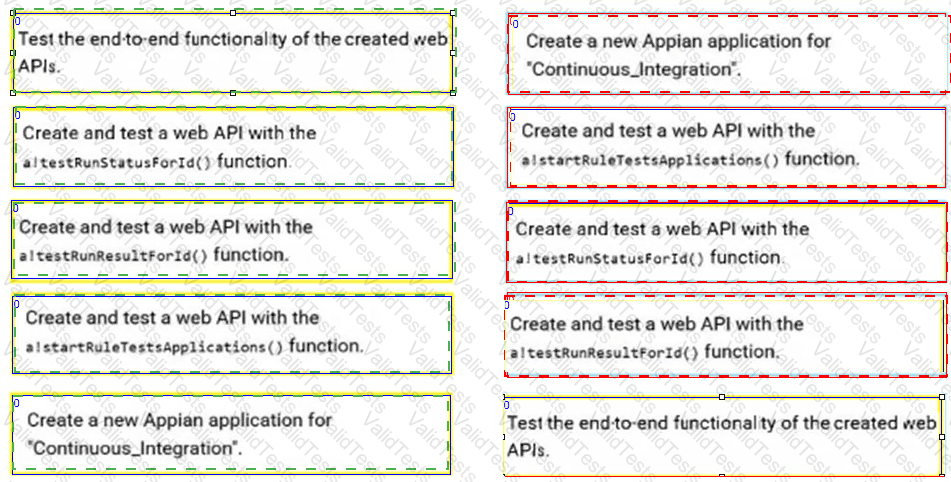
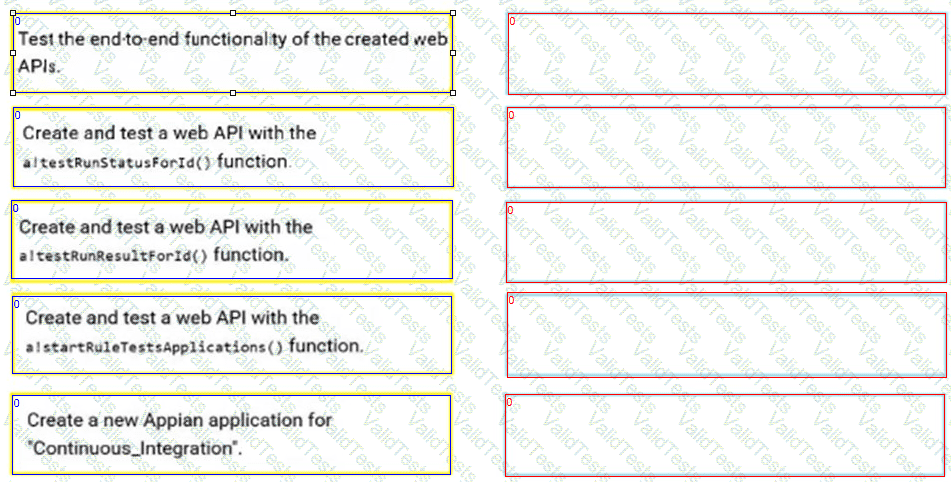
Your development team has selected Jenkins as a Continuous Integration (CI) system to integrate testing of Appian into your overall testing strategy.

What should you do to set up automated testing of expression rules using Jenkins?

Note: To answer, move all steps from the Options list to the Answer List area and arrange them in the correct order.
Question # 29

Options:

Questions # 30:

What are three locations to call an Integration that changes the source data? (Choose three.)

Options:

A.

Rule

B.

Web API (GET)

C.

Process model (Call Integration Smart Service]

D.

Web API (POST, PUT, DELETE)

E.

Interface component savelnto parameter

Viewing page 3 out of 4 pages
Viewing questions 21-30 out of questions