Summer Certification Special Limited Time 70% Discount Offer - Ends in 0d 00h 00m 00s - Coupon code: validbest

Pass the Cisco CyberOps Professional 300-215 Questions and answers with ValidTests

Exam 300-215 All Questions
Exam 300-215 Premium Access

View all detail and faqs for the 300-215 exam

Viewing page 2 out of 4 pages
Viewing questions 11-20 out of questions
Questions # 11:

Which magic byte indicates that an analyzed file is a pdf file?

Options:

A.

cGRmZmlsZQ

B.

706466666

C.

255044462d

D.

0a0ah4cg

Expert Solution
Questions # 12:

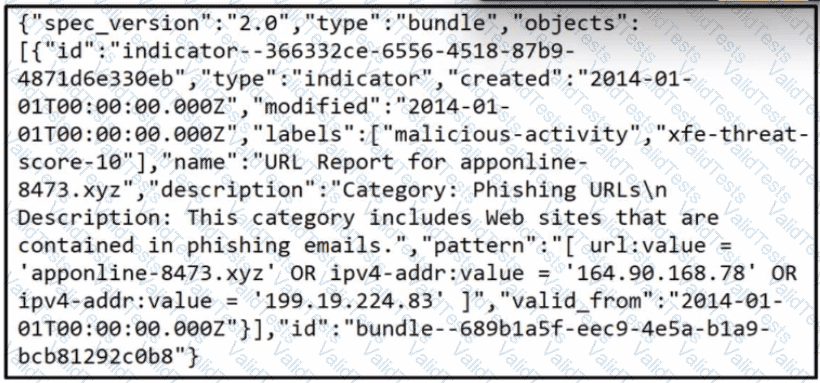
Refer to the exhibit.

Question # 12

Which two actions should be taken as a result of this information? (Choose two.)

Options:

A.

Block any URLs in received emails.

B.

Blacklist IPs 164.90.168.78 and 199.19.224.83.

C.

Block any access to and from domain apponline-8473.xyz.

D.

Block any malicious activity with xfe-threat-score-10.

E.

Block all emails sent from malicious domain apponline-8473.xyz.

Expert Solution
Questions # 13:

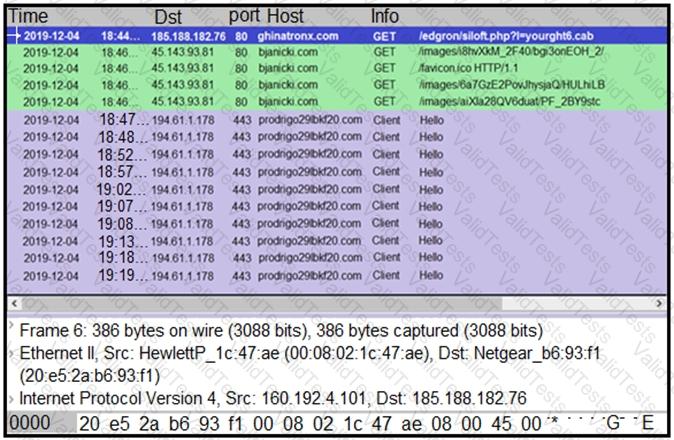
Refer to the exhibit.

Question # 13

A network engineer is analyzing a Wireshark file to determine the HTTP request that caused the initial Ursnif banking Trojan binary to download. Which filter did the engineer apply to sort the Wireshark traffic logs?

Options:

A.

http.request.un matches

B.

tls.handshake.type ==1

C.

tcp.port eq 25

D.

tcp.window_size ==0

Expert Solution
Questions # 14:

An organization experienced a ransomware attack that resulted in the successful infection of their workstations within their network. As part of the incident response process, the organization's cybersecurity team must prepare a comprehensive root cause analysis report. This report aims to identify the primary factor or factors responsible for the successful ransomware attack and to formulate effective strategies to prevent similar incidents in the future. In this context, what should the cybersecurity engineer emphasize in the root cause analysis report to demonstrate the underlying cause of the incident?

Options:

A.

evaluation of user awareness and training programs aimed at preventing ransomware attacks

B.

analysis of the organization's network architecture and security infrastructure

C.

detailed examination of the ransomware variant, its encryption techniques, and command-and-control servers

D.

vulnerabilities present in the organization's software and systems that were exploited by the ransomware

Expert Solution
Questions # 15:

A threat intelligence report identifies an outbreak of a new ransomware strain spreading via phishing emails that contain malicious URLs. A compromised cloud service provider, XYZCloud, is managing the SMTP servers that are sending the phishing emails. A security analyst reviews the potential phishing emails and identifies that the email is coming from XYZCloud. The user has not clicked the embedded malicious URL. What is the next step that the security analyst should take to identify risk to the organization?
Options:

A.

Reset the reporting user's account and enable multifactor authentication.

B.

Create a detailed incident report and share it with top management.

C.

Find any other emails coming from the IP address ranges that are managed by XYZCloud.

D.

Delete email from user mailboxes and update the incident ticket with lessons learned.

Expert Solution
Questions # 16:

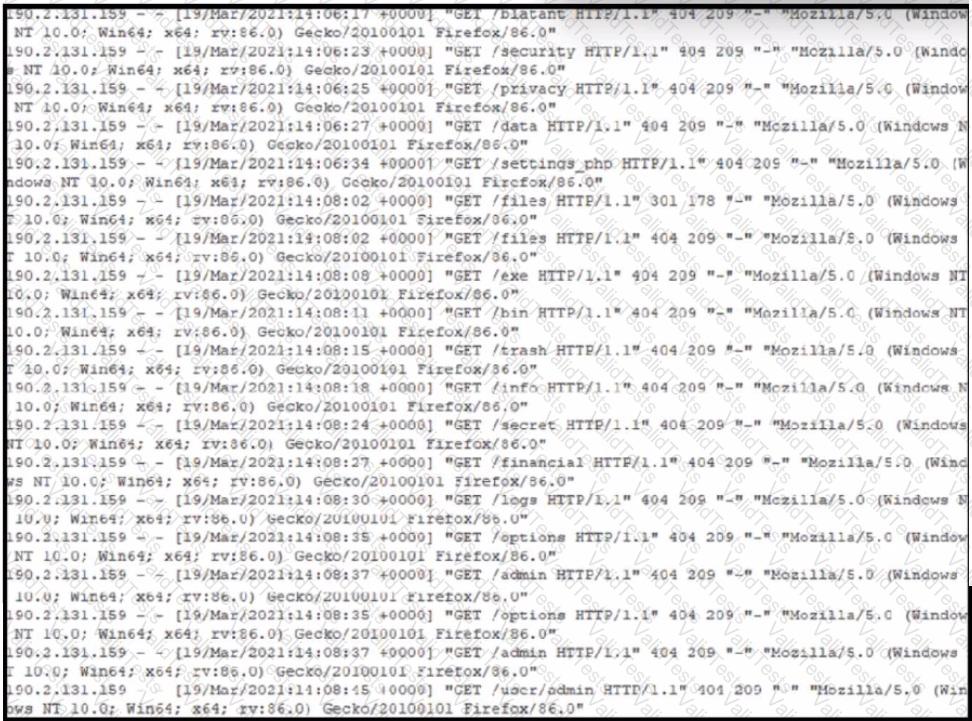
Question # 16

Refer to the exhibit. A security analyst notices that a web application running on NGINX is generating an unusual number of log messages. The application is operational and reachable. What is the cause of this activity?

Options:

A.

botnet infection

B.

directory fuzzing

C.

DDoS attack

D.

SQL injection

Expert Solution
Questions # 17:

Refer to the exhibit.

Question # 17

What does the exhibit indicate?

Options:

A.

The new file is created under the Software\Classes disk folder.

B.

A UAC bypass is created by modifying user-accessible registry settings.

C.

A scheduled task named "DelegateExecute" is created.

D.

The shell software is modified via PowerShell.

Expert Solution
Questions # 18:

Refer to the exhibit.Question # 18

What is occurring?

Options:

A.

Obfuscated scripts are getting executed on the victim machine.

B.

Malware is modifying the registry keys.

C.

RDP is used to move laterally to systems within the victim environment.

D.

The threat actor creates persistence by creating a repeatable task.

Expert Solution
Questions # 19:

An investigator notices that GRE packets are going undetected over the public network. What is occurring?

Options:

A.

encryption

B.

tunneling

C.

decryption

D.

steganography

Expert Solution
Questions # 20:

An engineer is analyzing a DoS attack and notices that the perpetrator used a different IP address to hide their system IP address and avoid detection. Which anti-forensics technique did the perpetrator use?

Options:

A.

cache poisoning

B.

spoofing

C.

encapsulation

D.

onion routing

Expert Solution
Viewing page 2 out of 4 pages
Viewing questions 11-20 out of questions