Pre-Summer Special Limited Time 70% Discount Offer - Ends in 0d 00h 00m 00s - Coupon code: validbest

Pass the F5-CA 201 Questions and answers with ValidTests

Exam 201 All Questions
Exam 201 Premium Access

View all detail and faqs for the 201 exam

Viewing page 3 out of 7 pages
Viewing questions 21-30 out of questions
Questions # 21:

A BIG-IP Administrator uses a device group to share the workload and needs to perform service on a BIG-IP device currently active for a traffic group. The administrator needs to enable the traffic group to run on another BIG-IP device in the device group. What should the administrator do to meet the requirement?

Options:

A.

Create a new Traffic Group and then fail to Standby Unit

B.

Select Traffic Group and then select Failover

C.

Select Traffic Group and then select Force to Standby

D.

Select Traffic Group on Primary Unit and then select Demote

Expert Solution
Questions # 22:

A BIG-IP Administrator adds new Pool Members into an existing, highly utilized pool. Soon after, there are reports that the application is failing to load for some users. What pool level setting should the BIG-IP Administrator check?

Options:

A.

Availability Requirement

B.

Allow SNAT

C.

Action On Service Down

D.

Slow Ramp Time

Expert Solution
Questions # 23:

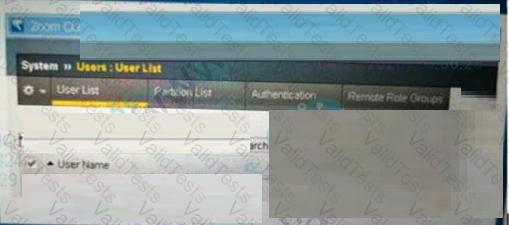
Refer to the exhibit.

Question # 23

According to the shown Configuration Utility stings What is the setting of the User Directory configuration under the Authentication submenu?

Options:

A.

Local

B.

Managed

C.

Remote-TACACS+

D.

Default system configuration

Expert Solution
Questions # 24:

Refer to the exhibit

The BIG-IP Administrator is unable to access the management console via Self-IP 10.10 1.33 and port 443.

What is the reason for this problem?

Options:

A.

Packet Filter needs to be configured to allow a source

B.

Self IP is configured to allow TCP All

C.

Self IP is configured to allow UDP 443

D.

Packet Filter is configured to allow port 443

Expert Solution
Questions # 25:

Which two statements are true about NATs? (Choose two.)

Options:

A.

NATs support UDP, TCP, and ICMP traffic.

B.

NATs can be configured with mirroring enabled or disabled.

C.

NATs provide a one-to-one mapping between IP addresses.

D.

NATs provide a many-to-one mapping between IP addresses.

Expert Solution
Questions # 26:

A virtual server is configured to offload SSL from a pool of backend servers. When users connect to the virtual server, they successfully establish an SSL connection but no content is displayed. A packet trace performed on the server shows that the server receives and responds to the request. What should a BIG-IP Administrator do to resolve the problem?

Options:

A.

enable Server SSL profile

B.

disable Server SSL profile

C.

disable SNAT

D.

enable SNAT

Expert Solution
Questions # 27:

Which statement accurately describes the difference between two loadbalancing modes specified as "member" and "node"?

Options:

A.

There is no difference; the two terms are referenced for backward compatibility purposes.

B.

When the loadbalancing choice references "node", priority group activation is unavailable.

C.

Loadbalancing options referencing "nodes" are available only when the pool members are defined for the "any" port.

D.

When the loadbalancing choice references "node", the addresses' parameters are used to make the loadbalancing choice rather than the member's parameters.

Expert Solution
Questions # 28:

You need to terminate client SSL traffic at the BIG-IP and also to persist client traffic to the same pool member based on a BIG IP supplied cookie. Which four are profiles that would normally be included in the virtual

server's definition? (Choose four.)
Options:

A.

TCP

B.

HTTP

C.

HTTPS

D.

ClientSSL

E.

ServerSSL

F.

CookieBased Persistence

Expert Solution
Questions # 29:

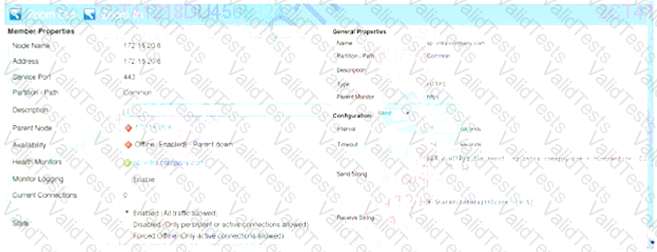
Question # 29

A BIG-IP Administrator notices that one of the servers that runs an application is NOT receiving any traffic. The BIG-IP Administrator examines the configuration status of the application and observes the displayed monitor configuration and affected Pool Member status. What is the possible cause of this issue?

Options:

A.

The Node Health Monitor is NOT responding.

B.

The application is NOT responding with the expected Receive String.

C.

HTTP 1.1 is NOT appropriate for monitoring purposes.

D.

The BIG-IP device is NOT able to reach the Pool.

Expert Solution
Questions # 30:

The BIG-IP Administrator needs to perform a BIG-IP device upgrade to the latest version of TMOS. Where can the administrator obtain F5 documentation on upgrade requirements?

Options:

A.

iHealth

B.

Network > Interfaces

C.

Local Traffic > Pools

D.

AsKFS

E.

Local Traffic > Virtual Servers

Expert Solution
Viewing page 3 out of 7 pages
Viewing questions 21-30 out of questions