Pre-Summer Special Limited Time 70% Discount Offer - Ends in 0d 00h 00m 00s - Coupon code: validbest

Pass the Google Cloud Certified Professional-Cloud-Architect Questions and answers with ValidTests

Exam Professional-Cloud-Architect All Questions
Exam Professional-Cloud-Architect Premium Access

View all detail and faqs for the Professional-Cloud-Architect exam

Viewing page 6 out of 10 pages
Viewing questions 51-60 out of questions
Questions # 51:

For this question, refer to the Dress4Win case study. You want to ensure that your on-premises architecture meets business requirements before you migrate your solution.

What change in the on-premises architecture should you make?

Options:

A.

Replace RabbitMQ with Google Pub/Sub.

B.

Downgrade MySQL to v5.7, which is supported by Cloud SQL for MySQL.

C.

Resize compute resources to match predefined Compute Engine machine types.

D.

Containerize the micro services and host them in Google Kubernetes Engine.

Expert Solution
Questions # 52:

For this question, refer to the Helicopter Racing League (HRL) case study. Your team is in charge of creating a

payment card data vault for card numbers used to bill tens of thousands of viewers, merchandise consumers,

and season ticket holders. You need to implement a custom card tokenization service that meets the following

requirements:

• It must provide low latency at minimal cost.

• It must be able to identify duplicate credit cards and must not store plaintext card numbers.

• It should support annual key rotation.

Which storage approach should you adopt for your tokenization service?

Options:

A.

Store the card data in Secret Manager after running a query to identify duplicates.

B.

Encrypt the card data with a deterministic algorithm stored in Firestore using Datastore mode.

C.

Encrypt the card data with a deterministic algorithm and shard it across multiple Memorystore instances.

D.

Use column-level encryption to store the data in Cloud SQL.

Expert Solution
Questions # 53:

For this question, refer to the Helicopter Racing League (HRL) case study. A recent finance audit of cloud

infrastructure noted an exceptionally high number of Compute Engine instances are allocated to do video

encoding and transcoding. You suspect that these Virtual Machines are zombie machines that were not deleted

after their workloads completed. You need to quickly get a list of which VM instances are idle. What should you

do?

Options:

A.

Log into each Compute Engine instance and collect disk, CPU, memory, and network usage statistics for

analysis.

B.

Use the gcloud compute instances list to list the virtual machine instances that have the idle: true label set.

C.

Use the gcloud recommender command to list the idle virtual machine instances.

D.

From the Google Console, identify which Compute Engine instances in the managed instance groups are

no longer responding to health check probes.

Expert Solution
Questions # 54:

For this question, refer to the Helicopter Racing League (HRL) case study. HRL is looking for a cost-effective

approach for storing their race data such as telemetry. They want to keep all historical records, train models

using only the previous season's data, and plan for data growth in terms of volume and information collected.

You need to propose a data solution. Considering HRL business requirements and the goals expressed by

CEO S. Hawke, what should you do?

Options:

A.

Use Firestore for its scalable and flexible document-based database. Use collections to aggregate race data

by season and event.

B.

Use Cloud Spanner for its scalability and ability to version schemas with zero downtime. Split race data

using season as a primary key.

C.

Use BigQuery for its scalability and ability to add columns to a schema. Partition race data based on

season.

D.

Use Cloud SQL for its ability to automatically manage storage increases and compatibility with MySQL. Use

separate database instances for each season.

Expert Solution
Questions # 55:

For this question, refer to the JencoMart case study.

The migration of JencoMart’s application to Google Cloud Platform (GCP) is progressing too slowly. The infrastructure is shown in the diagram. You want to maximize throughput. What are three potential bottlenecks? (Choose 3 answers.)
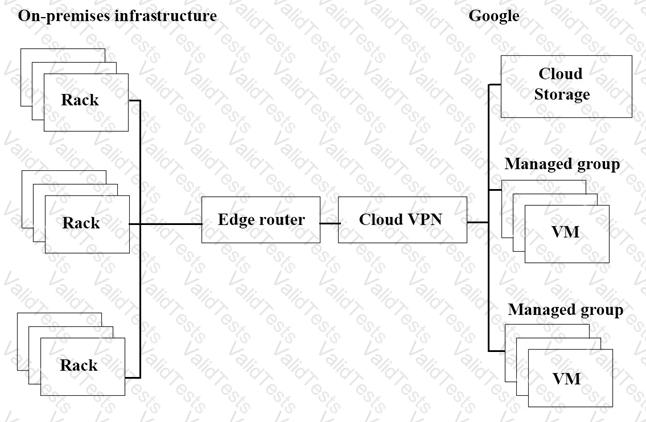
Question # 55

Options:

A.

A single VPN tunnel, which limits throughput

B.

A tier of Google Cloud Storage that is not suited for this task

C.

A copy command that is not suited to operate over long distances

D.

Fewer virtual machines (VMs) in GCP than on-premises machines

E.

A separate storage layer outside the VMs, which is not suited for this task

F.

Complicated internet connectivity between the on-premises infrastructure and GCP

Expert Solution
Questions # 56:

For this question, refer to the JencoMart case study.

JencoMart has decided to migrate user profile storage to Google Cloud Datastore and the application servers to Google Compute Engine (GCE). During the migration, the existing infrastructure will need access to Datastore to upload the data. What service account key-management strategy should you recommend?

Options:

A.

Provision service account keys for the on-premises infrastructure and for the GCE virtual machines (VMs).

B.

Authenticate the on-premises infrastructure with a user account and provision service account keys for the VMs.

C.

Provision service account keys for the on-premises infrastructure and use Google Cloud Platform (GCP) managed keys for the VMs

D.

Deploy a custom authentication service on GCE/Google Container Engine (GKE) for the on-premises infrastructure and use GCP managed keys for the VMs.

Expert Solution
Questions # 57:

For this question, refer to the JencoMart case study.

The JencoMart security team requires that all Google Cloud Platform infrastructure is deployed using a least privilege model with separation of duties for administration between production and development resources. What Google domain and project structure should you recommend?

Options:

A.

Create two G Suite accounts to manage users: one for development/test/staging and one for production. Each account should contain one project for every application.

B.

Create two G Suite accounts to manage users: one with a single project for all development applications and one with a single project for all production applications.

C.

Create a single G Suite account to manage users with each stage of each application in its own project.

D.

Create a single G Suite account to manage users with one project for the development/test/staging environment and one project for the production environment.

Expert Solution
Questions # 58:

For this question, refer to the JencoMart case study.

JencoMart has built a version of their application on Google Cloud Platform that serves traffic to Asia. You want to measure success against their business and technical goals. Which metrics should you track?

Options:

A.

Error rates for requests from Asia

B.

Latency difference between US and Asia

C.

Total visits, error rates, and latency from Asia

D.

Total visits and average latency for users in Asia

E.

The number of character sets present in the database

Expert Solution
Questions # 59:

For this question, refer to the JencoMart case study.

JencoMart wants to move their User Profiles database to Google Cloud Platform. Which Google Database should they use?

Options:

A.

Cloud Spanner

B.

Google BigQuery

C.

Google Cloud SQL

D.

Google Cloud Datastore

Expert Solution
Questions # 60:

For this question, refer to the JencoMart case study

A few days after JencoMart migrates the user credentials database to Google Cloud Platform and shuts down the old server, the new database server stops responding to SSH connections. It is still serving database requests to the application servers correctly. What three steps should you take to diagnose the problem? Choose 3 answers

Options:

A.

Delete the virtual machine (VM) and disks and create a new one.

B.

Delete the instance, attach the disk to a new VM, and investigate.

C.

Take a snapshot of the disk and connect to a new machine to investigate.

D.

Check inbound firewall rules for the network the machine is connected to.

E.

Connect the machine to another network with very simple firewall rules and investigate.

F.

Print the Serial Console output for the instance for troubleshooting, activate the interactive console, and investigate.

Expert Solution
Viewing page 6 out of 10 pages
Viewing questions 51-60 out of questions