A developer team requests integration of their legacy application with Vault to encrypt and decrypt data for a backend database. They cannot modify the application for Vault authentication. What is the best way to achieve this integration?
True or False? After rotating a transit encryption key, all data encrypted with the previous version must be rewrapped or re-encrypted with the new key.
True or False? Your organization currently runs all of its workloads on Google Cloud Platform (GCP). Recently, Vault has been deployed, and you need to select an auth method to authenticate your workloads with Vault. Based on this information, GCP is the only auth method that can be used in your environment.
Your organization runs workloads on both AWS and Azure for production applications. The security team has requested that a single Vault authentication mechanism be enabled to support applications on both public cloud platforms. Which of the following would be a valid auth method you can use?
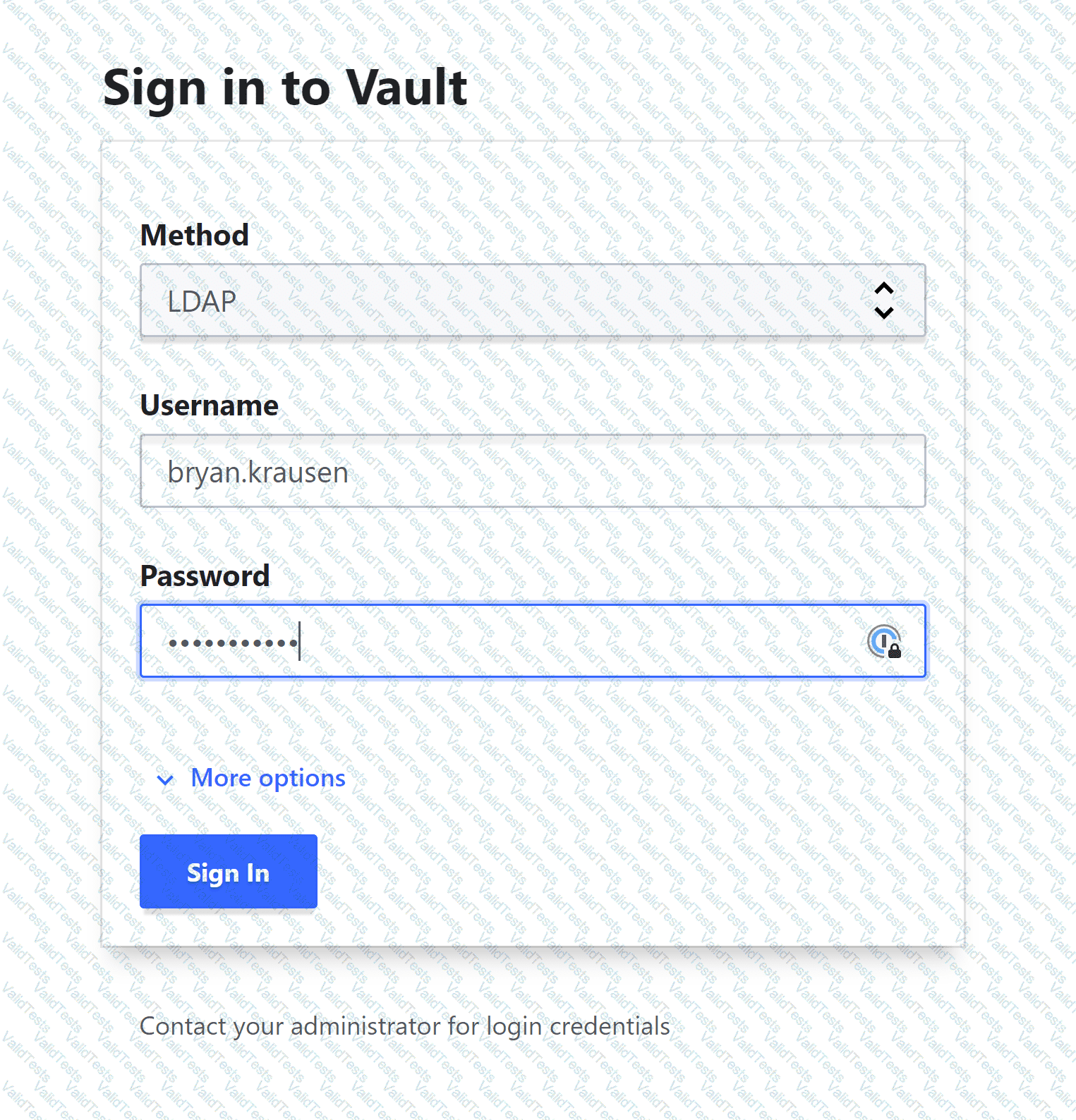
Your organization has enabled the LDAP auth method on the path of corp-auth/. When you access the Vault UI, you cannot log in despite providing the correct credentials. Based on the screenshot below, what action should you take to log in?
How long does the Transit secrets engine store the resulting ciphertext by default?
From the options below, select the benefits of using the PKI (x.509 certificates) secrets engine (select three):
After issuing the command to delete a secret, you run a vault kv list command, but the path to the secret still seems to exist. What command would permanently delete the path from Vault?

From the options below, select the auth methods that are better suited for machine-to-machine authentication (select five):
True or False? When encrypting data with the Transit secrets engine, Vault always stores the ciphertext in a dedicated KV store along with the associated encryption key.


