Which of the following methods does NOT contribute to keeping the data confidential?
SCENARIO
Please use the following to answer the next question:
Chuck, a compliance auditor for a consulting firm focusing on healthcare clients, was required to travel to the client’s office to perform an onsite review of the client’s operations. He rented a car from Finley Motors upon arrival at the airport as so he could commute to and from the client’s office. The car rental agreement was electronically signed by Chuck and included his name, address, driver’s license, make/model of the car, billing rate, and additional details describing the rental transaction. On the second night, Chuck was caught by a red light camera not stopping at an intersection on his way to dinner. Chuck returned the car back to the car rental agency at the end week without mentioning the infraction and Finley Motors emailed a copy of the final receipt to the address on file.
Local law enforcement later reviewed the red light camera footage. As Finley Motors is the registered owner of the car, a notice was sent to them indicating the infraction and fine incurred. This notice included the license plate number, occurrence date and time, a photograph of the driver, and a web portal link to a video clip of the violation for further review. Finley Motors, however, was not responsible for the violation as they were not driving the car at the time and transferred the incident to AMP Payment Resources for further review. AMP Payment Resources identified Chuck as the driver based on the rental agreement he signed when picking up the car and then contacted Chuck directly through a written letter regarding the infraction to collect the fine.
After reviewing the incident through the AMP Payment Resources’ web portal, Chuck paid the fine using his personal credit card. Two weeks later, Finley Motors sent Chuck an email promotion offering 10% off a future rental.
What is the strongest method for authenticating Chuck’s identity prior to allowing access to his violation information through the AMP Payment Resources web portal?
SCENARIO
Clean-Q is a company that offers house-hold and office cleaning services. The company receives requests from consumers via their website and telephone, to book cleaning services. Based on the type and size of service, Clean-Q then contracts individuals that are registered on its resource database - currently managed in-house by Clean-Q IT Support. Because of Clean-Q's business model, resources are contracted as needed instead of permanently employed.
The table below indicates some of the personal information Clean-Q requires as part of its business operations:
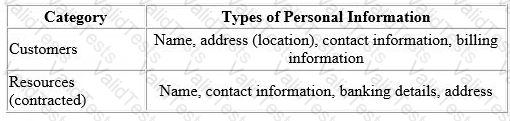
Clean-Q has an internal employee base of about 30 people. A recent privacy compliance exercise has been conducted to align employee data management and human resource functions with applicable data protection regulation. Therefore, the Clean-Q permanent employee base is not included as part of this scenario.
With an increase in construction work and housing developments, Clean-Q has had an influx of requests for cleaning services. The demand has overwhelmed Clean-Q's traditional supply and demand system that has caused some overlapping bookings.
Ina business strategy session held by senior management recently, Clear-Q invited vendors to present potential solutions to their current operational issues. These vendors included Application developers and Cloud-Q’s solution providers, presenting their proposed solutions and platforms.
The Managing Director opted to initiate the process to integrate Clean-Q's operations with a cloud solution (LeadOps) that will provide the following solution one single online platform: A web interface that Clean-Q accesses for the purposes of resource and customer management. This would entail uploading resource and customer information.
A customer facing web interface that enables customers to register, manage and submit cleaning service requests online.
A resource facing web interface that enables resources to apply and manage their assigned jobs.
An online payment facility for customers to pay for services.
Which question would you most likely ask to gain more insight about LeadOps and provide practical privacy recommendations?
Which of the following entities would most likely be exempt from complying with the General Data Protection Regulation (GDPR)?
Combining multiple pieces of information about an individual to produce a whole that is greater than the sum of its parts is called?
What is the main reason a company relies on implied consent instead of explicit consent from a user to process her data?
Why is first-party web tracking very difficult to prevent?
An organization is launching a new online subscription-based publication. As the service is not aimed at children, users are asked for their date of birth as part of the of the sign-up process. The privacy technologist suggests it may be more appropriate ask if an individual is over 18 rather than requiring they provide a date of birth. What kind of threat is the privacy technologist concerned about?
A key principle of an effective privacy policy is that it should be?
What is the potential advantage of homomorphic encryption?


