Pre-Summer Special Limited Time 70% Discount Offer - Ends in 0d 00h 00m 00s - Coupon code: validbest

Pass the Juniper JNCIP-ENT JN0-649 Questions and answers with ValidTests

Exam JN0-649 All Questions
Exam JN0-649 Premium Access

View all detail and faqs for the JN0-649 exam

Viewing page 2 out of 2 pages
Viewing questions 11-20 out of questions
Questions # 11:

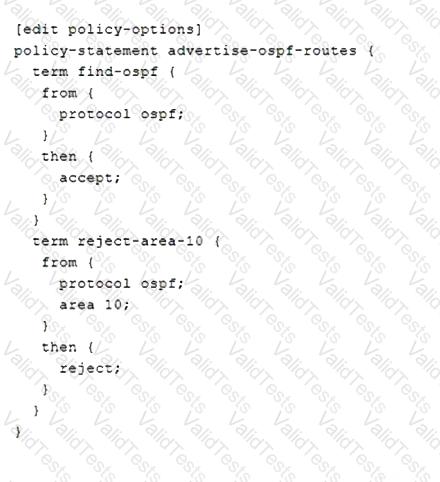
You recently committed a change to a router to reject OSPF routes sourced from area 10. However, you are still seeing area 10 routes in the routing table.

Referring to the exhibit, which statement is correct?
Question # 11

Options:

A.

The OSPF protocol is first matched by find-ospf and accepted.

B.

The routes only timeout after 24 hours.

C.

The routes remain in the table until the device is rebooted.

D.

The routes remain in the table until the routing daemon is restarted.

Expert Solution
Questions # 12:

You enable the Multiple VLAN Registration Protocol (MVRP) to automate the creation and management of virtual LANs.

Which statement is correct in this scenario?

Options:

A.

The forbidden mode does not register or declare VLANs.

B.

When enabled, MVRP affects all interfaces.

C.

Timers dictate when link state changes are propagated.

D.

MVRP works with RSTP and VSTP.

Expert Solution
Questions # 13:

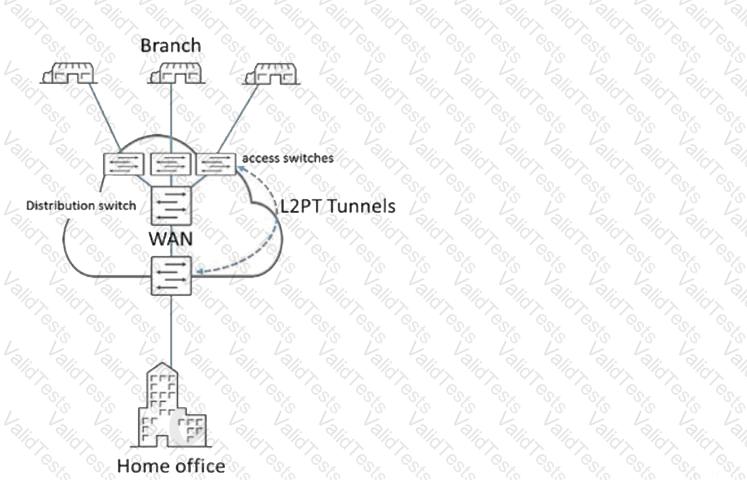
Remote branches connect to the corporate WAN through access switches. The access switches connect to access ports on the WAN distribution switch, as shown in the exhibit. L2PT has previously been configured on the tunnel Layer 2 traffic across the WAN. You decide to move the L2PT tunnel endpoints to the access switches. When you apply the L2PT configuration to the access switches, the ports that connect the access switches to the distribution switch shut down.

Which action would solve this problem?
Question # 13

Options:

A.

Configure the links between the access switches and the distribution switch as a trunk port.

B.

Disable the BPDU block function on the access switches.

C.

Disable the BPDU block function on the distribution switch.

D.

Configure a GRE tunnel to encapsulate the L2PT traffic across the WAN.

Expert Solution
Questions # 14:

You are using 802.1X authentication in your network to secure all ports. You have a printer that does not support 802.1X and you must ensure that traffic is allowed to and from this printer without authentication.

In this scenario, what will satisfy the requirement?

Options:

A.

MAC filtering

B.

MACsec

C.

static MAC bypass

D.

MAC RADIUS

Expert Solution
Questions # 15:

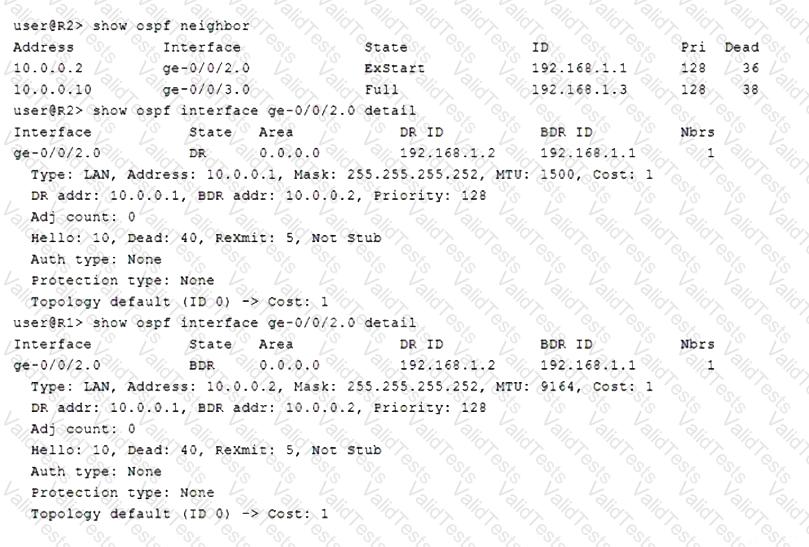
You are running OSPF as your IGP. The interfaces connecting two routers are in the ExStart state. You notice that something is incorrect with the configuration.

Referring to the exhibit, which statement is correct?
Question # 15

Options:

A.

The subnet mask is incorrect.

B.

The MTU setting are incorrect.

C.

The interface type is incorrect.

D.

The IP addresses are incorrect.

Expert Solution
Questions # 16:

You are deploying an 802.1X solution and must determine what would happen if clients are unable to re-authenticate to the RADIUS server.

In this scenario, which configuration would provide access to the network if the supplicant is already authenticated?

Options:

A.

move

B.

permit

C.

deny

D.

sustain

Expert Solution
Questions # 17:

You are asked to configure 802.1X on your access ports to allow only a single device to authenticate.

In this scenario, which configuration would you use?

Options:

A.

single supplicant mode

B.

multiple supplicant mode

C.

single-secure supplicant mode

D.

MAC authentication mode

Expert Solution
Questions # 18:

You must provide network connectivity to hosts that fail authentication.

In this scenario, what would be used in a network secured with 802.1X to satisfy this requirement?

Options:

A.

Configure the native-vlan-id parameter on the port.

B.

Use the server-reject-vlan command to specify a guest VLAN.

C.

Configure a secondary IP address on the port for unauthenticated hosts.

D.

Configure the port as a spanning tree edge port.

Expert Solution
Questions # 19:

BGP multipath or multihop are not configured in your network.

In this scenario, what is the correct sequence for BGP active route selection?

Options:

A.

higher local preference

shortest AS path

lowest peer address

lowest router ID

lower origin code

B.

higher local preference

shortest AS path

lower origin code

lowest router ID

lowest peer address

C.

higher local preference

lowest router ID

lowest peer address

lower origin code

shortest AS path

D.

higher local preference

shortest AS path

lowest router ID

lowest peer address

lower origin code

Expert Solution
Viewing page 2 out of 2 pages
Viewing questions 11-20 out of questions