Pre-Summer Special Limited Time 70% Discount Offer - Ends in 0d 00h 00m 00s - Coupon code: validbest

Pass the Kinaxis RapidResponse Author KX3-003 Questions and answers with ValidTests

Exam KX3-003 All Questions
Exam KX3-003 Premium Access

View all detail and faqs for the KX3-003 exam

Viewing page 2 out of 2 pages
Viewing questions 11-20 out of questions
Questions # 11:

You are creating a resource that is designed to evaluate the impact of converting planned orders to scheduled receipts. After the evaluation is complete, you want to provide users the opportunity to push their changes to the parent scenario. Users will be using their scenarios to consider changes to lead time, constraint available, and other planning parameters. The company policy stipulates that lead times cannot be adjusted in any shared scenarios.

What should you do to accomplish this task?

Options:

A.

Restrict the user to view only access to the parent scenario.

B.

Develop a cross scenario data change.

C.

Apply a perspective when creating your scenario.

D.

Export your changes to a .tab file and import to a scenario.

Expert Solution
Questions # 12:

You are asked to transform PlannedOrder data into new ScheduledReceipt records, assuming just one PartSource per part and no maximum quantity. You need to filter the PlannedOrder records to ensure you do not try to create any ScheduledReceipt records which already exist. The workbook includes a worksheet, LKPScheduledReceipt, on existing converted ScheduledReceipts and follows Kinaxis best practices.

In this situation, which filter expression will follow KInaixs best practices and provide the best performance to include PlannedOrder records that do not match existing ScheduledReceipt records?

Options:

A.

( Lookup({Part.Name,Part.Site.Value, DueDate}, LKPScheduledReceipt!, “N”, LKPScheduledReceipt!Exists) = “N” )

B.

NOT {Part, DueDate} IN LKPScheduledReceipt!

C.

NOT IsNull ( Lookup ({Part.Name, Part.Site.Value, DueDate}, LKPScheduledReceipt!, Null(Mfg::ScheduledReceipt), Exact, LKPScheduledReceipt!Self ))

D.

NOT {Part.Name, Part.Site.Value, DueDate} IN LKPScheduledReceipt!

Expert Solution
Questions # 13:

A user wants to build a crosstab worksheet that shows historical data in daily buckets for the last two years. Currently, historical data is stored in days.

What are two ways to accomplish this task? (Choose two.)

Choose 2 answers

Options:

A.

Enable the Bucket data by date checkbox, then select Day in the Bucket Size and 730 (365*2) in the Number of Buckets.

B.

Enable Advanced Bucketing, select Day in the Bucket Size and 365 in the Number of Buckets, and then adjust the Anchor date by 1 Year.

C.

Create calendar interval, start date, and end date variables using the CalendarDate table, and then reference these variables in the worksheet that displays historical data.

D.

Clear the Bucket data by date checkbox and then filter the worksheet for the last 2 years as Date >= MRPDate - 730 and Date <= MRPDate

Expert Solution
Questions # 14:

You are asked to restrict a worksheet so that users can only see data for the demand of the countries that they should have permission to see. A field has been added to the IndependentDemand table, which is a reference to a custom table called Country. Each user may have permission to see the demands from one or more countries, and each country can be seen by one or more users. They should be able to see data from multiple countries in the worksheet at the same time.

In this scenario, what should you do to enable this capability?

Options:

A.

Create a $DmdCountry list workbook variable with a query generated list of values based on the Country table. Add the expression UserInGroup ($User, 'DemandPlanners') to the variable filter and then in the column properties conditionally hide the column using the $DmdCountry = False expression.

B.

Create a $DmdCountry text workbook variable with the expression UserInGroup ($User, 'DemandPlanners'). Add the $DmdPlanners = TRUE expression to the worksheet.

C.

Build a Responsibility definition based on the Country table and assign the users to all of the countries that they should have permission to see. Add a responsibility column to the worksheet so users can select their country.

D.

Create a $DmdCountry profile variable and assign the country names to each user. Add the expression IF ($DmdCountry = "'*'", TRUE, User::DmdCountry IN eval($DmdCountry)) to the worksheet filter.

Expert Solution
Questions # 15:

You remove an automation chain step that runs in parallel with two other steps.

What is the result of this action?
Options:

A.

The automation chain will no longer run.

B.

The other steps will continue to run in parallel.

C.

The other steps are switched to run in series.

D.

A notification is sent to the owner for action.

Expert Solution
Questions # 16:

Question # 16

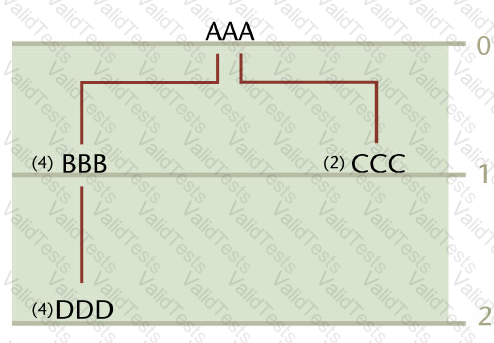
The Bill of Material structure is shown in the graphic. The quantity per for each component is shown in parentheses. Independent demand for 100 units of item AAA has been received. There are no ScheduledReceipt or OnHand records for any of the items; PartSource.OrderPolicy.OrderGenerationRule = Anytime.

What is the correct PegPart, DriverPart, and NeedQuantity found in the WhereConsumed table for item DDD?
Options:

A.

PegPart is assigned BBB

DriverPart is assigned AAA

NeedQuantity = 1600

B.

PegPart is assigned AAA

DriverPart is assigned BBB

NeedQuantity = 1600

C.

PegPart is assigned DDD

DriverPart is assigned BBB

NeedQuantity = 400

D.

PegPart is assigned BBB

DriverPart is assigned AAA

NeedQuantity = 400

Expert Solution
Questions # 17:

Question # 17

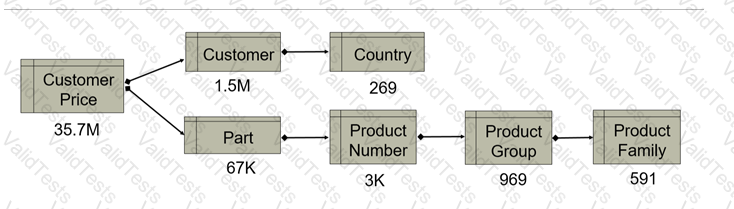
The graphic shows a path to generate a list of customer prices with record counts for each table in the path. Given the following filter expression:

Part.ProductNumber.ProductGroup.ProductFamily In ('bikes','trikes')

AND Customer.Country IN ("US", "CA")

In this situation, what is the chosen line of descent from the query engine?
Options:

A.

Country > Country_Customers > CustomerPrices

B.

ProductFamily > ProductFamily_ProductGroups > ProductGroup_ProductNumbers > ProductNumber_Parts > CustomerPartPrices

C.

CustomerPartPrices > ProductNumber_Parts > ProductGroup_ProductNumbers > ProductFamily_ProductGroups > ProductFamily

D.

CustomerPrices > Country_Customers > Country

Expert Solution
Questions # 18:

Question # 18

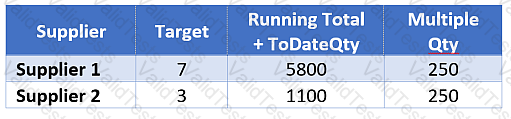
You have a new demand for 800 units of a product. SourceRule.AllotmentRule for this part is set to OnGoing.

Referring to the graphic, which planned order results will be created to satisfy this demand?

Options:

A.

Supplier1: quantity 250

Supplier2: quantity 750

B.

Supplier1: quantity 750

Supplier2: quantity 250

C.

Supplier1: quantity 1000

D.

Supplier2: quantity 1000

Expert Solution
Viewing page 2 out of 2 pages
Viewing questions 11-20 out of questions