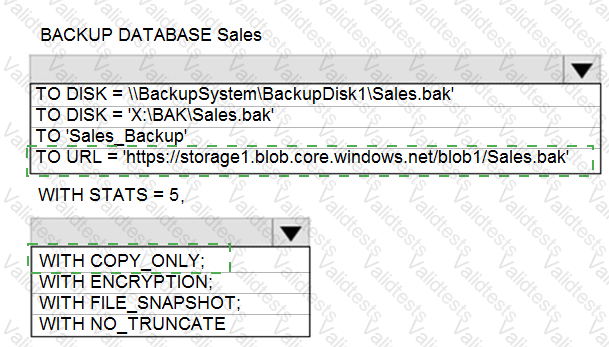
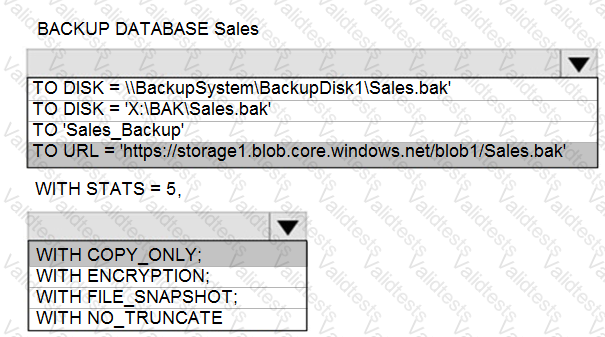
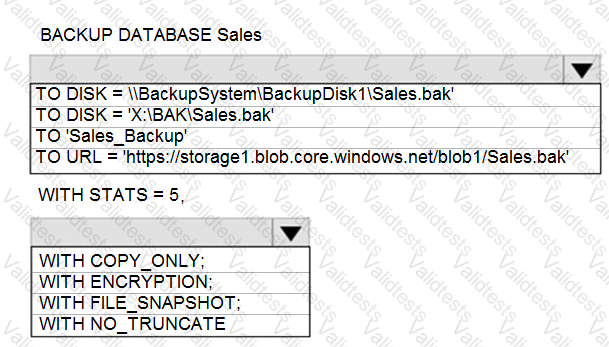
You have an Azure SQL Database managed instance named sqldbmi1 that contains a database name Sales.
You need to initiate a backup of Sales.
How should you complete the Transact-SQL statement? To answer, select the appropriate options in the answer area.
NOTE: Each correct selection is worth one point.
Note: This question is part of a series of questions that present the same scenario. Each question in the series contains a unique solution that might meet the stated goals. Some question sets might have more than one correct solution, while others might not have a correct solution.
After you answer a question in this section, you will NOT be able to return to it. As a result, these questions will not appear in the review screen.
You have an Azure Data Lake Storage account that contains a staging zone.
You need to design a daily process to ingest incremental data from the staging zone, transform the data by executing an R script, and then insert the transformed data into a data warehouse in Azure Synapse Analytics.
Solution: You use an Azure Data Factory schedule trigger to execute a pipeline that executes mapping data flow, and then inserts the data into the data warehouse.
Does this meet the goal?
You have SQL Server on Azure virtual machines in an availability group.
You have a database named DB1 that is NOT in the availability group.
You create a full database backup of DB1.
You need to add DB1 to the availability group.
Which restore option should you use on the secondary replica?
You have an Azure SQL database named DB1.
A user named User 1 has an Azure AD account.
You need to provide User1 with the ability to add and remove columns from the tables inDBV The solution must use the principle of least privilege.
Which two actions should you perform? Each correct answer presents part of the solution.
NOTE: Each correct selection is worth one point
You have an Azure subscription.
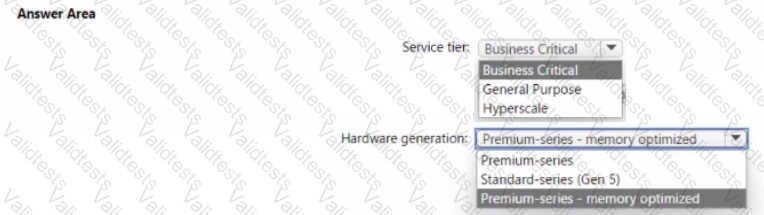
You need to deploy an Azure SQL managed instance that meets the following requirements:
• Optimize latency.
• Maximize the memory-to-vCore ratio.
Which service tier and hardware generation should you use? To answer, select the apocopate options in the answer area.
NOTE: Each correct selection is worth one point.
You have an Azure subscription that contains a logical SQL server named Serverl. The master database of Serverl contains a user named Userl. You need to ensure that Userl can create databases on Serverl. Which database role should you assign to Userl?
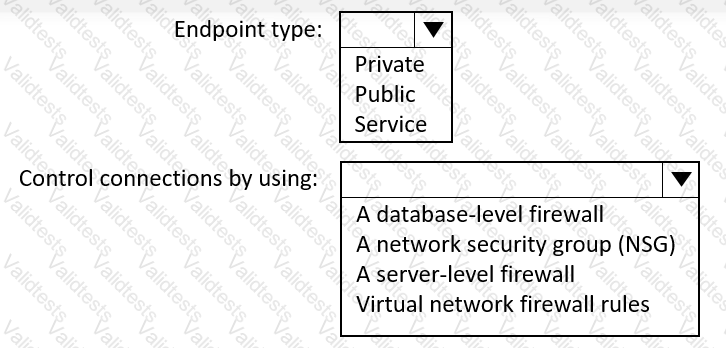
You have an Azure subscription that contains an Azure SQL managed instance named SQL1.
You use the Microsoft Power B1 service.
You need to configure connectivity from the Power B1 service to SQL1. The solution must ensure that only the Power B1 service can initiate connections to SQL1.
Which type of endpoint should you use for SQL1, and what should you use to control the connections to SQL1? To answer, select the appropriate options in the answer area.
NOTE: Each correct selection is worth one point.
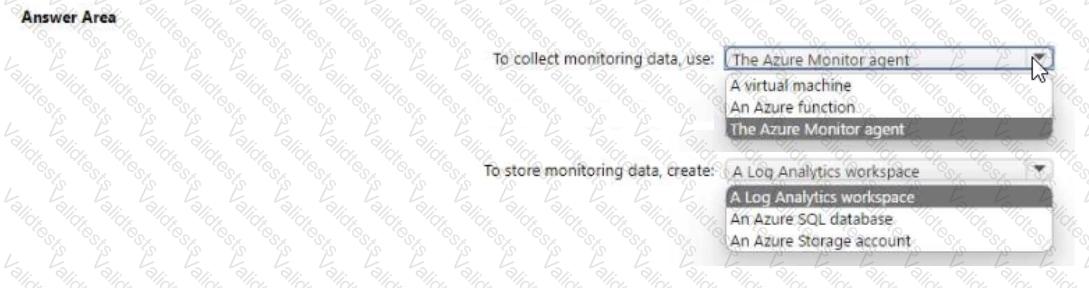
You have an Azure SQL database named DB1 in the General Purpose service tier.
You need to monitor D81 by using SQL insights.
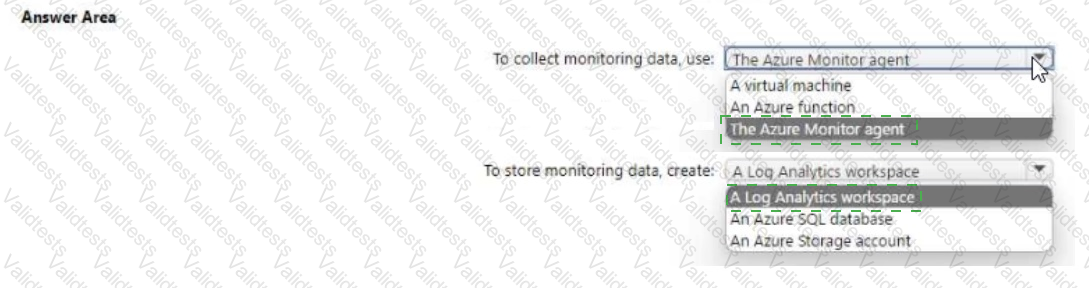
What should you include in the solution? To answer, select the appropriate options in the answer area.
NOTE: Each correct selection is worth one point.
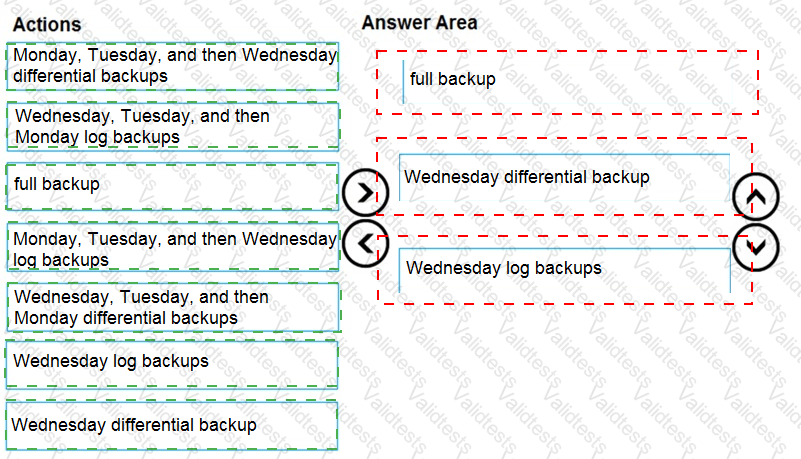
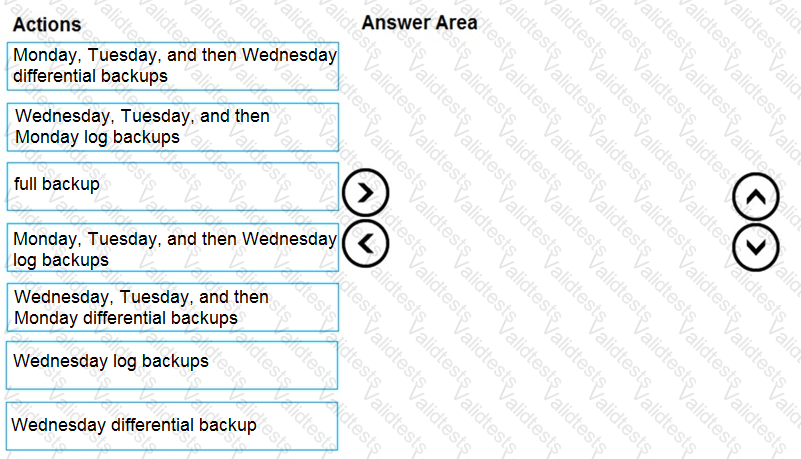
You have SQL Server on an Azure virtual machine that contains a database named DB1. DB1 is 30 TB and has a 1-GB daily rate of change.
You back up the database by using a Microsoft SQL Server Agent job that runs Transact-SQL commands. You perform a weekly full backup on Sunday, daily differential backups at 01:00, and transaction log backups every five minutes.
The database fails on Wednesday at 10:00.
Which three backups should you restore in sequence? To answer, move the appropriate backups from the list of backups to the answer area and arrange them in the correct order.
You have an Azure subscription that contains a SQL Server on Azure Virtual Machines instance named SQLVM1. SQLVM1 has the following configurations:
• Automated patching is enabled.
• The SQL Server laaS Agent extension is installed.
• The Microsoft SQL Server instance on SQLVM1 is managed by using the Azuie portal.
You need to automate the deployment of cumulative updates to SQLVM1 by using Azure Update Manager. The solution must ensure that the SQL Server instance on SQLVM1 can be managed by using the Azure portal.
What should you do first on SQLVM1?