You maintain a relational database for a book publisher. The database contains the following tables.
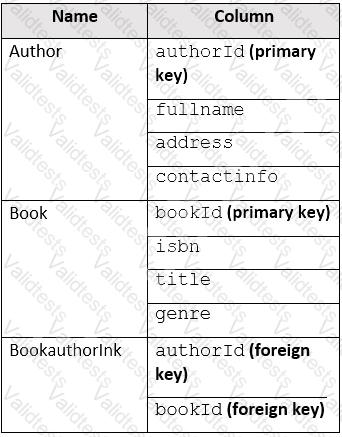
The most common query lists the books for a given authorId.
You need to develop a non-relational data model for Azure Cosmos DB Core (SQL) API that will replace the relational database. The solution must minimize latency and read operation costs.
What should you include in the solution?
You have an Azure Cosmos DB for NoSQL account named account1 that has a single read-write region and one additional read region. Account1 uses the strong default consistency level.
You have an application that uses the eventual consistency level when submitting requests to account1.
How will writes from the application be handled?
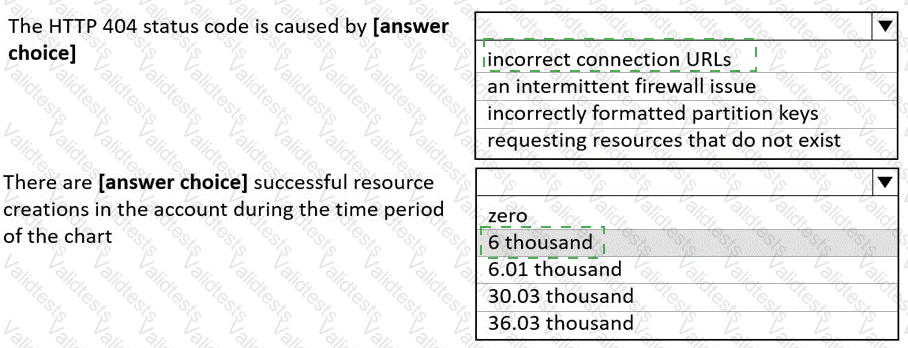
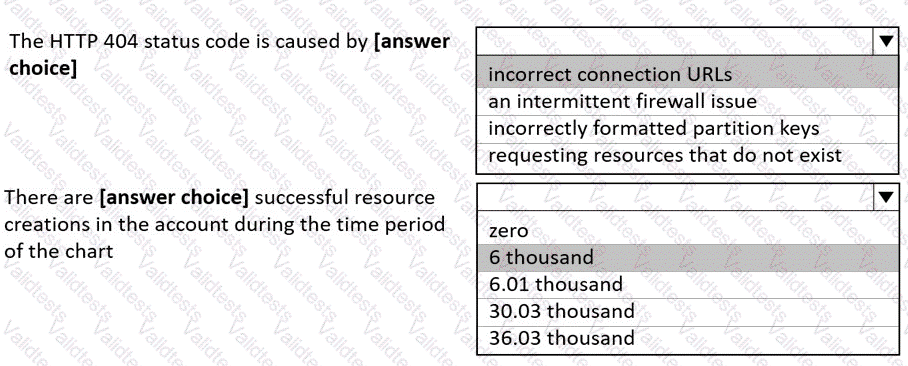
You have an Azure Cosmos DB Core (SQL) API account used by an application named App1.
You open the Insights pane for the account and see the following chart.
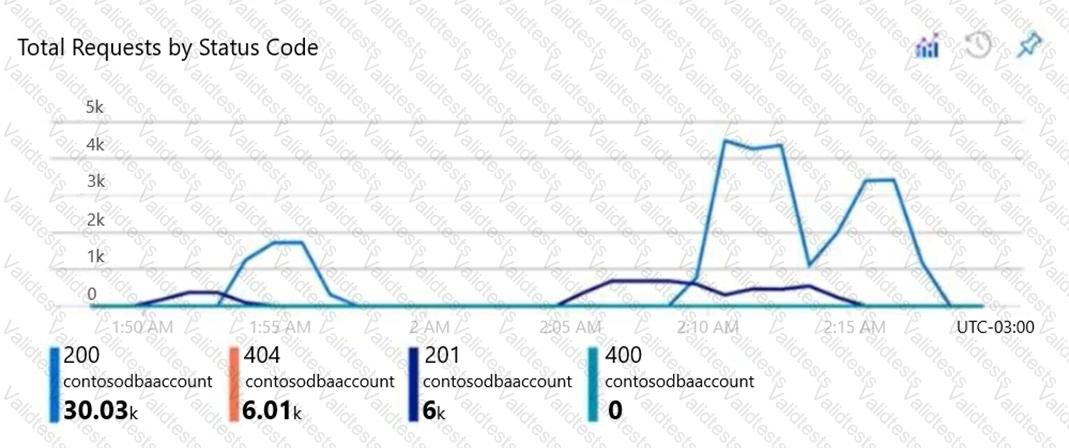
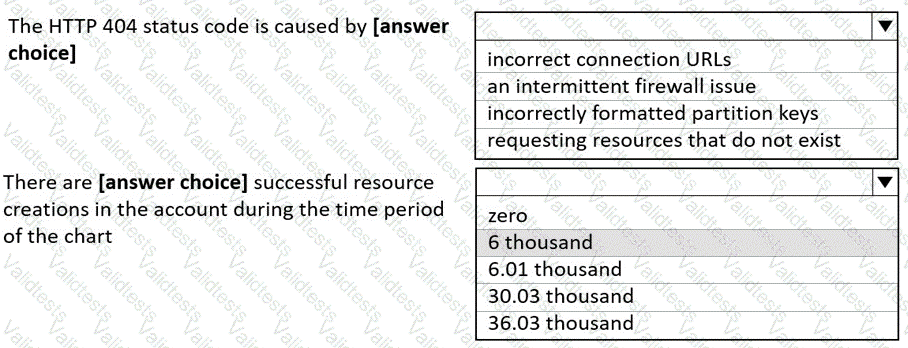
Use the drop-down menus to select the answer choice that answers each question based on the information presented in the graphic.
NOTE: Each correct selection is worth one point.
You have an Azure subscription that contains an Azure Cosmos DB for NoSQL account
You need to write a SQL query that will return multiple items. The solution must meet the following requirements:
• For each item returned, include the current Coordinated Universal Time (UTC) date and time, formatted as an ISO 8601 string.
• Minimize development effort.
What should you use?
Note: This question is part of a series of questions that present the same scenario. Each question in the series contains a unique solution that might meet the stated goals. Some question sets might have more than one correct solution, while others might not have a correct solution.
After you answer a question in this section, you will NOT be able to return to it. As a result, these questions will not appear in the review screen.
You have a container named container1 in an Azure Cosmos DB Core (SQL) API account.
You need to make the contents of container1 available as reference data for an Azure Stream Analytics job.
Solution: You create an Azure function that uses Azure Cosmos DB Core (SQL) API change feed as a trigger and Azure event hub as the output.
Does this meet the goal?
You plan to create an Azure Cosmos DB Core (SQL) API account that will use customer-managed keys stored in Azure Key Vault.
You need to configure an access policy in Key Vault to allow Azure Cosmos DB access to the keys.
Which three permissions should you enable in the access policy? Each correct answer presents part of the solution.
NOTE: Each correct selection is worth one point.
The following is a sample of a document in orders.
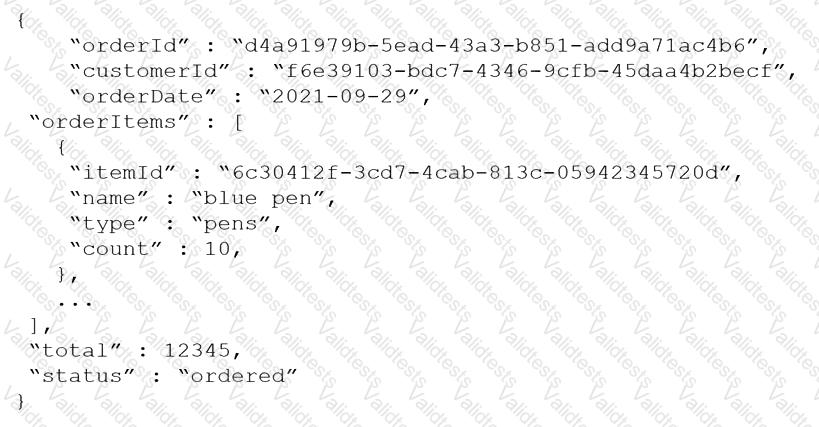
The orders container uses customer as the partition key.
You need to provide a report of the total items ordered per month by item type. The solution must meet the following requirements:
Ensure that the report can run as quickly as possible.
Minimize the consumption of request units (RUs).
What should you do?
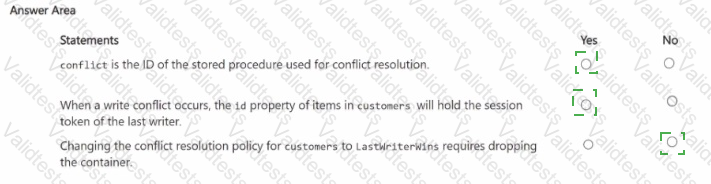
Vou have an Azure subscription. The subscription contains an Azure Cosmos DB for NoSQL account named account1 that hosts a container named Customers. Multi-region writes are allowed.
You execute the following C# code.
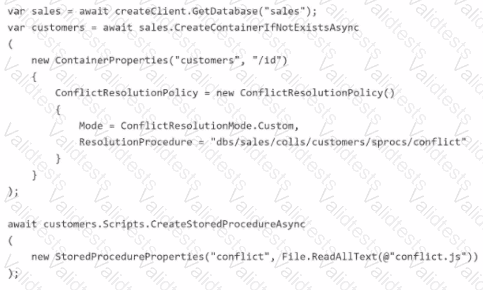
For each of the following statements, Select Yes if the statement is true, Otherwise, select No.
NOTE: Each correct selection is worth one point.
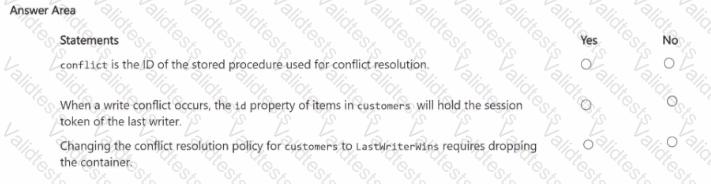
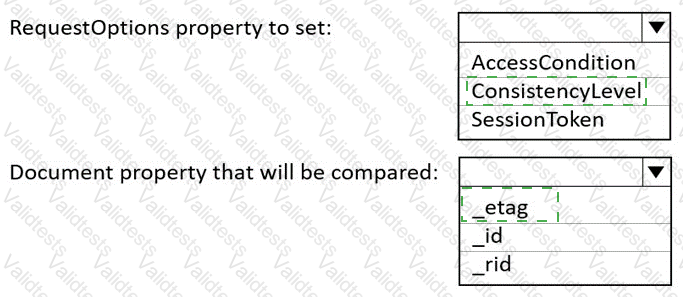
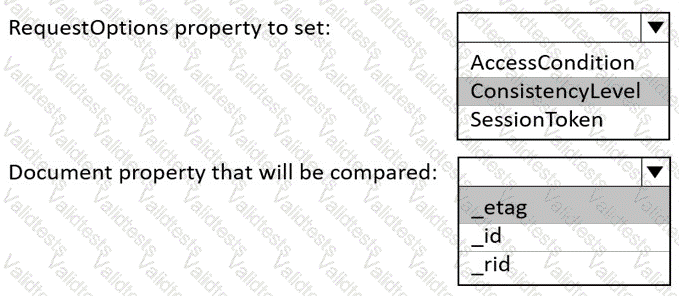
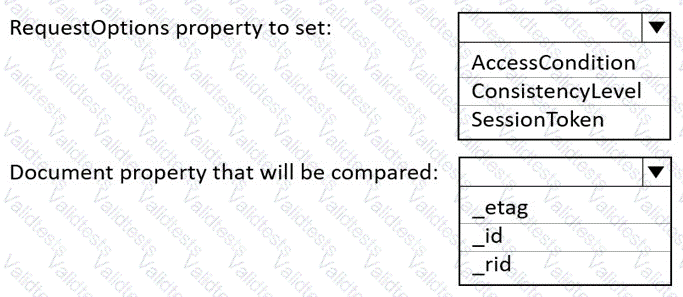
You have a container in an Azure Cosmos DB Core (SQL) API account.
You need to use the Azure Cosmos DB SDK to replace a document by using optimistic concurrency.
What should you include in the code? To answer, select the appropriate options in the answer area.
NOTE: Each correct selection is worth one point.
You need to select the partition key for con-iot1. The solution must meet the IoT telemetry requirements.
What should you select?