
View all detail and faqs for the MCIA-Level-1-Maintenance exam
An organization has defined a common object model in Java to mediate the communication between different Mule applications in a consistent way. A Mule application is being built to use this common object model to process responses from a SOAP API and a REST API and then write the processed results to an order management system.
The developers want Anypoint Studio to utilize these common objects to assist in creating mappings for various transformation steps in the Mule application.
What is the most idiomatic (used for its intended purpose) and performant way to utilize these common objects to map between the inbound and outbound systems in the Mule application?
As a part of project requirement, client will send a stream of data to mule application. Payload size can vary between 10mb to 5GB. Mule application is required to transform the data and send across multiple sftp servers. Due to the cost cuttings in the organization, mule application can only be allocated one worker with size of 0.2 vCore.
As an integration architect , which streaming strategy you would suggest to handle this scenario?
An organization is designing a mule application to support an all or nothing transaction between serval database operations and some other connectors so that they all roll back if there is a problem with any of the connectors
Besides the database connector , what other connector can be used in the transaction.
An organization has deployed both Mule and non-Mule API implementations to integrate its customer and order management systems. All the APIs are available to REST clients on the public internet.
The organization wants to monitor these APIs by running health checks: for example, to determine if an API can properly accept and process requests. The organization does not have subscriptions to any external monitoring tools and also does not want to extend its IT footprint.
What Anypoint Platform feature provides the most idiomatic (used for its intended purpose) way to monitor the availability of both the Mule and the non-Mule API implementations?
A Mule application is synchronizing customer data between two different database systems.
What is the main benefit of using eXtended Architecture (XA) transactions over local transactions to synchronize these two different database systems?
What is maximum vCores can be allocated to application deployed to CloudHub?
An organization has several APIs that accept JSON data over HTTP POST. The APIs are all publicly available and are associated with several mobile applications and web applications. The organization does NOT want to use any authentication or compliance policies for these APIs, but at the same time, is worried that some bad actor could send payloads that could somehow compromise the applications or servers running the API implementations. What out-of-the-box Anypoint Platform policy can address exposure to this threat?
An insurance company has an existing API which is currently used by customers. API is deployed to customer hosted Mule runtime cluster. The load balancer that is used to access any APIs on the mule cluster is only configured to point to applications hosted on the server at port 443.
Mule application team of a company attempted to deploy a second API using port 443 but the application will not start and checking logs shows an error indicating the address is already in use.
Which steps must the organization take to resolve this error and allow customers to access both the API's?
A company is designing a mule application to consume batch data from a partner's ftps server The data files have been compressed and then digitally signed using PGP.
What inputs are required for the application to securely consumed these files?
What Mule application can have API policies applied by Anypoint Platform to the endpoint exposed by that Mule application?

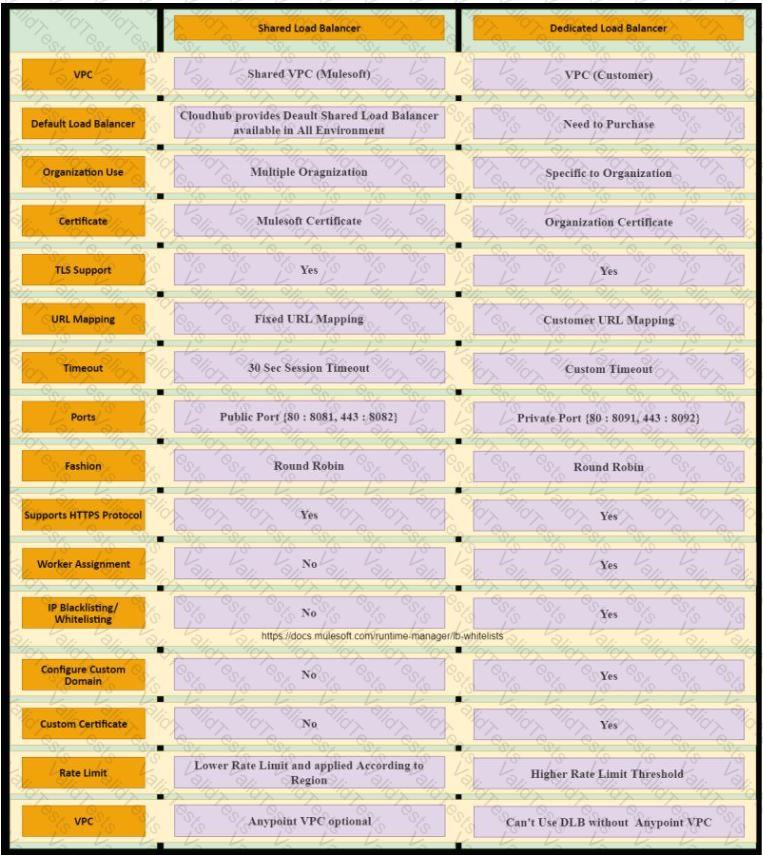 Table
Description automatically generated
Table
Description automatically generated