Pre-Summer Special Limited Time 70% Discount Offer - Ends in 0d 00h 00m 00s - Coupon code: validbest

Pass the Netskope NCCSA NSK300 Questions and answers with ValidTests

Exam NSK300 All Questions
Exam NSK300 Premium Access

View all detail and faqs for the NSK300 exam

Viewing page 2 out of 3 pages
Viewing questions 11-20 out of questions
Questions # 11:

You want to verify that Google Drive is being tunneled to Netskope by looking in the nsdebuglog file. You are using Chrome and the Netskope Client to steer traffic. In this scenario, what would you expect to see in the log file?

A)

Question # 11

B)

Question # 11

C)

Question # 11

D)

Question # 11

Options:

A.

Option A

B.

Option B

C.

Option C

D.

Option D

Expert Solution
Questions # 12:

You configured a pair of IPsec funnels from the enterprise edge firewall to a Netskope data plane. These tunnels have been implemented to steer traffic for a set of defined HTTPS SaaS applications accessed from end-user devices that do not support the Netskope Client installation. You discover that all applications steered through this tunnel are non-functional.

According to Netskope. how would you solve this problem?

Options:

A.

Restart the tunnel to stop the tunnel from flapping.

B.

Downgrade from IKE v2 to IKE v1.

C.

Install the Netskope root and intermediate certificates on the end-user devices.

D.

Disable Perfect Forward Secrecy on the tunnel configuration.

Expert Solution
Questions # 13:

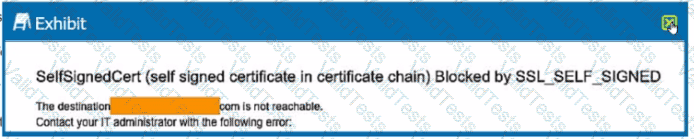
Review the exhibit.

Question # 13

You are the proxy administrator for a medical devices company. You recently changed a pilot group of users from cloud app steering to all Web traffic. Pilot group users have started to report that they receive the error shown in the exhibit when attempting to access the company intranet site that is publicly available. During troubleshooting, you realize that this site uses your company's internal certificate authority for SSL certificates.

Which three statements describe ways to solve this issue? (Choose three.)

Options:

A.

Import the root certificate for your internal certificate authority into Netskope.

B.

Bypass SSL inspection for the affected site(s).

C.

Create a Real-time Protection policy to allow access.

D.

Change the SSL Error Settings from Block to Bypass in the Netskope tenant.

E.

Instruct the user to proceed past the error message

Expert Solution
Questions # 14:

You deployed IPsec tunnels to steer on-premises traffic to Netskope. You are now experiencing problems with an application that had previously been working. In an attempt to solve the issue, you create a Steering Exception in the Netskope tenant tor that application: however, the problems are still occurring

Which statement is correct in this scenario?

Options:

A.

You must create a private application to steer Web application traffic to Netskope over an IPsec tunnel.

B.

Exceptions only work with IP address destinations

C.

Steering bypasses for IPsec tunnels must be applied at your edge network device.

D.

You must deploy a PAC file to ensure the traffic is bypassed pre-tunnel

Expert Solution
Questions # 15:

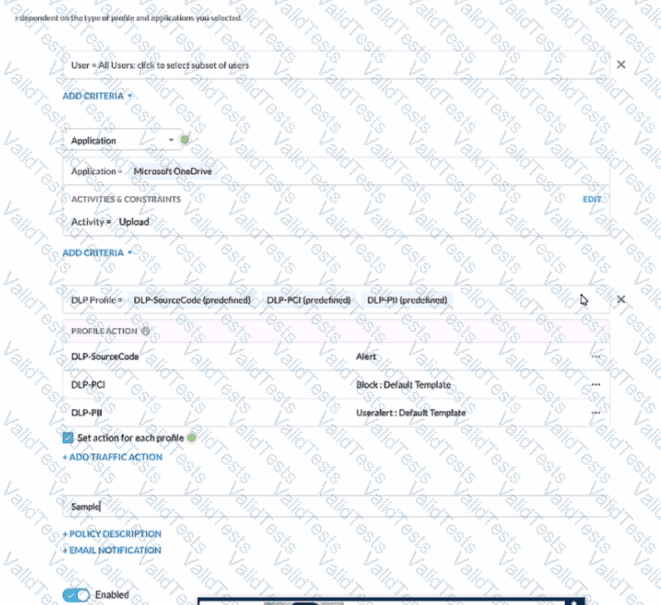
Review the exhibit.

Question # 15

A user has attempted to upload a file to Microsoft OneDrive that contains source code with Pll and PCI data.

Referring to the exhibit, which statement Is correct?

Options:

A.

The user will be blocked and a single Incident will be generated referencing the DLP-PCI profile.

B.

The user will be blocked and a single Incident will be generated referencing all of the matching DLP profiles

C.

The user will be blocked and a separate incident will be generated for each of the matching DLP profiles.

D.

The user will be alerted and a single incident will be generated referencing the DLP-PII profile.

Expert Solution
Questions # 16:

You want to enable the Netskope Client to automatically determine whether it is on-premises or off-premises. Which two options in the Netskope Ul would you use to accomplish this task? (Choose two.)

Options:

A.

the All Traffic option in the Steering Configuration section of the Ul

B.

the New Exception option in the Traffic Steering options of the Ul

C.

the Enable Dynamic Steering option in the Steering Configuration section of the Ul

D.

the On Premises Detection option under the Client Configuration section of the Ul

Expert Solution
Questions # 17:

You are implementing Netskope Cloud Exchange in your company lo include functionality provided by third-party partners. What would be a reason for using Netskope Cloud Risk Exchange in this scenario?

Options:

A.

to ingest events and alerts from a Netskope tenant

B.

to feed SOC with detection and response services

C.

to map multiple scores to a normalized range

D.

to automate service tickets from alerts of interest

Expert Solution
Questions # 18:

You deployed the Netskope Client for Web steering in a large enterprise with dynamic steering. The steering configuration includes a bypass rule for an application that is IP restricted. What is the source IP for traffic to this application when the user is on-premises at the enterprise?

Options:

A.

Loopback IPv4

B.

Netskope data plane gateway IPv4

C.

Enterprise Egress IPv4

D.

DHCP assigned RFC1918 IPv4

Expert Solution
Questions # 19:

You jus! deployed and registered an NPA publisher for your first private application and need to provide access to this application for the Human Resources (HR) users group only. How would you accomplish this task?

Options:

A.

1. Enable private app steering in the Steering Configuration assigned to the HR group.

2. Create a new Private App.

3. Create a new Real-time Protection policy as follows;

Source = HR user group Destination = Private App Action = Allow

B.

1. Create a new private app and assign it to the HR user group.

2. Create a new Real-time Protection policy as follows:

Source = HR user group Destination = Private App Action = Allow.

C.

1. Enable private app steering in Tenant Steering Configuration.

2. Create a new private app and assign it to the HR user group.

D.

1. Enable private app steering in the Steering Configuration assigned to the HR group.

2. Create a new private app and assign it to the HR user group

3. Create a new Real-time Protection policy as follows:

Source = HR user group Destination = Private App Action = Allow

Questions # 20:

A company has deployed Explicit Proxy over Tunnel (EPoT) for their VDI users They have configured Forward Proxy authentication using Okta Universal Directory They have also configured a number of Real-time Protection policies that block access to different Web categories for different AD groups so. for example, marketing users are blocked from accessing gambling sites. During User Acceptance Testing, they see inconsistent results where sometimes marketing users are able to access gambling sites and sometimes they are blocked as expected They are seeing this inconsistency based on who logs into the VDI server first.

What is causing this behavior?

Options:

A.

Forward Proxy is not configured to use the Cookie Surrogate

B.

Forward Proxy is not configured to use the IP Surrogate

C.

Forward Proxy authentication is configured but not enabled.

D.

Forward Proxy is configured to use the Cookie Surrogate

Viewing page 2 out of 3 pages
Viewing questions 11-20 out of questions