Summer Certification Special Limited Time 70% Discount Offer - Ends in 0d 00h 00m 00s - Coupon code: validbest

Pass the Nokia SRC 4A0-102 Questions and answers with ValidTests

Exam 4A0-102 All Questions
Exam 4A0-102 Premium Access

View all detail and faqs for the 4A0-102 exam

Viewing page 2 out of 5 pages
Viewing questions 11-20 out of questions
Questions # 11:

Which of the following regarding the TTL of a BGP message is TRUE?

Options:

A.

TTL is a well-known mandatory BGP attribute.

B.

The default TTL value of an eBGP message is 1, and64 for an iBGP message.

C.

The default TTL value of an iBGP message can be modified using the multihop command.

D.

The default TTL value of an eBGP message can be modified using the "ttl-security" command.

Expert Solution
Questions # 12:

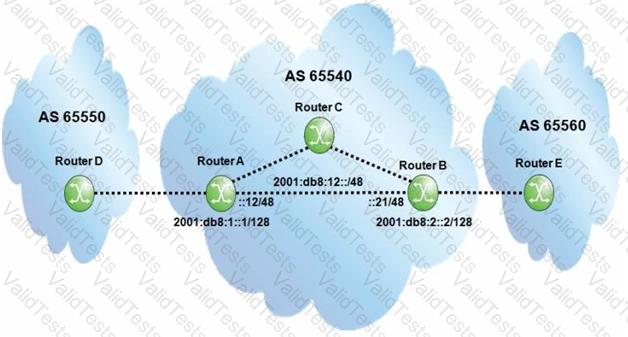
Click theexhibit.

Question # 12

Assume all router-IDs are properly configured, and global IPv6 addresses are used to establish eBGP sessions. Which of the following configurations is required on router A so that router B can exchange traffic with router D?
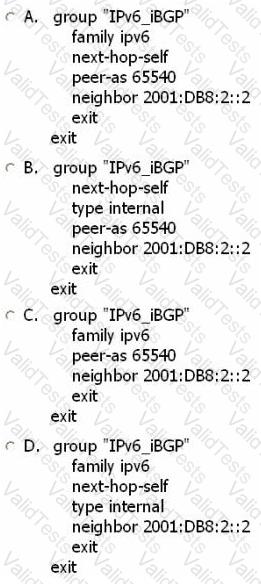
Question # 12

Options:

A.

Option A

B.

Option B

C.

Option C

D.

Option D

Expert Solution
Questions # 13:

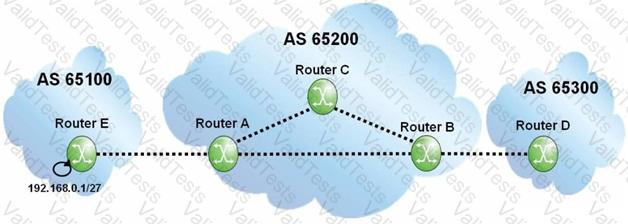
Click the exhibit.

Question # 13

Assuming that none of the routers within AS 65200 is configured with next-hop-self", what will the BGP update for the 192.168.0.1/27 prefix contain when it arrives at router B?

Options:

A.

AS Path of 65200 65100, Next Hop of router A.

B.

AS Path of 65200 65100, Next Hop of router E.

C.

AS Path of 65100, Next Hop of router E.

D.

AS Path of 65100, Next Hop of router A.

Expert Solution
Questions # 14:

What is the defaultNokia7750 SR TTL of a BGP advertisement between confederation members?

Options:

A.

1

B.

32

C.

64

D.

255

Expert Solution
Questions # 15:

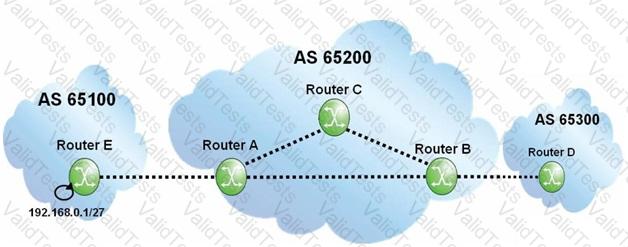
Click the exhibit.

Question # 15

Assuming router A is configured with "next-hop-self", what does the BGP update for prefix 192.168.0.1/27 contain when it arrives at router B?

Options:

A.

AS Path of 65200 65100, Next Hop of router A.

B.

AS Path of 65200 65100, Next Hop of router E.

C.

AS Path of 65100, Next Hop of router A.

D.

AS Path of 65100, Next Hop of router E.

Expert Solution
Questions # 16:

Which of the following prefixlists include prefixes 192.168.128.0/17 and 192.168.64.0/18?

Options:

A.

Prefix list 192.168.0.0/16 through 18.

B.

Prefix 192.168.0.0/17 longer.

C.

Prefix list 192.168.0.0/17 through 18.

D.

Prefix 192.160.0.0/13 longer.

Expert Solution
Questions # 17:

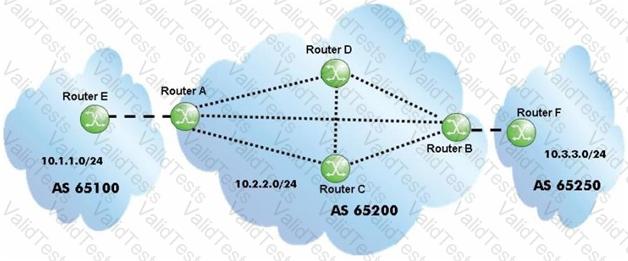
Click the exhibit.

Question # 17

After router A receives the BGP update for the 10.3.3.0/24 prefix, which routers will the route be propagated to?

Options:

A.

All routers with which it has a BGP session.

B.

All routers with which it has a BGPsession, except the router it received the update from, which is router B.

C.

All routers with which it has a BGP session, except the router it received the update from, which is router C.

D.

All routers with which it has a BGP session, except the router it received the update from, which is router D.

E.

Only eBGP neighbors.

Expert Solution
Questions # 18:

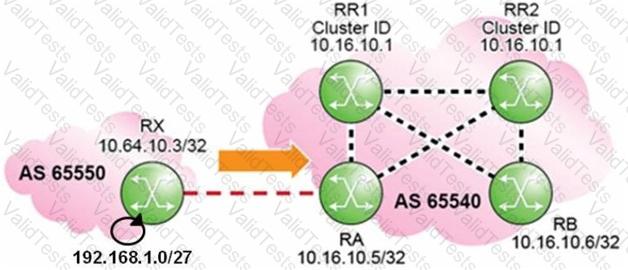
Click the exhibit.

Question # 18

Routers RR1 and RR2 are route reflectors with the same Cluster-ID. How does router RA treat the updates forprefix 192.168.1.0/27 received from routers RR1 and RR2?

Options:

A.

Router RA prefers the update received from router RR1.

B.

Router RA prefers the update received from router RR2.

C.

Router RA flags both updates as invalid.

D.

Router RA accepts bothupdates and flags them as used.

Expert Solution
Questions # 19:

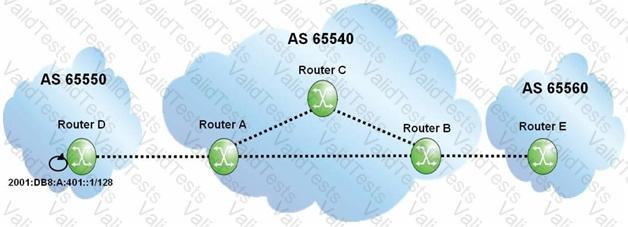
Click the exhibit.

Question # 19

Assume all router-IDs are properly configured, and IPv6 link-local addresses are used to establish all eBGP sessions. Given the following iBGP configuration on router A, what is the Next Hop forprefix 2001:DB8:A:401::1/128 on router B?
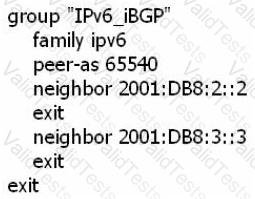
Question # 19

Options:

A.

The IPv6 link-local address of the router D interface towards router A.

B.

The IPv6 link-local address of the router A interface towards router D.

C.

The IPv6 global address of router A.

D.

The IPv6 globaladdress of router D.

Expert Solution
Questions # 20:

Which of the following statements regarding Internet Exchange Points is FALSE?

Options:

A.

They provide both peering and transit services.

B.

They provide services only to Tier 1 service providers.

C.

They can be either public or private.

D.

They provide services at the local, regional and continental levels.

Expert Solution
Viewing page 2 out of 5 pages
Viewing questions 11-20 out of questions