Pre-Summer Special Limited Time 70% Discount Offer - Ends in 0d 00h 00m 00s - Coupon code: validbest

Pass the Nokia SRC 4A0-103 Questions and answers with ValidTests

Exam 4A0-103 All Questions
Exam 4A0-103 Premium Access

View all detail and faqs for the 4A0-103 exam

Viewing page 2 out of 8 pages
Viewing questions 11-20 out of questions
Questions # 11:

Click on the exhibit button.
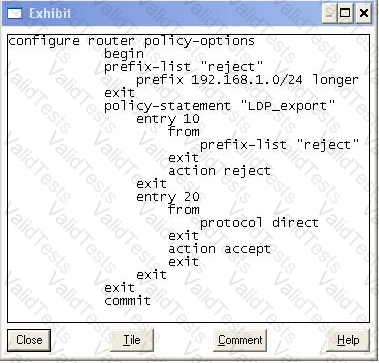
Question # 11

The policy on router R2 is applied as an LDP export policy. What FECs now appear in router R2's LIB?

Options:

A.

Local FECs, not including those in the 192.168.1.0/24 address space.

B.

Only system ID FECs may appear in the LIB.

C.

Any local FECs, except those with a 24 bit mask.

D.

Local FECs in the 192.168.1.0/24 address space

Expert Solution
Questions # 12:

Which of the following statements regarding the MPLS SWAP label operation is true?

Options:

A.

The inner label will be exchanged with the MPLS outer label.

B.

The inner label will be exchanged for a new label.

C.

The outer label will be exchanged for a new label.

D.

All labels will be exchanged for one new label.

E.

All labels will be exchanged for an equal number of new labels.

Expert Solution
Questions # 13:

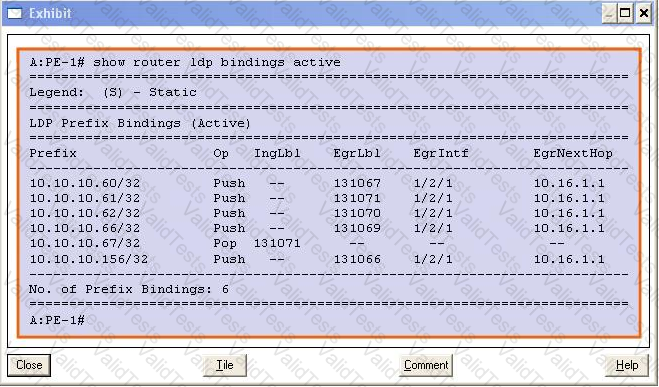
Click on the exhibit button below.

Question # 13

Consider the output shown; what table is displayed?

Options:

A.

RIB

B.

FIB

C.

LIB

D.

LFIB

Expert Solution
Questions # 14:

Which of the following describes how a router sets the destination IP address for an RSVP RESV message?

Options:

A.

It sets the address to the system address of the head-end router.

B.

It sets the address to the next upstream hop from the ERO.

C.

It sets the address to the next upstream hop from the PSB.

D.

It sets the address to the next upstream hop from the RRO.

Expert Solution
Questions # 15:

Click on the exhibit button below. Assume the following:
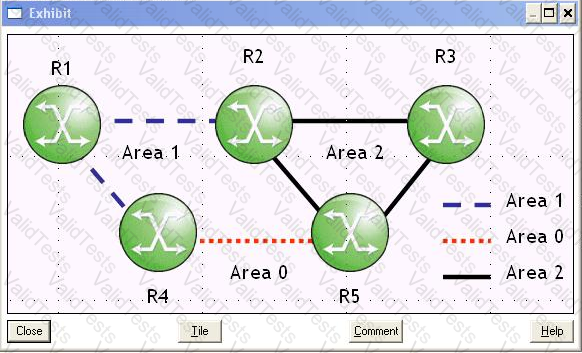
Question # 15

- Each router's OSPF interfaces are in the areas shown.

- Bidirectional LDP-over-RSVP tunnels extend from routers R1 to R3 and back over the path R1-R4-R5-R3.

- You enable fast reroute facility bypass on the R5-R3 RSVP LSP.

- Router R5 acts as a PLR, protecting the R5-R3 link by building a bypass tunnel through router R2.

You build a layer 2 VPN on routers R1 and R3, using the LDP-over-RSVP tunnels. What MPLS configuration step must you complete on router R2 for it to protect the end-to-end service?

Options:

A.

Enable LDP on the R2-R5 interface.

B.

Configure T-LDP sessions between routers R2 and R5 and R3.

C.

Configure LDP-over-RSVP support on router R2.

D.

Enable MPLS and RSVP on the router R2 network interfaces.

E.

Enable LDP on the R2-R5 and R2-R3 interfaces.

Expert Solution
Questions # 16:

Which of the following conditions must a router meet for an LSP path's RSVP session to exist? Choose two answers

Options:

A.

The router must build the Path State Block (PSB).

B.

The router must build the Reservation State Block (RSB).

C.

The router must build the Session State Block (SSB)

D.

The router must send the second RESV refresh message.

E.

The router must receive the second PATH refresh message.

Expert Solution
Questions # 17:

Which of the following LDP message categories is UDP-based?

Options:

A.

Notification

B.

Session

C.

Discovery

D.

Advertisement

Expert Solution
Questions # 18:

Which of the following are the default settings for the Alcatel-Lucent 7750 SR when using LDP?

Options:

A.

Per-platform label space, conservative retention mode

B.

Per-interface label space, conservative retention mode

C.

Per-platform label space, liberal retention mode

D.

Per-interface label space, liberal retention mode

Expert Solution
Questions # 19:

How does MPLS-TE overcome the issue of IP hyper-aggregation?

Options:

A.

By enabling the creation of LSPs across alternate links to balance the network traffic.

B.

By eliminating the requirement for core IP routing.

C.

By not allowing more than one LSP to use a particular path.

D.

By defining multiple LSPs across a network and implementing an IGP load balancing algorithm across them.

Expert Solution
Questions # 20:

What is the purpose of a T-LDP session?

Options:

A.

It allows link LDP to be configured on the edge devices only.

B.

It is used to signal the transport labels in the provider core.

C.

It allows selective control over which devices are configured for LDP.

D.

It is used to signal the service labels in the provider core.

Expert Solution
Viewing page 2 out of 8 pages
Viewing questions 11-20 out of questions