Summer Certification Special Limited Time 70% Discount Offer - Ends in 0d 00h 00m 00s - Coupon code: validbest

Pass the Nokia Optical Network Professional 4A0-205 Questions and answers with ValidTests

Exam 4A0-205 All Questions
Exam 4A0-205 Premium Access

View all detail and faqs for the 4A0-205 exam

Viewing page 2 out of 2 pages
Viewing questions 11-20 out of questions
Questions # 11:

Which of the following are the main reasons for fiber attenuation?

Options:

A.

Refraction and reflection

B.

Scattering and absorption

C.

Chromatic dispersion (CD) and polarization mode dispersion

D.

Small channel spacing

Expert Solution
Questions # 12:

What is the purpose of the NFM-T node synchronization?

Options:

A.

The partial or full node synchronization allows several entities/items defined at node level to be retrieved into the NFM-T database (upload).

B.

The partial or full node synchronization allows several entities/items defined at NFM-T level to be written into the node database (download).

C.

The partial or full node synchronization allows several entities/items defined at EPT level to be retrieved into the NFM-T database (upload from design).

D.

The partial or full node synchronization allows several entities/items defined at NFM-T level to be exported into an XML file, to be used as input for EPT (download to design).

Expert Solution
Questions # 13:

What is the main function of an optical amplifier?

Options:

A.

Demodulating the incoming signal

B.

Compensating for optical power attenuation

C.

Compensating for chromatic dispersion

D.

Compensating for attenuation through an optical-electrical-optical amplification

Questions # 14:

When monitoring the quality of the received signal in WDM, an open eye indicates:

Options:

A.

Low noise

B.

High distortion

C.

High jitter

D.

Presence of high inter-symbolic interference

Questions # 15:

Which of the following statements about the ODUk unit is TRUE?

Options:

A.

The ODUk contains the FEC.

B.

The ODUk is the basic payload that can be electronically groomed and switched in the OTN network.

C.

The ODUk is processed at an optical level.

D.

The ODUk is the first container in which the client signal is inserted.

Questions # 16:

Which of the following statements is true?

Options:

A.

Logs report both active and historical events.

B.

Alarms and conditions report a real time status of the node.

C.

Alarms and conditions report only historical status of the node.

D.

Logs report a real time status of the node.

Questions # 17:

What is the meaning of demand in EPT?

Options:

A.

Demand refers to the amount of OTN interfaces within a single network element.

B.

Demand refers to the required capacity of a single network element in terms of bandwidth.

C.

Demand refers to the required number of trails to be automatically created to meet design requirements.

D.

Demand refers to one or more client signal.

Questions # 18:

With reference to the image, where is the OPS card placed to provide the OMSP protection?
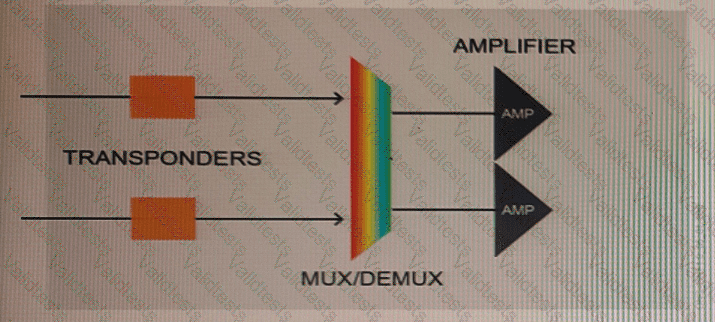
Question # 18

Options:

A.

After the amplifiers

B.

Between the mux/demux and the amplifier

C.

Between the transponders and the mux/demux

D.

Before the transponder, on the client side, towards the external device

Questions # 19:

Which statement is correct about node synchronization?

Options:

A.

Full synchronization retrieves the correlated alarms from the node

B.

Node synchronization is executed to test the reachability of a node

C.

Node synchronization is executed to align the time of the node to the time of the NFM-T platform

D.

Full synchronization retrieves all items from the node (NE parameters. Ports, Alarms, Internal Links, etc)

Questions # 20:

Which statement is correct about the NFM-T network map?

Options:

A.

It automatically represents all nodes grouped by the location string assigned during the NE creation.

B.

It represents all supervised nodes grouped by alarm status (with a different color).

C.

It allows context sensitive navigation and represents nodes and related physical connections with different colors. depending on the active alarms.

D.

It allows the graphical visualization of the services deployed in the network with the details of the boards involved in the service.

Viewing page 2 out of 2 pages
Viewing questions 11-20 out of questions