
View all detail and faqs for the ISO-14001-Lead-Auditor exam
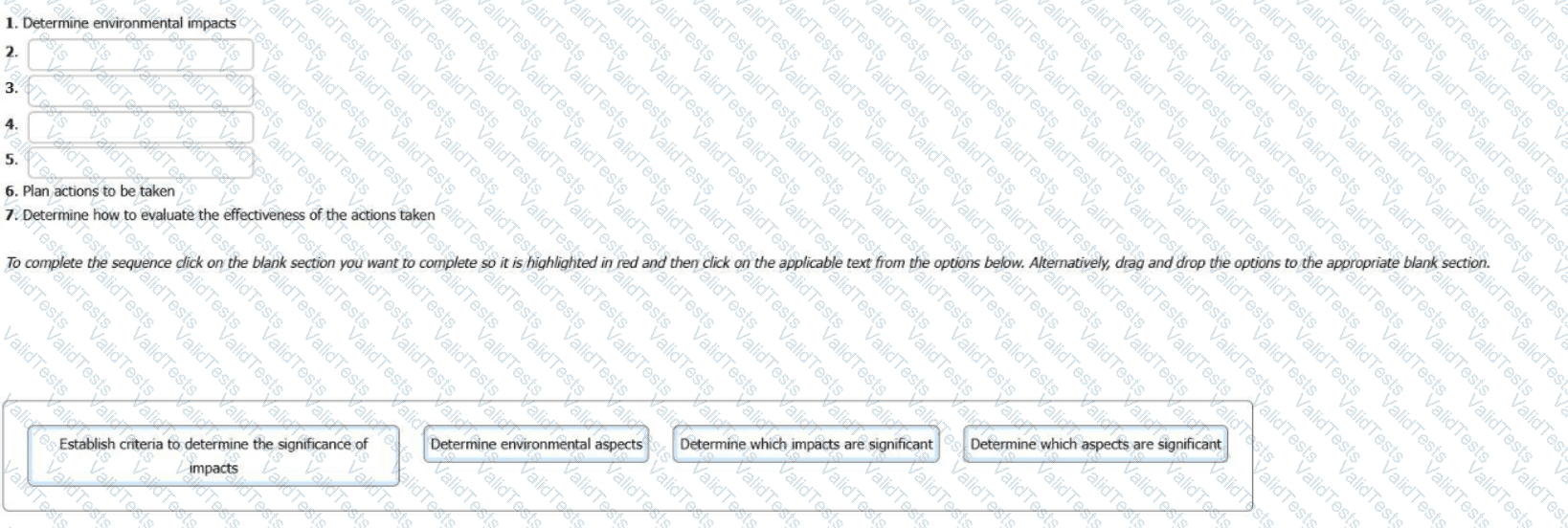
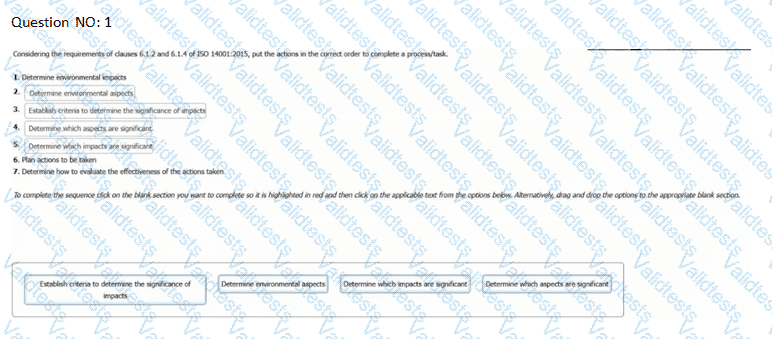
Considering the requirements of clauses 6.1.2 and 6.1.4 of ISO 14001:2015, put the actions in the correct order to complete a process/task.
What are the primary purposes of implementing an EMS based on ISO 14001:2015? Select two.
A chain of 10 paint shops in a city has established an EMS following the requirements of ISO 14001, which was third-party certified 10 years ago. You are performing a second-party audit. The audit plan included an interview with the General Manager (GM). The dialogue was as follows:
You: Hi, good evening, I have seen a well-developed environmental risk assessment process. However, I did not find the identification of emergency situations included in the results of this process. The Environmental Manager (EM) could not provide me with an acceptable answer to this question.
GM: The EM joined us 2 months ago, and he may not know some decisions we made some time ago, when we first certified our EMS. During those days, I met with all 10 supervisors and asked them what the emergencies were that they feared most. They unanimously said: fire. That was it. This is the only emergency we care of. As far as I remember we do not test the plan very often because the supervisors of all our 10 shops know it very well. The auditors of our certification body accepted this. We did not have a fire in the last 10 years.
What evidence would you need to review to determine conformity with ISO 14001 in this scenario? Select six.
A chain of 10 paint shops in a city has established an EMS following the requirements of ISO 14001, which was third-party certified 10 years ago. You are performing a second-party audit. The audit plan included an interview with the General Manager.
The dialogue was as follows:
You: Hi, good evening. I have seen well-developed environmental risk assessment processes. However, I did not find the identification of emergency situations included in the results of this process. The Environmental Manager could not provide me with an acceptable answer to this question.
GM: The EM joined us two months ago, and he may not know some decisions we made some time ago, when we first certified our EMS. During those days, I met with all 10 supervisors and asked them what the emergencies were that they feared most. They unanimously said: fire. That was it. This is the only emergency we care of. As far as I remember we do not test the plan very often because the supervisors of all our 10 shops know it very well. The auditors of our certification body accepted this. We did not have a fire in the last 10 years.
What evidence would you need to review to determine conformity with ISO 14001 in this scenario? Select six.
A small services organisation has been contracted to handle the disposal of waste for a local hospital. You are an auditor conducting a Stage 2 audit of the care home to ISO 14001. You are reviewing the contract with the Service Manager (SM). An addendum to the contract only requires that biological waste is disposed of in the most environmentally friendly way, without reference to any regulatory requirements.
You: How was the waste disposal plan for the contract developed?
SM: We have a basic template that covers the materials, labour requirements and methods to be employed. Some of that is specified by the contractor.
You: How does the plan deal with specific items like biological waste, which are included in the contract and can pose biological hazards to the environment?
SM: The basic plan covers general waste, but we have an addendum that covers biological waste.
You: Are you aware of the regulatory requirements for waste disposal standards in hospitals?
SM: Yes but we depend on the contractor to look after that side of things.
You raise a nonconformity against section 8.1.d of ISO 14001.
At the Stage 2 closing meeting of the audit, the EMS Manager objects to the nonconformity raised and asks for it to be withdrawn. He insists that they meet all the regulations.
Choose one of the options that the audit team leader should take in response to the request.
A huge public library established an EMS following the requirements of ISO 14001, which was third-party certified 10 years ago. You are performing the second surveillance audit of the third certification cycle. The audit plan included an audit to the Director as the last interview before the closing meeting.
During the interview with the Director, you audit clause 6.2 (Objectives and planning to achieve them). The dialogue is as follows:
You: Could you please tell me which were the environmental objectives defined for last year and show evidence of their achievement?
Director: Yes. We had defined three objectives. As you can see from our Annual Plan, one of them was to separate our waste in four categories: paper, plastics, metals, food — before, we had only three (plastic and paper were disposed together). We developed an Action Plan to achieve this objective.
Which six of the questions would you ask related to the Action Plan?
Whistlekleen is a national dry cleaning and laundry organisation with 50 shops. You are conducting an EMS surveillance audit of Head Office and are sampling environmental performance measurement. You find that 80 per cent of failures to meet performance criteria originate from five shops in the same region. Most of these failures relate to the release of volatile organic compounds (VOCs) that exceeds regulations. The Environmental Manager tells you that these are the oldest shops in the organisation. The cleaning equipment needs replacing but the organisation cannot afford it at the moment.
On raising the matter with senior management, you are told that there are plans to replace the equipment in these shops over the next five years.
Select two options that apply to how you should respond to the information given.
Which two of the following documents are not required for documentation review by an auditor conducting a Stage 1 certification audit to ISO 14001?
Which two of the following phrases would apply to " audit criteria " ?
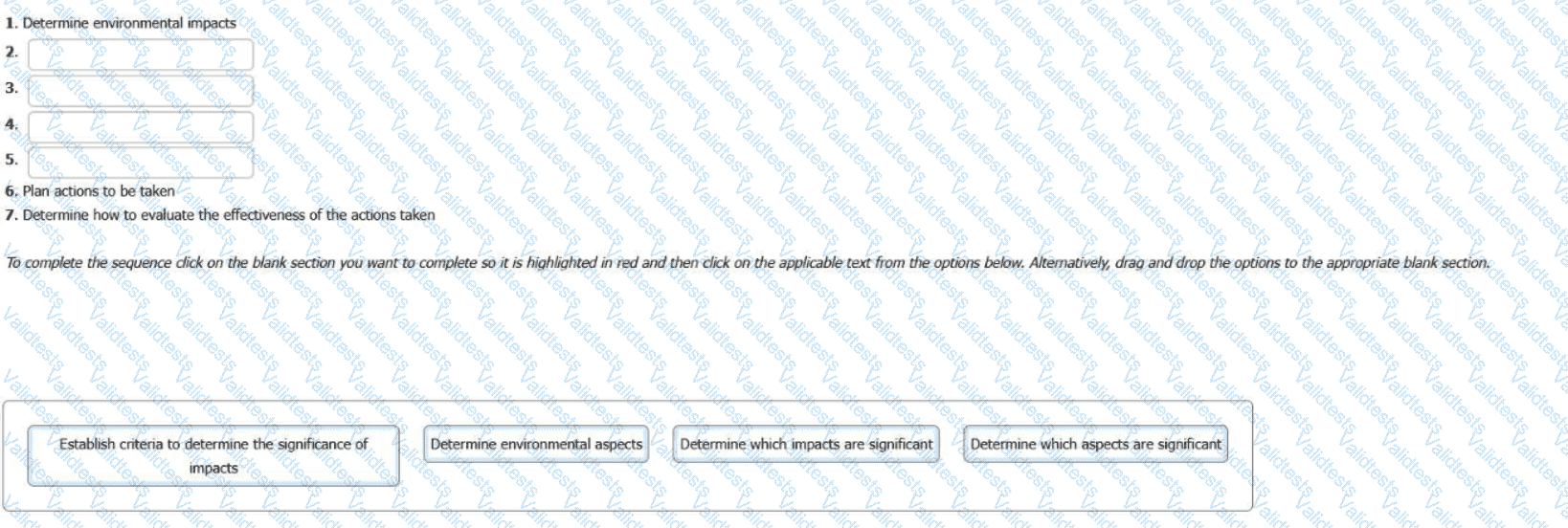
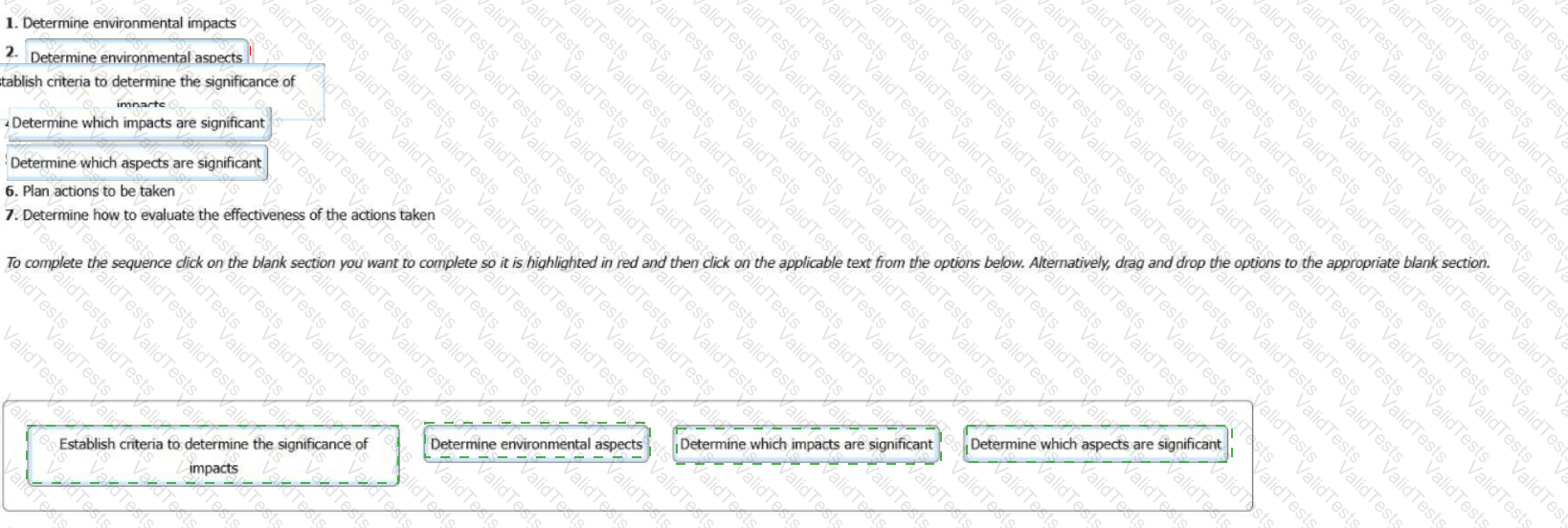
Considering the requirements of clauses 6.1.2 and 6.1.4 of ISO 14001:2015, put the actions in the correct order to complete a process/task.

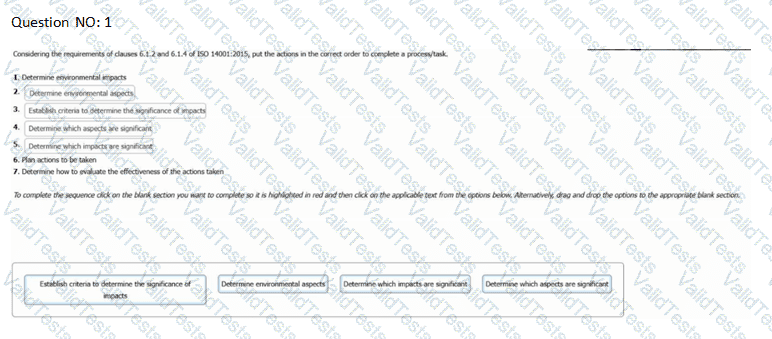 C:\Users\Intellectual Works\Pictures\Screenshots\Screenshot 2025-06-12 143525.png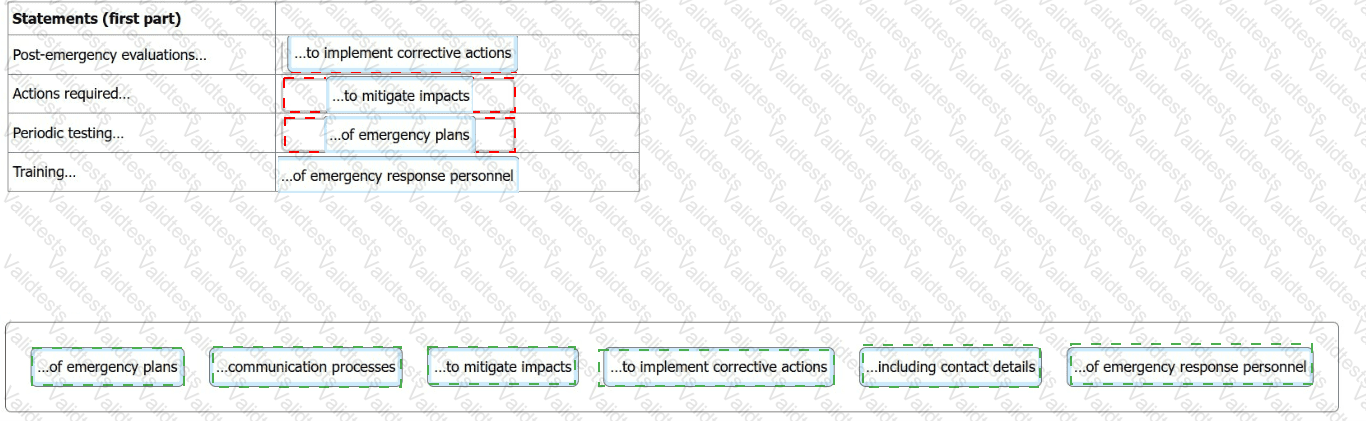
 C:\Users\Intellectual Works\Pictures\Screenshots\Screenshot 2025-06-12 143525.png