Summer Certification Special Limited Time 70% Discount Offer - Ends in 0d 00h 00m 00s - Coupon code: validbest

Pass the Salesforce Developer OmniStudio-Developer Questions and answers with ValidTests

Exam OmniStudio-Developer All Questions
Exam OmniStudio-Developer Premium Access

View all detail and faqs for the OmniStudio-Developer exam

Viewing page 6 out of 6 pages
Viewing questions 51-60 out of questions
Questions # 51:

An OmniStudio Developer is using a Data Mapper Transform. The source JSON has a field named Phone_Number, which is a string. The target JSON requires the field to be an array named ContactDetails containing a Phone object: { " ContactDetails " : [{ " Phone " : " ... " }]}. Which mapping technique is required?

Options:

A.

Direct mapping from Phone_Number to ContactDetails:Phone

B.

Mapping the source to the nested target path and relying on the Data Mapper to create the array and object nodes

C.

Creating an intermediate array in the Formula tab

D.

Mapping the source to the root node

Questions # 52:

Which two fields in an Integration Procedure can use a function like CONCAT or DATEDIFF?

Choose 2 answers

Options:

A.

In Procedure Configuration, in a Tracking Custom Data value field.

B.

In a Remote Action, in a Remote Options value field.

C.

In a Remote Action, in an Additional Output value field.

D.

In a Response Action, in an Additional input value field.

Questions # 53:

A developer has a requirement to create a child FlexCard that contains all of its parent FlexCard’s records In a Datable How should the developer configure the parent FlexCard’s Node?

Options:

A.

{Records {0}}

B.

{Records}

C.

{Params, records}

D.

{Recorded}

Questions # 54:

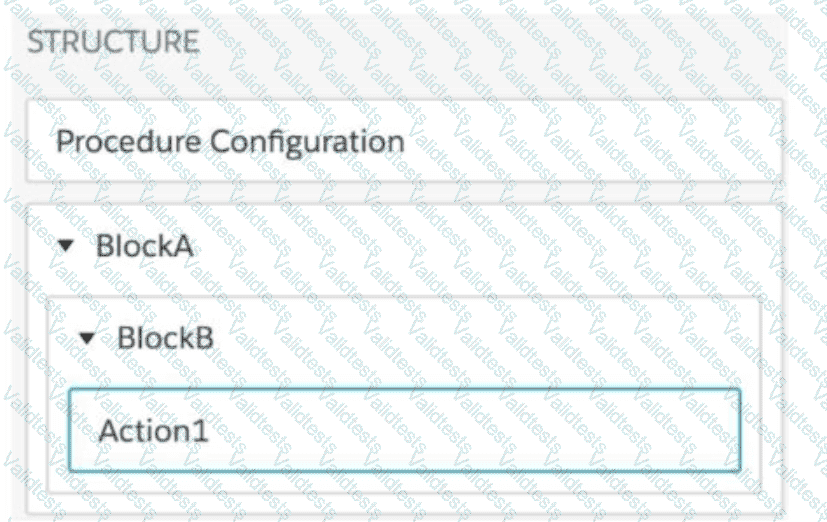
Refer to the exhibit below.

Question # 54

In this Integration Procedure structure, which Send JSON Path should be used to send the output of the Action1 element to a Remote Action?

Options:

A.

BlockA.BlockB.Action1

B.

BlockA:BlockB:Action1

C.

Action1:BlockB:BlockA

D.

Action1.BlockB.BlockA

Questions # 55:

An OmniStudio Developer is building an OmniScript and needs to retrieve data from many fields in a Salesforce record.

Options:

A.

HTTP Action

B.

Data Mapper Extract Action

C.

Lookup

D.

Select

Questions # 56:

A developer creates an Integration Procedure with a Set values and a DataRaptor Extract Action that requires Accountld as a key. When the developer previews the Integration Procedure, the developer enters the Accountld correctly and executes the preview. The developer sees the dataextracted by the DataRaptor in the Debug Log, but the response is empty.

What is the likely cause of this issue?

Options:

A.

The Response cannot be previewed directly.

B.

The DataRaptor Action did not have the Add Response To Response JSON property set to true.

C.

A Response Action was not added to the Integration Procedure.

D.

The Accountld used for the preview is invalid.

Questions # 57:

An OmniStudio Developer is designing a reusable Integration Procedure for a high-volume process. The data changes frequently, every 5 minutes. The developer wants to use caching but must ensure the cache is automatically refreshed shortly after the data changes. What is the most appropriate strategy?

Options:

A.

Set the Cache Duration to 300 seconds, or 5 minutes.

B.

Set the Contextual Cache Key to a unique value.

C.

Disable caching, as the data changes too frequently.

D.

Set the Cache Duration to a very high value, for example, 24 hours.

Questions # 58:

In an Integration Procedure, a developer needs to perform a multi-step calculation on every element of an array.

Based on best practices, what two methods are recommended?

Choose 2 answers

Options:

A.

Use a List Action to merge the array elements together.

B.

Use a Calculation Action to call a Calculation Procedure.

C.

Use a Set Values Element inside a Loop Block.

D.

Use a Matrix Action to call a Calculation Matrix.

Questions # 59:

Why would a developer clone an Integration Procedure instead of versioning it?

Options:

A.

The new Integration Procedure uses a Cache Block.

B.

The new Integration Procedure will be used independently.

C.

The new Integration Procedure is replacing stub data.

D.

The new Integration Procedure is Chainable.

Questions # 60:

When performing an update of multiple related Salesforce records within an Integration Procedure, what is best practice for handling the updates?

Options:

A.

Use a single Data Mapper Load Action designed to handle all related object mappings.

B.

Use multiple sequential Data Mapper Load Actions.

C.

Use a Remote Action to call an Apex trigger.

D.

Use a single HTTP Action to call the Salesforce REST API.

Viewing page 6 out of 6 pages
Viewing questions 51-60 out of questions