Summer Certification Special Limited Time 70% Discount Offer - Ends in 0d 00h 00m 00s - Coupon code: validbest

Pass the Snowflake SnowPro Core Certification COF-C02 Questions and answers with ValidTests

Exam COF-C02 All Questions
Exam COF-C02 Premium Access

View all detail and faqs for the COF-C02 exam

Viewing page 15 out of 17 pages
Viewing questions 281-300 out of questions
Questions # 281:

What actions will prevent leveraging of the ResultSet cache? (Choose two.)

Options:

A.

Removing a column from the query SELECT list

B.

Stopping the virtual warehouse that the query is running against

C.

Clustering of the data used by the query

D.

Executing the RESULTS_SCAN() table function

E.

Changing a column that is not in the cached query

Questions # 282:

What affects whether the query results cache can be used?

Options:

A.

If the query contains a deterministic function

B.

If the virtual warehouse has been suspended

C.

If the referenced data in the table has changed

D.

If multiple users are using the same virtual warehouse

Questions # 283:

The Snowflake cloud services layer is responsible for which tasks? (Choose two.)

Options:

A.

Local disk caching

B.

Authentication and access control

C.

Metadata management

D.

Query processing

E.

Database storage

Questions # 284:

Which of the following statements describe features of Snowflake data caching? (Choose two.)

Options:

A.

When a virtual warehouse is suspended, the data cache is saved on the remote storage layer.

B.

When the data cache is full, the least-recently used data will be cleared to make room.

C.

A user can only access their own queries from the query result cache.

D.

A user must set USE_METADATA_CACHE to TRUE to use the metadata cache in queries.

E.

The RESULT_SCAN table function can access and filter the contents of the query result cache.

Questions # 285:

Which tasks are performed in the Snowflake Cloud Services layer? (Choose two.)

Options:

A.

Management of metadata

B.

Computing the data

C.

Maintaining Availability Zones

D.

Infrastructure security

E.

Parsing and optimizing queries

Questions # 286:

Which columns are part of the result set of the Snowflake LATERAL FLATTEN command? (Choose two.)

Options:

A.

CONTENT

B.

PATH

C.

BYTE_SIZE

D.

INDEX

E.

DATATYPE

Questions # 287:

What happens to historical data when the retention period for an object ends?

Options:

A.

The data is cloned into a historical object.

B.

The data moves to Fail-safe

C.

Time Travel on the historical data is dropped.

D.

The object containing the historical data is dropped.

Questions # 288:

The following JSON is stored in a VARIANT column called src of the CAR_SALES table:
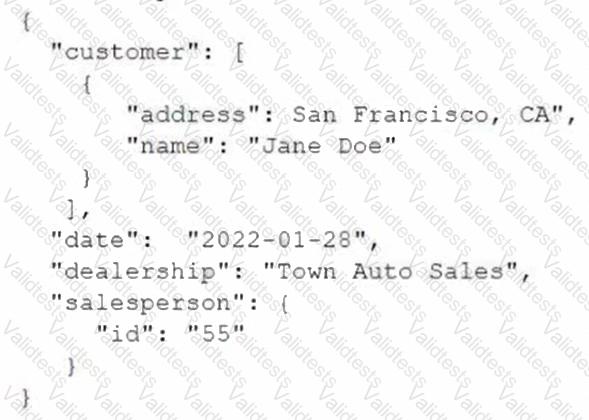
Question # 288

A user needs to extract the dealership information from the JSON.

How can this be accomplished?

Options:

A.

select src:dealership from car_sales;

B.

select src.dealership from car_sales;

C.

select src:Dealership from car_sales;

D.

select dealership from car_sales;

Questions # 289:

Which of the following features, associated with Continuous Data Protection (CDP), require additional Snowflake-provided data storage? (Choose two.)

Options:

A.

Tri-Secret Secure

B.

Time Travel

C.

Fail-safe

D.

Data encryption

E.

External stages

Questions # 290:

Which of the following is an example of an operation that can be completed without requiring compute, assuming no queries have been executed previously?

Options:

A.

SELECT SUM (ORDER_AMT) FROM SALES;

B.

SELECT AVG(ORDER_QTY) FROM SALES;

C.

SELECT MIN(ORDER_AMT) FROM SALES;

D.

SELECT ORDER_AMT * ORDER_QTY FROM SALES;

Questions # 291:

In the Snowflake access control model, which entity owns an object by default?

Options:

A.

The user who created the object

B.

The SYSADMIN role

C.

Ownership depends on the type of object

D.

The role used to create the object

Questions # 292:

What do the terms scale up and scale out refer to in Snowflake? (Choose two.)

Options:

A.

Scaling out adds clusters of the same size to a virtual warehouse to handle more concurrent queries.

B.

Scaling out adds clusters of varying sizes to a virtual warehouse.

C.

Scaling out adds additional database servers to an existing running cluster to handle more concurrent queries.

D.

Snowflake recommends using both scaling up and scaling out to handle more concurrent queries.

E.

Scaling up resizes a virtual warehouse so it can handle more complex workloads.

F.

Scaling up adds additional database servers to an existing running cluster to handle larger workloads.

Questions # 293:

By default, which Snowflake role is required to create a share?

Options:

A.

ORGADMIN

B.

SECURITYADMIN

C.

SHAREADMIN

D.

ACCOUNTADMIN

Questions # 294:

What are best practice recommendations for using the ACCOUNTADMIN system-defined role in Snowflake? (Choose two.)

Options:

A.

Ensure all ACCOUNTADMIN roles use Multi-factor Authentication (MFA).

B.

All users granted ACCOUNTADMIN role must be owned by the ACCOUNTADMIN role.

C.

The ACCOUNTADMIN role must be granted to only one user.

D.

Assign the ACCOUNTADMIN role to at least two users, but as few as possible.

E.

All users granted ACCOUNTADMIN role must also be granted SECURITYADMIN role.

Questions # 295:

When publishing a Snowflake Data Marketplace listing into a remote region what should be taken into consideration? (Choose two.)

Options:

A.

There is no need to have a Snowflake account in the target region, a share will be created for each user.

B.

The listing is replicated into all selected regions automatically, the data is not.

C.

The user must have the ORGADMIN role available in at least one account to link accounts for replication.

D.

Shares attached to listings in remote regions can be viewed from any account in an organization.

E.

For a standard listing the user can wait until the first customer requests the data before replicating it to the target region.

Questions # 296:

What occurs when a pipe is recreated using the CREATE OR REPLACE PIPE command?

Options:

A.

The Pipe load history is reset to empty.

B.

The REFRESH command is executed.

C.

The stage will be purged.

D.

The destination table is truncated.

Questions # 297:

Which methods can be used to delete staged files from a Snowflake stage? (Choose two.)

Options:

A.

Use the DROP < file > command after the load completes.

B.

Specify the TEMPORARY option when creating the file format.

C.

Specify the PURGE copy option in the COPY INTO < table > command.

D.

Use the REMOVE command after the load completes.

E.

Use the DELETE LOAD HISTORY command after the load completes.

Questions # 298:

In a Snowflake role hierarchy, what is the top-level role?

Options:

A.

SYSADMIN

B.

ORGADMIN

C.

ACCOUNTADMIN

D.

SECURITYADMIN

Questions # 299:

Files have been uploaded to a Snowflake internal stage. The files now need to be deleted.

Which SQL command should be used to delete the files?

Options:

A.

PURGE

B.

MODIFY

C.

REMOVE

D.

DELETE

Questions # 300:

Which Snowflake function will interpret an input string as a JSON document, and produce a VARIANT value?

Options:

A.

parse_json()

B.

json_extract_path_text()

C.

object_construct()

D.

flatten

Viewing page 15 out of 17 pages
Viewing questions 281-300 out of questions