Pre-Summer Special Limited Time 70% Discount Offer - Ends in 0d 00h 00m 00s - Coupon code: validbest

Pass the The Open Group Enterprise Architecture OGEA-10B Questions and answers with ValidTests

Exam OGEA-10B All Questions
Exam OGEA-10B Premium Access

View all detail and faqs for the OGEA-10B exam

Viewing page 2 out of 2 pages
Viewing questions 11-20 out of questions
Questions # 11:

Which statement about Requirements Management is most correct?

Options:

A.

The purpose of Requirements Management is to process change requests

B.

Stakeholder requirements are captured once in Phase A and managed throughout the ADM cycle

C.

Requirements Management is a step of all ADM Phases

D.

Requirements Management and stakeholder engagement are placed at the center of architecture development

Expert Solution
Questions # 12:

Please read this scenario prior to answering the question

You have been appointed as senior architect working for an autonomous driving technology development company. The mission of the company is to build an industry leading unified technology and software platform to support connected cars and autonomous driving.

The company uses the TOGAF Standard as the basis for its Enterprise Architecture (EA) framework. Architecture development within the company follows the purpose-based EA Capability model as described in the TOGAF Series Guide: A Practitioners'Approach to Developing Enterprise Architecture Following the TOGAF® ADM.

An architecture to support strategy has been completed defining a long-range Target Architecture with a roadmap spanning five years. This has identified the need for a portfolio of projects over the next two years. The portfolio includes development of travel assistance systems using swarm data from vehicles on the road.

The current phase of architecture development is focused on the Business Architecture which needs to support the core travel assistance services that the company plans to provide. The core services will manage and process the swarm data generated by vehicles, paving the way for autonomous driving in the future.

The presentation and access to different variations of data that the company plans to offer through its platform poses an architecture challenge. The application portfolio needs to interact securely with various third-party cloud services, and V2X (Vehicle-to-Everything) service providers in many countries to be able to manage the data at scale. The security of V2X is a key concern for the stakeholders. Regulators have stated that the user's privacy be always protected, for example, so that the drivers' journey cannot be tracked or reconstructed by compiling data sent or received by the car.

Refer to the scenario

You have been asked to describe the risk and security considerations you would include in the current phase of the architecture development?

Based on the TOGAF standard which of the following is the best answer?

Options:

A.

You will focus on the relationship with the third parties required for the travel assistance systems and define a trust framework. This will describe the relationship with each party. Digital certificates are a key part of the framework and will be used to create trust between parties. You will monitor legal and regulatory changes across all the countries to keep the trust framework in compliance.

B.

You will perform a qualitative risk assessment for the data assets exchanged with partners. This will deliver a set of priorities, high to medium to low, based on identified threats, the likelihood of occurrence, and the impact if it did occur. Using the priorities, you would then develop a Business Risk Model which will detail the risk strategy including classifications to determine what mitigation is enough.

C.

You will focus on data quality as it is a key factor in risk management. You will identify the datasets that need to be safeguarded. For each dataset, you will assign ownership and responsibility for the quality of data needs. A security classification will be defined and applied to each dataset. The dataset owner will then be able to authorize processes that are trusted for a certain activity on the dataset under certain circumstances.

D.

You will create a security domain model so that assets with the same level can be managed under one security policy. Since data is being shared across partners, you will establish a security federation to include them. This would include contractual arrangements, and a definition of the responsibility areas for the data exchanged, as well as security implications. You would undertake a risk assessment determining risks relevant to specific

Expert Solution
Questions # 13:

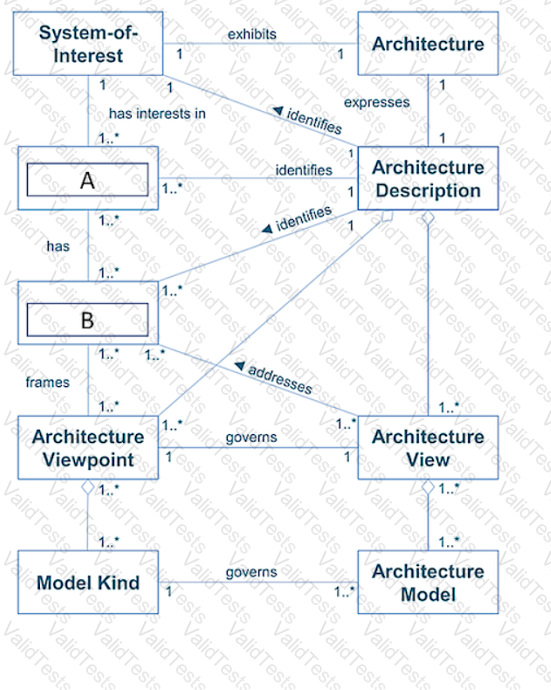
Exhibit:

Question # 13

Consider the image showing basic architectural concepts.

What are items A and B?

Options:

A.

A-Candidate Architecture, B-Trade-off

B.

A-User, B-Requirement

C.

A-Stakeholder, B-Concern

D.

A-Base Architecture, B-Target Architecture

Expert Solution
Questions # 14:

Complete the following sentence. In the ADM, documents which are under development and have not undergone any formal review and approval process are called______ Documents which have been reviewed and approved are called ______

Options:

A.

"draft"- "finalized"

B.

"draft" - "approved"

C.

"concept" - "deliverable"

D.

"Version 0.1" - "Version 1.0"

Expert Solution
Questions # 15:

Please read this scenario prior to answering the question

You are the Lead Enterprise Architect at a major agribusiness company. The company's main

annual harvest is lentils, a highly valued food grown worldwide. The lentil parasite, broomrape,

has been an increasing concern for many years and is now becoming resistant to chemical

controls. In addition, changes in climate favor the propagation and growth of the parasite. As a

result, the parasite cannot realistically be exterminated, and it has become pandemic, with lentil

yields falling globally.

The CEO appreciates the seriousness of the situation and has set out a change in direction

that is effectively a new business for the company. There are opportunities for new products,

and new markets. The company will use the fields for another harvest and will cease to process

third-party lentils. Thus, the target market will change, and the end-products will be different

and more varied. This is a major decision and the CEO has stated a desire to repurpose rather

than replace so as to manage the risks and limit the costs.

The company has a mature Enterprise Architecture practice based in its headquarters and uses

the TOGAF standard as the method and guiding framework. The practice has an established

Architecture Capability, and uses iteration for architecture development. The CIO is the sponsor

of the activity.

The CIO has assigned the Enterprise Architecture team to this activity. At this stage there is no

shared vision, or requirements.

Refer to the scenario

You have been asked to propose the best approach for architecture development to realize the

CEO's change in direction for the company.

Based on the TOGAF standard which of the following is the best answer?

Options:

A.

You propose that the team focus on architecture definition, with emphasis on defining

the change parameters to support this new business strategy that the CEO has

identified. Once understood, the team will be in the best position to identify the

requirements, drivers, issues, and constraints for the change. You would ensure that the

architecture development addresses non-functional requirements to assure that the

B.

You propose that this engagement define the baseline Technology Architecture first in

order to assess the current infrastructure capacity and capability for the company. Then

the focus should be on transition planning and incremental architecture deployment.

This will identify requirements to ensure that the projects are sequenced in an optimal

fashion so as to realize the change.

C.

You propose that the priority is to understand and bring structure to the definition of the

change. The team should focus iteration cycles on a baseline first approach to

architecture development, and then transition planning. This will identify what needs to

change in order to transition from the baseline to the target, and can be used to work out

in detail what the shared vision is for the change.

D.

You propose that the team focus its iteration cycles on architecture development by

going through the architecture definition phases (B-D) with a baseline first approach.

This will support the change in direction as stated by the CEO. It will ensure that the

change can be defined in a structured manner and address the requirements needed to

realize the change.

Expert Solution
Questions # 16:

Please read this scenario prior to answering the question

You have been appointed as Chief Enterprise Architect (CEA). reporting to the Chief Technical Officer (CTO), of a company established as a separate operating entity by a major automotive manufacturer. The mission of the company is to build a new industry leading unified technology and software platform for electric vehicles.

The company uses the TOGAF Standard as the basis for its Enterprise Architecture (EA) framework, and architecture development follows the purpose-based EA Capability model as described in the TOGAF Series Guide: A Practitioners'Approach to Developing Enterprise Architecture Following the TOGAF® ADM.

An end-to-end Target Architecture has been completed with a roadmap for change over a five-year period. The new platform will be a cross-functional effort between hardware and software teams, with significant changes over the old platform. It is expected to be developed in several stages over three years. The EA team has inherited the architecture for the previous generation hardware and software automotive platform, some of which can be carried over to the new unified platform. The EA team has started to define the new platform, including defining which parts of the architecture to carry forward.

Enough of the Business Architecture has been defined, so that work can commence on the Information Systems and Technology Architectures. Those need to be defined to support the core business services that the company plans to provide. The core services will feature an innovative approach with swarm data generated by vehicles, paving the way for autonomous driving in the future.

The presentation and access to different variations of data that the company plans to offer through its platform pose an architecture challenge. The application portfolio and supporting infrastructure need to interact with various existing cloud services and data-

Refer to the scenario

You have been asked what approach should be taken to determine and organize the work to deliver the requested architectures?

Based on the TOGAF standard which of the following is the best answer?

Options:

A.

You would look outside the enterprise to research data models and application portfolios of leading big data businesses. You would develop just enough applications, data, and technology architecture to identify options. For each project this should include identification of candidate architecture and solution building blocks. You will identify solution providers, perform a readiness assessment, and assess the viability and fitness of the so

B.

You would refer to the end-to-end Target Architecture for guidance and direction. The first objective should be to identify projects, dependencies and synergies, then prioritize before initiating the projects. You will develop high-level architecture descriptions. For each project you would estimate effort size, identify reference architectures, and candidate building blocks. You will identify the resource needs considering cost and value.

C.

You will revisit ADM Phase A. identifying the stakeholders and creating a new Architecture Vision. You will update the Stakeholder map produced for the strategic architecture so it reflects the stakeholders who are now the most relevant to the projects that are to be developed. You would then ask the CTO to make some decisions about the Architecture Roadmap, and update the Implementation and Migration Plan to reflect the decisions.

D.

You will research leading data businesses, developing high-level Target Data, Application and Technology Architectures. You would review the Architecture Vision in order to estimate the level of detail, time, and breadth of the ADM cycle phases that will be needed to develop the architecture. You will identify and cost major work packages, and then develop an Architecture Roadmap. You would then seek approval by the Architecture Board and i

Expert Solution
Viewing page 2 out of 2 pages
Viewing questions 11-20 out of questions