Section C (4 Mark)
Read the senario and answer to the question.
Calculate the Net Worth of Mr. Adhikari as on 31/03/2009.
Section A (1 Mark)
Disclaimers and assumptions are a part of
Section B (2 Mark)
How much total principal is repaid between the 1st and 17th payment interval of a 4.5-year loan for Rs 4567 at an interest rate of 7.44% compounded monthly. The payments are also monthly.
Section B (2 Mark)
If after the partition of an HUF 2 members became partners in 3 firms on behalf of their respective HUFs and they also become partners in a fourth firm. The funds were obtained by means of loans from the other 3 firms. The share incomes of the members from the fourth firm were assessable as their individual income only.
Section B (2 Mark)
EDLI stands for
Section A (1 Mark)
Stock broker’s human capital is _________ to stock market as compared to a school teacher
Section B (2 Mark)
Vikrant Juneja gifted his house property to his wife in year 2007. Mrs. Juneja then lets out this house @ Rs. 5000 per month. The income from such house property will be taxable in the hands of:
Section B (2 Mark)
_____________ begins with the price at which a product that has been purchased from an Associated Enterprise AE is resold to an independent enterprise
Section A (1 Mark)
An example of a highly cyclical industry is ________.
Section B (2 Mark)
The Motor Vehicle Insurance Policy has inbuilt cover for death/disability of driver/owner caused by accident during the use of the insured motor vehicle up to Rs. __________ in case of car/commercial vehicle and Rs. _________ in case of two wheelers.
Section C (4 Mark)
The Puri’s family includes a financially well-informed couple, both aged 34, and two children aged 4 and 6. They are financially sound, but were not in the market during the Indian Bull market of the 2003 to 2007 as many of their neighbors were. The couple’s total income, Rs. 12,00,000, which they do not expect to grow significantly in times to come
They have saved 15,00,000, which they hope will be the financial foundation from which they will send their children to college and retire comfortably.
Which of the following biases does the Puri Family suffer from:?

Section C (4 Mark)
Ramesh aged 50 could not save for his retirement till date but now decides to save Rs. 50000 per month till his retirement age of 65. He anticipates that the return in the first 5 years would be 13% p.a. next 5 years 10% and in the last 5 years 8% p.a. He wants to accumulate a corpus of Rs. 1.50 Crores till his retirement. Calculate the surplus or shortfall he would have on his retirement.
Section C (4 Mark)
The expected return for the market is 12 percent, with a standard deviation of 20 percent. The expected risk-free rate is 8 percent. Information is available for three mutual funds, all assumed to be efficient, as follows:
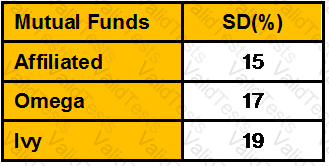
Calculate the expected return on each of these portfolios respectively.
Section A (1 Mark)
Incentive schemes, additional services and sentiments based scheme are called:
Section A (1 Mark)
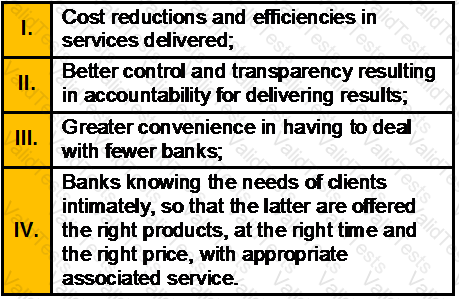
Which one of the above statements is/are not a important needs of clients in the context of relationship management:
Section A (1 Mark)
While matching orders for equity trading in NSE, which one of the following gets precedence over all the others?
Section C (4 Mark)
As a CWM you are required to calculate the tax liability of an individual whose Taxable income is:
• $ 142700 in US dollars and he is a US citizen (married Individual Filing Joint returns and Surviving Spouses)
• $ 67250 in SGD and he is a citizen of Singapore
Section C (4 Mark)
Mr. XYZ is bullish about ABC Ltd stock. He buys ABC Ltd. at current market price of Rs. 4000 on 4th July. To protect against fall in the price of ABC Ltd. (his risk), he buys an ABC Ltd. Put option with a strike price Rs. 3900 (OTM) at a premium of Rs. 143.80 expiring on 31st July.
What would be the Net Payoff of the Strategy?
• If ABC Ltd closes at 3458
• If ABC Ltd closes at 4352
Section B (2 Mark)
As a CWM you are considering the following bond for inclusion in the fixed income portfolio of your client:
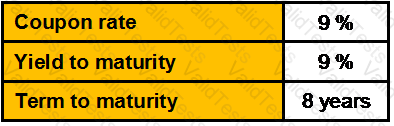
What will be the duration of this bond? and What will be the effect of the changes on the duration of the bond if the coupon rate is 6% rather than 9%?
Section B (2 Mark)
Which of the following is an assumption of two stage dividend discount model?
Section A (1 Mark)
Monetary policy is determined by
Section C (4 Mark)
An investor purchased on margin Alpha Computer for Rs. 30/- a share. The stock's price subsequently rose to Rs. 50/- a share at which time the investor sold the stock. If the margin requirement is 60 percent and the interest rate on borrowed funds was 7 percent, what would be the percentage earned on the investor's funds (excluding commissions)? What would have been the return if the investor had not bought the stock on margin?
Section A (1 Mark)
In a bull spread, the investor makes profits if market goes
Section A (1 Mark)
The APT is based on the:
Section B (2 Mark)
The lesson from the credit crisis of 2007-2009 is that securitized assets and credit swaps are:
Section A (1 Mark)
NSSO stands for ____________
Section C (4 Mark)
Suppose ABC Ltd. is trading at Rs 4500 in June. An investor, Mr. A, shorts Rs 4300 Put by selling a July Put for Rs. 24 while shorting an ABC Ltd. stock. The net credit received by Mr. A is Rs. 4500 + Rs. 24 = Rs. 4524.
What would be the Net Payoff of the Strategy?
• If ABC Ltd closes at 4053
• If ABC Ltd closes at 5025
Section A (1 Mark)
Pure premium and Loss Ratio methods are two methods to determine
Section C (4 Mark)
Suppose an investor Mr. A buys or is holding ABC Ltd. currently trading at Rs. 4758. He decides to establish a collar by writing a Call of strike price Rs. 5000 for Rs. 39 while simultaneously purchasing a Rs. 4700 strike price Put for Rs. 27. Since he pays Rs. 4758 for the stock ABC Ltd., another Rs. 27 for the Put but receives Rs. 39 for selling the Call option, his total investment is Rs. 4746.
What would be the Net Payoff of the Strategy?
• If ABC Ltd closes at 4851
• If ABC Ltd closes at 5267
Section A (1 Mark)
At the time of renewal of working capital limits by a bank, the loan officer observed that M/s ABC’s utilisation of funds on a long term basis is 80% of the long term sources during the year. Which among the following would be the result of this kind of financial management?
Section B (2 Mark)
Mr. Jain is projecting an income stream providing Rs. 2,000/- for first 3 months, Rs. 3,200 for next 2 months, Rs. 4,500 for next 1 month, Rs. 3,700 for next 6 months and Rs. 800 for 2 months thereafter. EACH CASH FLOW starts from the beginning of the month. Please calculate the Present Value of this cash stream if rate of interest is 9 % per annum compounded monthly?
Section B (2 Mark)
Mr Dixit is considering purchasing an office building for Rs. 2,500,000. He expects the potential gross income (PGI) in the first year to be Rs. 450,000; vacancy and collection losses to be 9 percent of PGI; and operating expenses to be 42 percent of effective gross income (EGI). What is the (effective) gross income multiplier?
Section A (1 Mark)
Which of the following is an element of an organization’s internal-environment?
Section B (2 Mark)
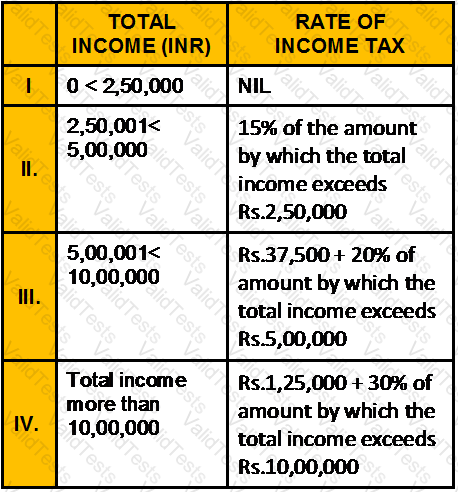
Which of the following statements is/are correct with respect for Resident Senior Citizen i.e. who is of an age of 60 years and above, but below 80 years?
Section B (2 Mark)
If a portfolio manager has a good ability to forecast overall market but a poor ability to select undervalued securities, the following strategy would suit best to him.
Section C (4 Mark)
KB, a household product manufacturer, reported earnings per share of Rs3.20 in 1993, and paid dividends per share of Rs1.70 in that year. The firm reported depreciation of Rs315 million in 1993, and capital expenditures of Rs475 million. (There were 160 million shares outstanding, trading at Rs51 per share.) This ratio of capital expenditures to depreciation is expected to be maintained in the long term. The working capital needs are negligible. KB had debt outstanding of Rs1.6 billion, and intends to maintain its current financing mix (of debt and equity) to finance future investment needs. The firm is in steady state and earnings are expected to grow 7% a year. The stock had a beta of 1.05. (The Risk Free Rate is 6.25%.)
Estimate the value per share, using the FCFE Model.
Section A (1 Mark)
After originally investing Rs10,000 and selling your investment for Rs 12,000, you reinvest the total amount and tell yourself that you will not be concerned if you lose Rs 2,000 in this new investment. You are likely demonstrating which type of judgment error?
Section B (2 Mark)
Resident but not ordinary resident (RNOR) is ____________ on Indian Income and ___________ on Foreign Income.
Section A (1 Mark)
A “Family Office” segment client has investible assets worth of
Section A (1 Mark)
Shyam invests in a plan in which he has to pay Rs. 10,000/- per year Starting from the end of 5th year till the end of 12th. How much amount Should he invest today in order to meet his objective. If the interest rate is 10%p.a.?
Section A (1 Mark)
____________ may be responsible for the prevalence of active versus passive investments management.
Section A (1 Mark)
A put option on a stock is said to be out of the money if
Section A (1 Mark)
Merton’s theory is ___________
Section A (1 Mark)
Which one of the following statements is/are true?
Section B (2 Mark)
Suppose that Chicken Express, Inc. has a ROA of 7% and pays a 6% coupon on its debt. Chicken Express has a capital structure that is 70% equity and 30% debt. Relative to a firm that is 100% equity-financed, Chicken Express’s Net Profit will be ________ and its ROE will be ________.
Section A (1 Mark)
A testator sometimes make two wills one relating to his property in his native country and other relating to his property in some foreign country this type of will is called
Section A (1 Mark)
A swap that involves the exchange of one set of interest payments for another set of interest payments is called a(n)
Section A (1 Mark)
A business angel is best described in which one of the following statements?
Section B (2 Mark)
Why do share prices usually drop when news about decline in a company’s earnings per share is reported?
Section A (1 Mark)
Debt investments in real estate, such as mortgages or deeds of trust, are called income property investments.


