Section A (1 Mark)
All of the following are assumptions made by technical analysts except:
Section A (1 Mark)
Commodity exchanges enable producers and consumer to hedge their _______ given the uncertainty of the future.
Section A (1 Mark)
Technical analysis differs from fundamental analysis because technical analysis:
Section C (4 Mark)
Read the senario and answer to the question.
Calculate the return on Jogen’s investments in SBI Ltd shares.
Section A (1 Mark)
A draft of a will prepared by the head of the family which will decide the nature in which his properties will be distrubuted among his heirs is known as_____________________.
Section C (4 Mark)
Suppose an investor Mr. Kishan Raj is holding ABC Ltd. currently trading at Rs. 4758. He decides to establish a collar by writing a Call of strike price Rs. 5000 for Rs. 39 while simultaneously purchasing a Rs. 4700 strike price Put for Rs. 27.
What would be the Net Payoff of the Strategy?
• If Nifty closes at 4948
• If Nifty closes at 4858
Section A (1 Mark)
Who would get the first preference when the property of a deceased person is to be distributed?
Section A (1 Mark)
A European put option can be exercised
Section B (2 Mark)
An analyst expects a firm’s earning per share to grow at 8% per year. If the firm now earns Rs. 3.50 a share, its earnings per share five years from now are expected to be:
Section A (1 Mark)
The investors who buy the debt of troubled companies including subordinated debt, junk bonds, bank loans, and obligations to suppliers are called__________
Section C (4 Mark)
You own 3 scripts with their market value at
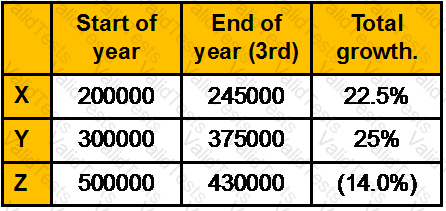
Calculate the CAGR of portfolio.
Section B (2 Mark)
A dealer sold one January Nifty futures contract for Rs.250,000 on 15th January. Each Nifty futures contract is for delivery of 50 Nifties. On 25th January, the index closed at 5100. How much profit/loss did he make ?
Section A (1 Mark)
Creation of an Estate Plan normally occurs during __________
Section A (1 Mark)
Manav saves Rs. 20,000/- a year for 5 years and Rs. 30,000/- a year for 10 years thereafter. What will be the total amount in his account after 15 years, if ROI is 10 % per annum?
Section C (4 Mark)
Read the senario and answer to the question.
Portfolio A had a return of 12% in the previous year, while the market had an average return of 10%. The standard deviation of the portfolio was calculated to be 20%, while the standard deviation of the market was 15% over the same time period. If the correlation between the portfolio and the market is 0.8, what is the Beta of the portfolio A?
Section C (4 Mark)
Pizer Drugs, a large drugstore chain, had sales per share of Rs122 in 1993, on which it reported earnings per share of Rs2.45 and paid a dividend per share of Rs1.12. The company is expected to grow 6% in the long term, and has a beta of 0.90. The current Risk Free Rate is 7%.
Estimate the appropriate Price for Pizer Drug and what would the profit margin need to be to justify the price per share if the stock is currently trading for Rs34 per share, assuming the growth rate is estimated correctly,
Section A (1 Mark)
The use of P/E ratios to select stocks suggests that
Section A (1 Mark)
Strategic asset allocation involves
Section A (1 Mark)
Adjusted gross income is used in establishing limits on the following deductions, with the exception of
Section B (2 Mark)
Mr. Gupta has got his stock insured against fire for Rs5,00,000/- ,during the year he lost the stock in his ware house for Rs. 4,00,000/-. The surveyor from insurance company gave his report that at the time of fire the stock in the ware house had value 6,00,000/-
Calculate what amount Mr. Gupta will receive from the insurance company.
Section C (4 Mark)
Read the senario and answer to the question.
What will be the taxable amount of Gratuity on his retirement?
Section C (4 Mark)
Azhar deposits Rs. 12,500 in an account that pays a ROI of 20% p.a compounded annually on 5th. Of March 2010. Calculate the date on which the balance in his account would be Rs.35,338/-
Section B (2 Mark)
When the income of an individual includes Rs. 20000 as the income of his minor child in terms of section 64(1A), taxable income in this respect will be:
Section C (4 Mark)
Read the senario and answer to the question.
Mahesh’s company has made plans for the next year. It is estimated that the company will employ total assets of Rs. 1000 lakh: 50% of the assets being financed by borrowed capital at an interest cost of 8% per year. The direct costs are estimated at Rs. 500 lakh. All other operating expenses are estimated at Rs. 76 lakh. The good will be sold to customer at 140% of the direct costs. Income tax rate is assumed to be 30%. Calculate net profit margin and return on owners’ equity.
Section A (1 Mark)
Which of the following could be classified as an emotional bias?
Section A (1 Mark)
_______________ is concerned with capturing, storing, extracting, integrating, processing, interpreting, distributing, using and reporting customer-related data to enhance both customer and company value.
Section B (2 Mark)
Withholding Tax Rates for payments made to Non-Residents are determined by the Finance Act passed by the Parliament for various years. The current rates for Interest are:
Section C (4 Mark)
Read the senario and answer to the question.
Calculate income from House property for Mr. Keshav for assessment year 2010-11.
Section A (1 Mark)
Aditya’s father has given him general power of attorney what does this mean?
Section C (4 Mark)
Read the senario and answer to the question.
If Mrs. Deepika, a conservative investor, has Rs. 50, lakhs today that she could invest for the next three months in a three month bank CD or in a stock .The bank CD offers a guaranteed return 6 % over the three-month period. Alternatively she thinks the price of the stock will rise by 5% over the next months. She is confused in taking the decision. Guide her in trade off between return and risk so that she makes a decision in choosing investments?
Section A (1 Mark)
Which of the following statement is not true?
Section B (2 Mark)
A taxpayer has taxable income for 2011-12 (after deducting the personal allowance) of £185,300. None of the income is derived from savings or dividends. The income tax liability for the year is:
Section C (4 Mark)

Sajan Mathews, aged 29 years (as on 2nd April, 2010), is working with a Multi National Company since December 2004. He has approached you, a CWM® for preparing his wealth plan. He is staying in his own house at Ahmedabad. His wife Jennifer, aged 31 years, is a fashion designer. She has earned a net profit of Rs. 4 lakh in FY 2008-09. They have a son, Mark of age 4 years (born on 12.02.2006), and a daughter, Stephanie (born on of 23.09.2009). Sajan is also supporting his parents staying in their own house at Surat to whom he sends Rs. 10,000 p.m. His monthly house hold expenses are Rs. 30000 p.m. (excludes his investments, payment of premia and EMIs). Sajan normally gets 5% increase in his gross salary year-on-year in the beginning of every financial year, apart from bonus. The effect for this year is yet to take place, though he has received a bonus of Rs. 3,31,680 for the year 2009-10. He has taken a family floater policy for health insurance involving an annual premium of Rs. 16268 and a total cover of Rs. 15 lakh.
Current Assets & Liabilities of the Family (As on 31st March, 2010 unless otherwise specified in foot notes)


____________
1.Purchased on 25th October, 2006, annual premium paid Rs. 14,798
2.Purchased on Mark’s 2nd birthday for a term of 15 years; annual premium Rs. 41,374
3.Subscribed on 01.09.2008 @ 10% p.a., with interest credited quarterly to his savings account; renewed at same rate for one year on 01.09.2009 without penal provision for premature withdrawal
4.Home loan of Rs. 17 lakh taken on 1st November, 2004 at a fixed interest of 7.5% p.a. for a 15 year term.
5.Car loan of Rs. 4.50 lakh taken on 1st April, 2008 at a fixed interest of 11.25% p.a. for a 4-year term.
Goals:
1.To provide for higher education of Mark and Stephanie. Initial expenses at their respective age of 18 years, Rs. 3 lakh (current cost), and subsequently Rs. 2 lakh p.a. for the next two years, and Rs. 3.5 lakh p.a. for the following 2 years.
2.Marriage expenses of Rs. 15 lakh (current cost) for each child at their respective age of 27 years.
3.Retirement corpus at the age of 58 years to sustain 70% of pre-retirement household expenses till his lifetime and 50% till stephanie’s expected life.
4.A Bigger house valued at Rs. 50 lakh today, a year from now.
5.To build a separate fund for vacation expenses of Rs. 2 lakh (at current cost) every year 10 years from now so that the corpus so built is self-sustaining till the marriage of Stephanie.
Assumptions:
Regarding long-term pre-tax returns on various asset classes:

Regarding economic factors:

Section B (2 Mark)
Portfolio A has expected return of 10% and standard deviation of 19%. Portfolio B has expected return of 12% and standard deviation of 17%. Rational investors will
Section B (2 Mark)
What is the correlation coefficient between the companies A and B, if their covariance is 23 and their standard deviation is 8 and 7 respectively?
Section B (2 Mark)
Which of the following Biases are exhibited by Independent Individualist?

Section A (1 Mark)
Decision horizon is __________
Section B (2 Mark)
Which of the following statement is/are correct?

Section A (1 Mark)
You buy a investment plan by investing Rs. 5000/- per month for first 12years what is the maximum amount you can withdraw from this account for 12 years every month if you want to have Rs. 500000 at the end of 24 years .The rate of interest is 15% per annum compounded monthly.
Section C (4 Mark)
Medicon is one the world's largest manufacturer of implantable biomedical devices, reported earnings per share in 1993 of Rs3.95, and paid dividends per share of Rs0.68. Its earnings are expected to grow 16% from 1994 to 1998, but the growth rate is expected to decline each year after that to a stable growth rate of 6% in 2003. The payout ratio is expected to remain unchanged from 1994 to 1998, after which it will increase each year to reach 60% in steady state. The stock is expected to have a beta of 1.25 from 1994 to 1998, after which the beta will decline each year to reach 1.00 by the time the firm becomes stable. (The Risk Free rate is 6.25%.)
Estimate the value per share, using the three-stage dividend discount model.
Section B (2 Mark)
Which of the following statement is/are correct?

Section A (1 Mark)
When two banks simply agree to exchange a portion of their customers' loan repayments, they are using:
Section A (1 Mark)
Garima deposits Rs. 2,000/- every month in an account and is getting interest @ 12 % per annum compounded monthly. How much will be her nest egg after 10 years ?
Section A (1 Mark)
You buy a investment plan by investing Rs. 5000/- per month for first 12years and Rs. 10000/- per month for next 12 years. If the rate of interest is 15% per annum compounded monthly . How much amount would you have after 24 years?
Section C (4 Mark)
Mr. Chopra runs a Garment Factory, he is very concerned about his retirement and wants you to help him out in planning for it. His Current annual expenses are Rs. 12,00,000 which would be rising at an annual rate of 8% pre- retirement and 2% post retirement. His current age is 50 years and he wants to work till the age of 65. The expected life expectancy in his family is 75 years. Calculate the monthly contribution he must make till his retirement if the pre- retirement returns are 12% p.a. compounded monthly and post-retirement returns are 8% p.a compounded annually.
Section A (1 Mark)
An appealing feature of options on futures contracts is that:
Section B (2 Mark)
Which of the following statements is/are correct?
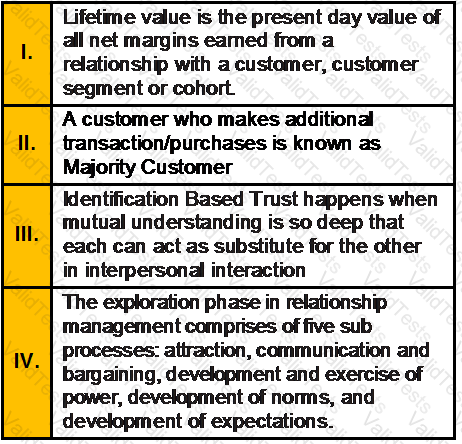
Section A (1 Mark)
During “Building the foundation” life stage, we learn about _______
Section B (2 Mark)
A typical personal accident policy would normally have provisions to pay
Section A (1 Mark)
General Insurance business was established in India in


