The essays in this collection, which explore the adaptation of literary texts to film, all (i)_________the view that the fidelity of film adaptations to their literary precursors is (ii)_________. In fact, the authors of these essays broadly concur that an emphasis on fidelity in film adaptations can be traced to an outmoded academic ideology that insistently prizes the literary in a way that (iii)_________the value of the cinematic.
The relevance of the literary personality—a writer's distinctive attitudes, concerns, and artistic choices—to the analysis of a literary work is being scrutinized by various schools of contemporary criticism. Deconstmctionists view the literary personality, like the writer's biographical personality, as irrelevant. The proper focus of literary analysis, they argue, is a work's intertextuality (interrelationship with other texts), subtexts (unspoken, concealed. or repressed discourses), and metatexts (self-referential aspects), not a perception of a writer's verbal and aesthetic "fingerprints." New historicists also devalue the literary personality, since, in their emphasis on a work's historical context, they credit a writer with only those insights and ideas that were generally available when the writer lived. However, to readers interested in literary detective work—say scholars of classical (Greek and Roman! literature who wish to reconstruct damaged texts or deduce a work's authorship— the literary personality sometimes provides vital clues.
It can be inferred from the passage that on the issue of how to analyze a literary work, the new historic its would most likely agree with the deconstructionists that
Exhibit.
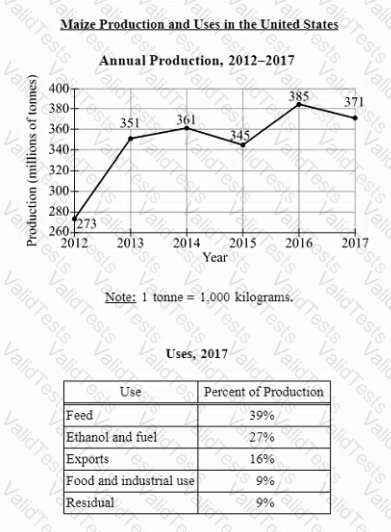
For the years shown, the greatest annual maize production was what percent greater than the median annual maize production?
Give your answer to the nearest whole percent.
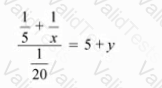
If x and v in the equation shown are numbers that satisfy y < 0 and |x| = |y|, which of the following must be the value of x ?
The list price of a certain snowblower is S600.0O. At Store At the sale price of the snowblower is 10 percent less than its list price, and there is no sales tax. At Store y the sale price of the snowblower is 15 percent less than its list price, plus there is a sales tax of 5 percent of the sale price. If the cost of the snowblower is equal to its sale price plus any applicable sales tax. how much greater is the cost of the snowblower at Store X than at Store Y ?
In the late eighteenth and early nineteenth centuries, during the period of the American Revolution and the early republic, political poems appeared regularly in newspapers and pamphlets. commenting on the issues and controversies engaging the new nation. Given the sheer number of poems that engaged explicitly with politics, one might wonder why the form has remained largely ignored by scholars of early American literature even as many other once obscure forms—sentimental novels, diaries, travelogues, belles letters—have enjoyed unprecedented scholarly interest in recent decades. Part of the reason may stem from frustrations involved with reading poems that are so highly topical—often requiring, even as a condition of first-level comprehension, a familiarity with names and references that, while wholly recognizable in their own time, are obscure to modem readers. Yet beyond this is the fact that American political verse from the eighteenth and early nineteenth centuries has never fully shaken off the verdict, delivered by its earliest generation of scholarly readers. that it is simply unworthy of serious attention as literature. Even the term commonly used to describe it—"verse." as opposed to "poetry"— suggests an occasional or forgettable, rather than enduring, form of expression, not quite deserving the designation of poetry. Nor was such verse considered by early critics as worthy of the designation "American." as the tendency of eighteenth-century American poets to model their works on those of British precursors suggested an unforgivable failure, as one critic described it. to declare their "literary independence" from Britain.
The passage suggests which of the following about the "earliest generation**?
When Flemish painter Anthony Van Dyck moved to England in 1632 to become court painter to Charles The introduced an entirely new way of representing dress in portraiture. In women's portraits. he left off fashionable accessories, depicted subjects in unbuttoned sleeves and collars, and added lavish drapery and jewels. For the first time an artist actively participated in dressing his subjects, creating an amalgam of fantasy and reality. While Van Dyck was most innovative when representing women, he used similar elements in portraits of men.
Van Dyck's Portrait of Thomas Killigrew and Willian. Lord Crofts (1638) demonstrates how the artist relaxed and unbuttoned men's dress to accord with an underlying theme. The double portrait may be seen as an essay in grief: Killigrew. a poet and playwright, had lost his wife Cecelia to the plague shortly before the sitting, and Crofts was her nephew. The painting contains clear references to the situation at hand. The background features a broken column, a traditional emblem of earthly transience. A drawing in Killigrew's right hand depicts two Itinerary monuments. Crofts holds a blank sheet of paper, seen by some scholars as an analog to the drawing Killigrew holds: a symbol of what is gone.
At historians have interpreted the clothing depicted in this portrait, particularly Crofts' doublet which is worn unbuttoned in back, as an allusion to the subjects' grief-stricken distraction. It is true that Killigrew's dress includes references to his loss—he wears a cross inscribed with his wife's initials. There is an intimate nature to this painting, which seems underscored by the loose clothing worn by both subjects. However, diis reading of the costumes as signs of grief does not take account of seventeenth-century fashion conventions. Only Killigrew appears in noticeably disheveled attire;
Crofts" dress would be quite appropriate for a formal portrait. Though black clothing, such as that won by Crofil, was common for mourning, it was also ordinary on other occasions. Furthermore, during the first stage of mounting no shiny surfaces, such as Crofts' satin doublet, would be permitted. The unbuttoned slit on Crofts" doublet was probably a matter of style: a French courtier in a 1635 fashion print by Bosse. who is gallivanting rather than grieving, wears a similarly undone doublet. Evidence suggests that by the late 1630s a certain calculated looseness was conventional in men's formal dress. Ribeiro. for example, cites the writings of moralists objecting to this style.
Killigrew's attire, though even looser than Crofts", should not necessarily be associated with grief. Other seventeenth-century subjects depicted in melancholic states do not dress this way. Although Killigrew's "undress" lends this portrait a distinctive intimacy, it might also refer to Killigrew's literary career. Many of Van Dyck's other subjects who engaged in literary pursuits are depicted in loose clothing. The blank sheet held by Crofts may be a reminder not only of Killigrew's loss but also of his solace: he had but to express his grief in writing.
Which of the following best describes (he function of the last sentence of the passage?
A divide between aesthetic and technical considerations has played a crucial role in mapmakiug and cartographic scholarship. Some nineteenth-century cartographers, for instance, understood themselves as technicians who did not care about visual effects, while others saw themselves as landscape painters. That dichotomy structured the discipline of the history of cartography. Until the 1980s, in what Blakemore and Harley called "the 'Old is Beautiful' paradigm." scholars largely focused on maps made before 1800. marveling at their beauty and sometimes regretting the decline of the pre-technical age. Early mapmaking was considered art while modem cartography was located within the realm of engineering utility. Alpers. however, has argued that this boundary would have puzzled mapmakers in the seventeenth century, because they considered themselves to be visual engineers.
It can be inferred from the passage that, beginning in the 1980s. historians of cartography
Birds that prey on sage grouse generally hunt by circling over sagebrush and pouncing on sage grouse that come out into the open. Where there are power lines, however, these predators often survey the ground while sitting on the power lines. Although the area they can survey is smaller, predators sitting on power lines are more likely to catch sage grouse than are predators circling in the air. because_________,
The primary purpose of the passage is to
The current_________of repackaged music under Miles Davis* name might prompt any reasonable person to conclude that the recording vault has been plundered bare.


