Pre-Summer Special Limited Time 70% Discount Offer - Ends in 0d 00h 00m 00s - Coupon code: validbest

Pass the Amazon Web Services AWS Certified Associate DVA-C02 Questions and answers with ValidTests

Exam DVA-C02 All Questions
Exam DVA-C02 Premium Access

View all detail and faqs for the DVA-C02 exam

Viewing page 10 out of 12 pages
Viewing questions 136-150 out of questions
Questions # 136:

A developer is modifying an AWS Lambda function that accesses an Amazon RDS for MySQL database. The developer discovers that the Lambda function has the database credentials stored as plaintext in the Lambda function code.

The developer must implement a solution to make the credentials more secure. The solution must include automated credential rotation every 30 days.

Which solution will meet these requirements?

Options:

A.

Move the credentials to a secret in AWS Secrets Manager. Modify the Lambda function to read from Secrets Manager. Set a schedule to rotate the secret every 30 days.

B.

Move the credentials to a secure string parameter in AWS Systems Manager Parameter Store. Modify the Lambda function to read from Parameter Store. Set a schedule to rotate the parameter every 30 days.

C.

Move the credentials to an encrypted Amazon S3 bucket. Modify the Lambda function to read from the S3 bucket. Configure S3 Object Lambda to rotate the credentials every 30 days.

D.

Move the credentials to a secure string parameter in AWS Systems Manager Parameter Store. Create an Amazon EventBridge rule to rotate the parameter every 30 days.

Questions # 137:

A developer creates a static website for their department The developer deploys the static assets for the website to an Amazon S3 bucket and serves the assets with Amazon CloudFront The developer uses origin access control (OAC) on the CloudFront distribution to access the S3 bucket

The developer notices users can access the root URL and specific pages but cannot access directories without specifying a file name. For example, /products/index.html works, but /products returns an error The developer needs to enable accessing directories without specifying a file name without exposing the S3 bucket publicly.

Which solution will meet these requirements'?

Options:

A.

Update the CloudFront distribution's settings to index.html as the default root object is set

B.

Update the Amazon S3 bucket settings and enable static website hosting. Specify index html as the Index document Update the S3 bucket policy to enable access. Update the CloudFront distribution's origin to use the S3 website endpoint

C.

Create a CloudFront function that examines the request URL and appends index.html when directories are being accessed Add the function as a viewer request CloudFront function to the CloudFront distribution's behavior.

D.

Create a custom error response on the CloudFront distribution with the HTTP error code set to the HTTP 404 Not Found response code and the response page path to /index html Set the HTTP response code to the HTTP 200 OK response code

Questions # 138:

A developer is creating an AWS CloudFormation template to deploy Amazon EC2 instances across multiple AWS accounts. The developer must choose the EC2 instances from a list of approved instance types.

How can the developer incorporate the list of approved instance types in the CloudFormation template?

Options:

A.

Create a separate CloudFormation template for each EC2 instance type in the list.

B.

In the Resources section of the CloudFormation template, create resources for each EC2 instance type in the list.

C.

In the CloudFormation template, create a separate parameter for each EC2 instance type in the list.

D.

In the CloudFormation template, create a parameter with the list of EC2 instance types as AllowedValues.

Questions # 139:

A developer has an application that makes batch requests directly to Amazon DynamoDB by using the BatchGetItem low-level API operation. The responses frequently return values in the UnprocessedKeys element.

Which actions should the developer take to increase the resiliency of the application when the batch response includes values in UnprocessedKeys? (Choose two.)

Options:

A.

Retry the batch operation immediately.

B.

Retry the batch operation with exponential backoff and randomized delay.

C.

Update the application to use an AWS software development kit (AWS SDK) to make the requests.

D.

Increase the provisioned read capacity of the DynamoDB tables that the operation accesses.

E.

Increase the provisioned write capacity of the DynamoDB tables that the operation accesses.

Questions # 140:

A company uses AWS X-Ray to monitor a serverless application. The components of the application have different request rates. The user interactions and transactions are important to trace, but they are low in volume. The background processes such as application health checks, polling, and connection maintenance generate high volumes of read-only requests.

Currently, the default X-Ray sampling rules are universal for all requests. Only the first request per second and some additional requests are recorded. This setup is not helping the company review the requests based on service or request type.

A developer must configure rules to trace requests based on service or request properties. The developer must trace the user interactions and transactions without wasting effort recording minor background tasks.

Which solution will meet these requirements?

Options:

A.

Disable sampling for high-volume read-only requests. Sample at a lower rate for all requests that handle user interactions or transactions.

B.

Disable sampling and trace all requests for requests that handle user interactions or transactions. Sample high-volume read-only requests at a higher rate.

C.

Disable sampling and trace all requests for requests that handle user interactions or transactions. Sample high-volume read-only requests at a lower rate.

D.

Disable sampling for high-volume read-only requests. Sample at a higher rate for all requests that handle user interactions or transactions.

Questions # 141:

A company stores its data in data tables in a series of Amazon S3 buckets. The company received an alert that customer credit card information might have been exposed in a data table on one of the company's public applications. A developer needs to identify all potential exposures within the application environment.

Which solution will meet these requirements?

Options:

A.

Use Amazon Athena to run a job on the S3 buckets that contain the affected data. Filter the findings by using the SensitiveData:S30bject/Personal finding type.

B.

Use Amazon Made to run a job on the S3 buckets that contain the affected data. Filter the findings by using the SensitiveData:S30bject/Financial finding type.

C.

Use Amazon Made to run a job on the S3 buckets that contain the affected data. Filter the findings by using the SensitiveData:S30bject/Personal finding type.

D.

Use Amazon Athena to run a job on the S3 buckets that contain the affected data. Filter the findings by using the SensitiveData:S30bject/Financial finding type.

Questions # 142:

A company's developer has deployed an application in AWS by using AWS CloudFormation The CloudFormation stack includes parameters in AWS Systems Manager Parameter Store that the application uses as configuration settings. The application can modify the parameter values

When the developer updated the stack to create additional resources with tags, the developer noted that the parameter values were reset and that the values ignored the latest changes made by the application. The developer needs to change the way the company deploys the CloudFormation stack. The developer also needs to avoid resetting the parameter values outside the stack.

Which solution will meet these requirements with the LEAST development effort?

Options:

A.

Modify the CloudFormation stack to set the deletion policy to Retain for the Parameter Store parameters.

B.

Create an Amazon DynamoDB table as a resource in the CloudFormation stack to hold configuration data for the application Migrate the parameters that the application is modifying from Parameter Store to the DynamoDB table

C.

Create an Amazon RDS DB instance as a resource in the CloudFormation stack. Create a table in the database for parameter configuration. Migrate the parameters that the application is modifying from Parameter Store to the configuration table

D.

Modify the CloudFormation stack policy to deny updates on Parameter Store parameters

Questions # 143:

A developer is planning to migrate on-premises company data to Amazon S3. The data must be encrypted, and the encryption Keys must support automate annual rotation. The company must use AWS Key Management Service (AWS KMS) to encrypt the data.

When type of keys should the developer use to meet these requirements?

Options:

A.

Amazon S3 managed keys

B.

Symmetric customer managed keys with key material that is generated by AWS

C.

Asymmetric customer managed keys with key material that generated by AWS

D.

Symmetric customer managed keys with imported key material

Questions # 144:

A company recently deployed an AWS Lambda function. A developer notices an increase in the function throttle metrics in Amazon CloudWatch.

What are the MOST operationally efficient solutions to reduce the function throttling? (Select TWO.)

Options:

A.

Migrate the function to Amazon EKS.

B.

Increase the maximum age of events in Lambda.

C.

Increase the function’s reserved concurrency.

D.

Add the lambda:GetFunctionConcurrency action to the execution role.

E.

Request a service quota change for increased concurrency.

Questions # 145:

A company needs to distribute firmware updates to its customers around the world.

Which service will allow easy and secure control of the access to the downloads at the lowest cost?

Options:

A.

Use Amazon CloudFront with signed URLs for Amazon S3.

B.

Create a dedicated Amazon CloudFront Distribution for each customer.

C.

Use Amazon CloudFront with AWS Lambda@Edge.

D.

Use Amazon API Gateway and AWS Lambda to control access to an S3 bucket.

Questions # 146:

A developer is optimizing an AWS Lambda function and wants to test the changes in production on a small percentage of all traffic. The Lambda function serves requests to a REST API in Amazon API Gateway. The developer needs to deploy their changes and perform a test in production without changing the API Gateway URL.

Which solution will meet these requirements?

Options:

A.

Define a function version for the currently deployed production Lambda function. Update the API Gateway endpoint to reference the new Lambda function version. Upload and publish the optimized Lambda function code. On the production API Gateway stage, define a canary release and set the percentage of traffic to direct to the canary release. Update the API Gateway endpoint to use the $LATEST version of the Lambda function. Publish the API to

B.

Define a function version for the currently deployed production Lambda function. Update the API Gateway endpoint to reference the new Lambda function version. Upload and publish the optimized Lambda function code. Update the API Gateway endpoint to use the $LATEST version of the Lambda function. Deploy a new API Gateway stage.

C.

Define an alias on the $LATEST version of the Lambda function. Update the API Gateway endpoint to reference the new Lambda function alias. Upload and publish the optimized Lambda function code. On the production API Gateway stage, define a canary release and set the percentage of traffic to direct to the canary release. Update the API Gateway endpoint to use the SLAT EST version of the Lambda function. Publish to the canary stage.

D.

Define a function version for the currently deployed production Lambda function. Update the API Gateway endpoint to reference the new Lambda function version. Upload and publish the optimized Lambda function code. Update the API Gateway endpoint to use the $LATEST version of the Lambda function. Deploy the API to the production API Gateway stage.

Questions # 147:

A company wants to share information with a third party. The third party has an HTTP API endpoint that the company can use to share the information. The company has the required API key to access the HTTP API.

The company needs a way to manage the API key by using code. The integration of the API key with the application code cannot affect application performance.

Which solution will meet these requirements MOST securely?

Options:

A.

Store the API credentials in AWS Secrets Manager. Retrieve the API credentials at runtime by using the AWS SDK. Use the credentials to make the API call.

B.

Store the API credentials in a local code variable. Push the code to a secure Git repository. Use the local code variable at runtime to make the API call.

C.

Store the API credentials as an object in a private Amazon S3 bucket. Restrict access to the S3 object by using IAM policies. Retrieve the API credentials at runtime by using the AWS SDK. Use the credentials to make the API call.

D.

Store the API credentials in an Amazon DynamoDB table. Restrict access to the table by using resource-based policies. Retrieve the API credentials at runtime by using the AWS SDK. Use the credentials to make the API call.

Questions # 148:

A developer has written the following IAM policy to provide access to an Amazon S3 bucket:
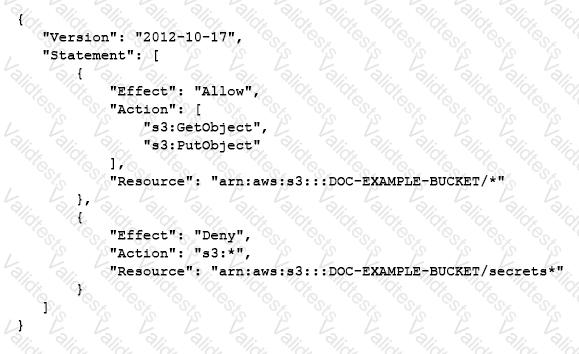
Question # 148

Which access does the policy allow regarding the s3:GetObject and s3:PutObject actions?

Options:

A.

Access on all buckets except the “DOC-EXAMPLE-BUCKET” bucket

B.

Access on all buckets that start with “DOC-EXAMPLE-BUCKET” except the “DOC-EXAMPLE-BUCKET/secrets” bucket

C.

Access on all objects in the “DOC-EXAMPLE-BUCKET” bucket along with access to all S3 actions for objects in the “DOC-EXAMPLE-BUCKET” bucket that start with “secrets”

D.

Access on all objects in the “DOC-EXAMPLE-BUCKET” bucket except on objects that start with “secrets”

Questions # 149:

A company is implementing an application on Amazon EC2 instances. The application needs to process incoming transactions. When the application detects a transaction that is not valid, the application must send a chat message to the company's support team. To send the message, the application needs to retrieve the access token to authenticate by using the chat API.

A developer needs to implement a solution to store the access token. The access token must be encrypted at rest and in transit. The access token must also be accessible from other AWS accounts.

Which solution will meet these requirements with the LEAST management overhead?

Options:

A.

Use an AWS Systems Manager Parameter Store SecureString parameter that uses an AWS Key Management Service (AWS KMS) AWS managed key to store the access token. Add a resource-based policy to the parameter to allow access from other accounts. Update the IAM role of the EC2 instances with permissions to access Parameter Store. Retrieve the token from Parameter Store with the decrypt flag enabled. Use the decrypted access token to send the mess

B.

Encrypt the access token by using an AWS Key Management Service (AWS KMS) customer managed key. Store the access token in an Amazon DynamoDB table. Update the IAM role of the EC2 instances with permissions to access DynamoDB and AWS KMS. Retrieve the token from DynamoDB. Decrypt the token by using AWS KMS on the EC2 instances. Use the decrypted access token to send the message to the chat.

C.

Use AWS Secrets Manager with an AWS Key Management Service (AWS KMS) customer managed key to store the access token. Add a resource-based policy to the secret to allow access from other accounts. Update the IAM role of the EC2 instances with permissions to access Secrets Manager. Retrieve the token from Secrets Manager. Use the decrypted access token to send the message to the chat.

D.

Encrypt the access token by using an AWS Key Management Service (AWS KMS) AWS managed key. Store the access token in an Amazon S3 bucket. Add a bucket policy to the S3 bucket to allow access from other accounts. Update the IAM role of the EC2 instances with permissions to access Amazon S3 and AWS KMS. Retrieve the token from the S3 bucket. Decrypt the token by using AWS KMS on the EC2 instances. Use the decrypted access token to send the ma

Questions # 150:

A developer has been asked to create an AWS Lambda function that is invoked any time updates are made to items in an Amazon DynamoDB table. The function has been created and appropriate permissions have been added to the Lambda execution role Amazon DynamoDB streams have been enabled for the table, but the function 15 still not being invoked.

Which option would enable DynamoDB table updates to invoke the Lambda function?

Options:

A.

Change the StreamViewType parameter value to NEW_AND_OLOJMAGES for the DynamoDB table.

B.

Configure event source mapping for the Lambda function.

C.

Map an Amazon Simple Notification Service (Amazon SNS) topic to the DynamoDB streams.

D.

Increase the maximum runtime (timeout) setting of the Lambda function.

Viewing page 10 out of 12 pages
Viewing questions 136-150 out of questions