A company has an existing web application that runs on two Amazon EC2 instances behind an Application Load Balancer (ALB) across two Availability Zones. The application uses an Amazon RDS Multi-AZ DB Instance. Amazon Route 53 record sets route requests for dynamic content to the load balancer and requests for static content to an Amazon S3 bucket. Site visitors are reporting extremely long loading times.
Which actions should be taken to improve the performance of the website? (Choose two.)
A company has attached the following policy to an IAM user.
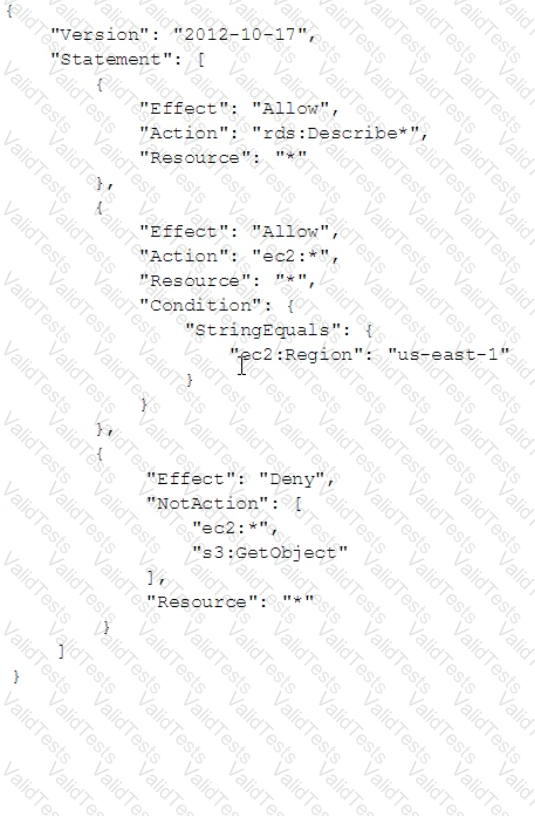
What of the following actions are allowed for the IAM user?
A SysOps Administrator is deploying a test site running on Amazon EC2 instances. The application requires both incoming and outgoing connectivity to the Internet.
Which combination of steps are required to provide internet connectivity to the EC2 instances? (Choose two.)
Based on the AWS Shared Responsibility Model, which of the following actions are the responsibility of the customer for an Aurora database?
An Applications team has successfully deployed an AWS CloudFormation stack consisting of 30 t2-medium Amazon EC2 instances in the us-west-2 Region. When using the same template to launch a stack in us-east-2, the launch failed and rolled back after launching only 10 EC2 instances.
What is a possible cause of this failure?
A sysops administrator is implementing SSL for a domain of an internet facing application running behind an Application load balancer (ALB). The administrator decides to use an SSL certificates from Amazon certificate Manager (ACM) to secure it. Upon creating a request for the ALB fully qualified domain name (FQND), it fails, and the error message “Domain not allowed” is displayed.
How can the administrator fix this issue?
A SysOps Administrator is configuring AWS SSO tor the first time. The Administrator has already created a directory in the master account using AWS Directory Service and enabled full access in AWS Organizations
What should the Administrator do next to configure the service?
A SysOps Administrator must ensure all Amazon EBS volumes currently in use, and those created in the future, are encrypted with a specific AWS KMS customer master key (CMK).
What is the MOST efficient way for the Administrator to meet this requirement?
A SysOps Administrator is managing a web application that runs on Amazon EC2 instances behind an ELB Application Load Balancer (ALB). The instances run in an EC2 Auto Scaling group. The administrator wants to set an alarm for when all target instances associated with the ALB are unhealthy.
Which condition should be used with the alarm?
A company wants to identify specific Amazon EC2 instances that ate underutilized and the estimated cost savings for each instance How can this be done with MINIMAL effort?


