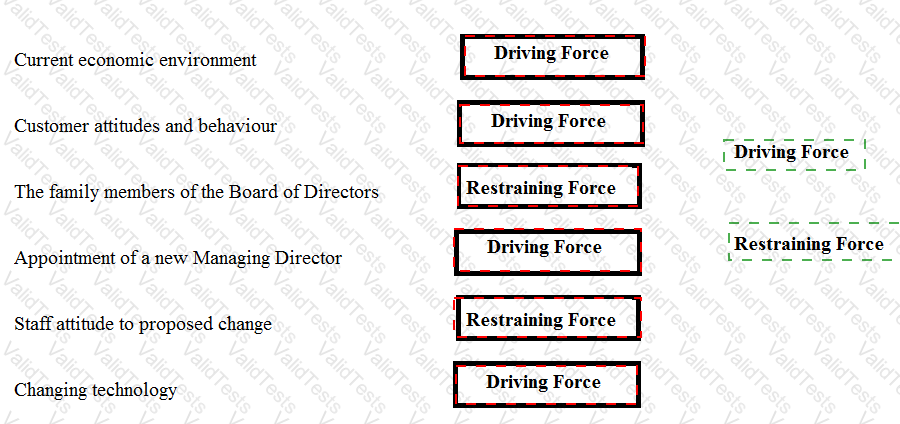
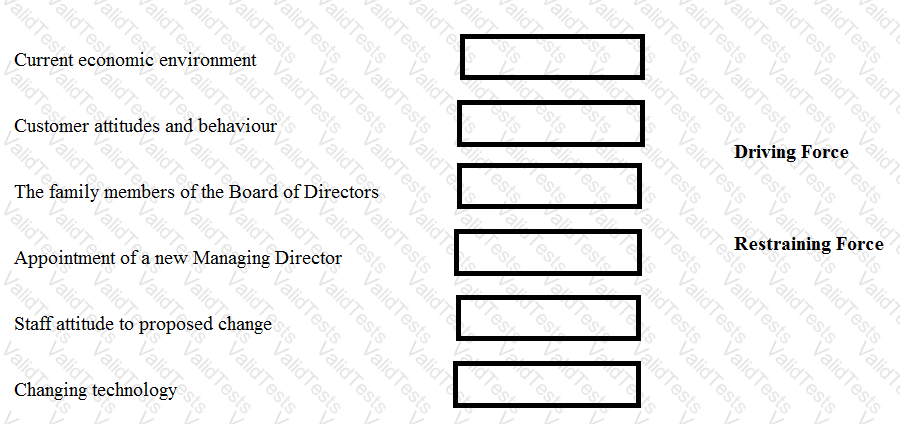
QQQ is a family run business which manufactures and sells chocolate. QQQ employs 80 staff in its factory and shops. It operates 10 shops within a number of small towns in the northern region of Country P. In the last four years, demand for QQQ's products has decreased, as customers in its local region are increasingly shopping in large supermarkets and out of town facilities, which are more convenient and tend to offer cheaper priced goods. The recent economic recession has hit the region hard and many local people have moved away to find work in other regions of the country. The internet has also impacted upon its business, as many customers are now making purchases of chocolate via the internet.
The Managing Director (MD) of QQQ has recently retired and the Board took the decision to make an external appointment to replace him. The new MD believes that QQQ needs to invest in new technology within its factory. This would reduce staffing levels by 15% and would reduce wastage and costs, allowing QQQ to offer more competitively priced products. He also believes that QQQ must invest in its own website. However QQQ's staff are very unhappy with these proposals. Some of the family members of the Board are concerned that this change will destroy the family tradition and reputation of QQQ that has been built up over many years.
Select the correct descriptor for each of the forces for change below.
JJJ is a publically quoted advertising agency. JJJ’s competitive advantage is based on the expertise of its staff and its reputation in digital media advertising. JJJ has robust systems to protect its intellectual property. These include patents and copyrights. JJJ has also restricted access for most of its staff to its most sensitive data, such as studies of its customers' profitability.
JJJ's new Managing Director, Z, is concerned that when staff leave JJJ, the company loses whatever tacit knowledge they possess. These losses also impact on JJJ's reported profits. In order to remedy the losses of knowledge and the reduced profits Z wants to introduce a knowledge management strategy.
Which of the following steps support the introduction of a knowledge management strategy? (Choose all that apply.)
As a qualified Management Accountant you have been asked by a non-financial manager to explain the CEO's recent comments, featured in the CEO's regular update to investors and analysts.
The CEO's update suggested the company, an established property development business, was about to pursue an exciting strategy. The strategy is to focus on conglomerate diversification, to be achieved through a number of pre-identified acquisitions, with the aim of significantly increasing shareholder value.
Which of the following statements is consistent with the concept of conglomerate diversification?
Which TWO of the following are advantages to an organization of using non-financial performance measures, rather than financial performance measures? (Choose two.)
Your management team is considering using Porter's Value Chain to assist it in developing a new competitive strategy for the business.
Which THREE of the following statements would inform your management team about Porter's Value Chain?
A fresh-food packaging manufacturer has recently changed the design of its packaging in order to reduce the amount of non-recyclable material. Its immediate customer, a large fresh-food wholesaler, does not see the need for this re-design as it believes that it will adversely affect the storage of the fresh food. However, the final customer, a large supermaket chain, has expressed strong interest in the new packaging design, as the supermarket chain has strict Corporate Social Responsibility targets to achieve.
Which of the following statements most appropriately describes the situation outlined above, from the perspective of the fresh-food packaging manufacturer?
LMN sells fashion clothing at competitive prices through its own retail stores. The clothes are manufactured for LMN by contractors in other countries.
In the past 4 years LMN has progressively lost market share to rival shops and online stores. This has been the consequence of poor designs, poor quality, and poor customer service.
In the past 3 years LMN tried to respond to this declining market share in several ways:
• Used e-sourcing to increase the number of suppliers LMN uses in order to obtain a larger choice of designs.
• Used e-procurement to buy in greater quantities to reduce cost per item.
• Warned each supplier that LMN will use a different supplier unless prices are reduced and better designs provided.
• Closed its own design studio to save costs, relying instead on its suppliers for designs.
• Reallocated budgets away from funding for customer research towards increased advertising.
• Avoided costs of product returns by making it difficult for customers to return items for a refund.
• Cancelled investment in a Customer Relationship Management system (CRM) to use the funds to finance its rising inventories.
You have been asked to suggest ways to improve the supply chain of LMN. This requires you to make a presentation to the Board of LMN.
Which THREE of the following techniques would improve the supply chain of LMN?
The future can be viewed as consisting of a large number of alternatives. Forecasting techniques have been designed to assist decision-making and planning.
Which TWO of the following statements are correct regarding the use of trend analysis as a forecasting tool?
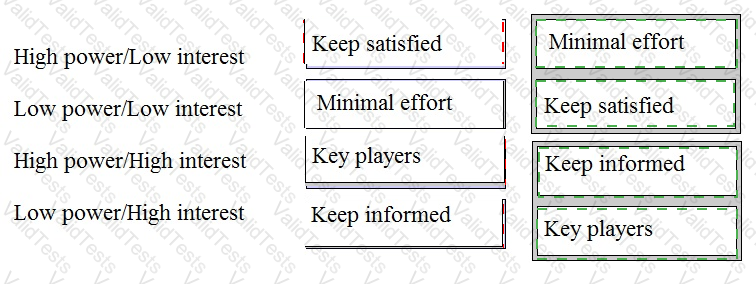
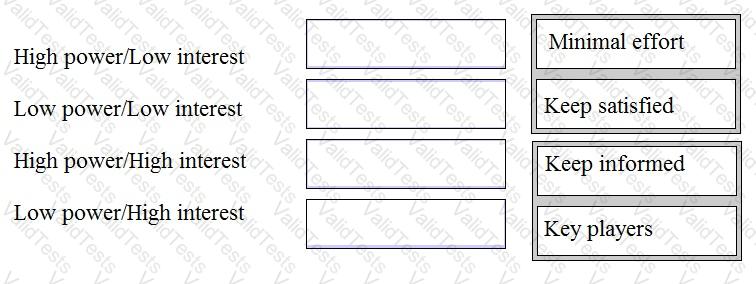
Mendelow developed a matrix in which he characterised stakeholders by reference to their degree of power and level of interest.
Place the correct category against each of the classes of stakeholders.
Which of the following correctly defines Information Systems (IS) strategy?