Summer Certification Special Limited Time 70% Discount Offer - Ends in 0d 00h 00m 00s - Coupon code: validbest

Pass the Cisco CyberOps Associate 200-201 Questions and answers with ValidTests

Exam 200-201 All Questions
Exam 200-201 Premium Access

View all detail and faqs for the 200-201 exam

Viewing page 15 out of 15 pages
Viewing questions 141-150 out of questions
Questions # 141:

How does an attack surface differ from an attack vector?

Options:

A.

An attack vector recognizes the potential outcomes of an attack, and the attack surface is choosing a method of an attack.

B.

An attack surface identifies vulnerable parts for an attack, and an attack vector specifies which attacks are feasible to those parts.

C.

An attack surface mitigates external vulnerabilities, and an attack vector identifies mitigation techniques and possible workarounds.

D.

An attack vector matches components that can be exploited, and an attack surface classifies the potential path for exploitation

Questions # 142:

What is a ransomware attack?

Options:

A.

It is a component of a malware attack used to establish a remote covert channel.

B.

It is malicious software that steals confidential data.

C.

It encrypts a victim’s data and prevents access to it.

D.

The volume of data exceeds storage capacity.

Questions # 143:

Which list identifies the information that the client sends to the server in the negotiation phase of the TLS handshake?

Options:

A.

ClientStart, ClientKeyExchange, cipher-suites it supports, and suggested compression methods

B.

ClientStart, TLS versions it supports, cipher-suites it supports, and suggested compression methods

C.

ClientHello, TLS versions it supports, cipher-suites it supports, and suggested compression methods

D.

ClientHello, ClientKeyExchange, cipher-suites it supports, and suggested compression methods

Questions # 144:

What is session data used for in network security?

Options:

A.

It is the transaction log between monitoring software.

B.

It contains the set of parameters used for fetching logs.

C.

It is the summary of the transmission between two network devices.

D.

It tracks cookies within each session initiated from a user.

Questions # 145:

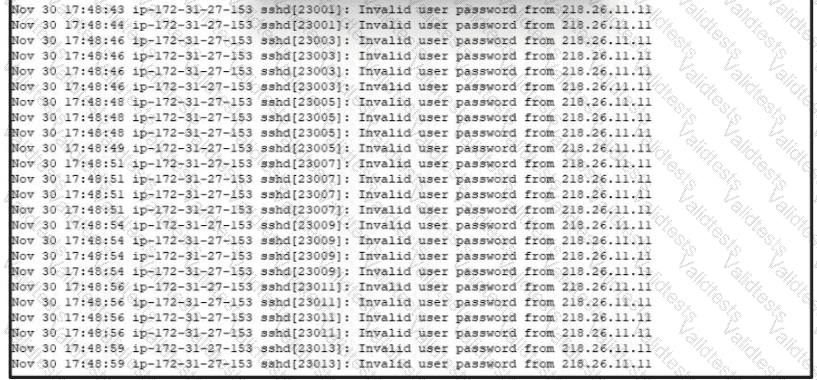
Refer to the exhibit.

Question # 145

A security analyst is investigating unusual activity from an unknown IP address Which type of evidence is this file1?

Options:

A.

indirect evidence

B.

best evidence

C.

corroborative evidence

D.

direct evidence

Questions # 146:

When communicating via TLS, the client initiates the handshake to the server and the server responds back with its certificate for identification.

Which information is available on the server certificate?

Options:

A.

server name, trusted subordinate CA, and private key

B.

trusted subordinate CA, public key, and cipher suites

C.

trusted CA name, cipher suites, and private key

D.

server name, trusted CA, and public key

Questions # 147:

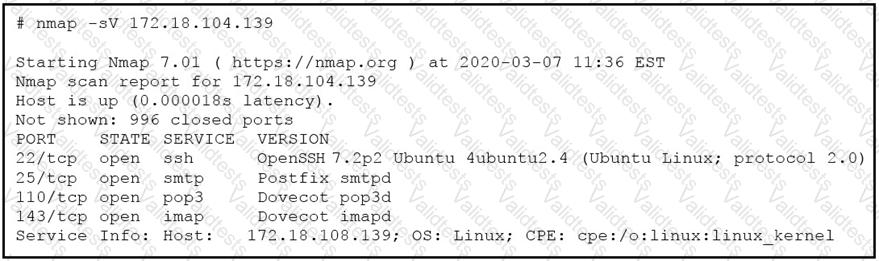
Refer to the exhibit.

Question # 147

What does the output indicate about the server with the IP address 172.18.104.139?

Options:

A.

open ports of a web server

B.

open port of an FTP server

C.

open ports of an email server

D.

running processes of the server

Questions # 148:

What is the difference between a threat and an exploit?

Options:

A.

A threat is a result of utilizing flow in a system, and an exploit is a result of gaining control over the system.

B.

A threat is a potential attack on an asset and an exploit takes advantage of the vulnerability of the asset

C.

An exploit is an attack vector, and a threat is a potential path the attack must go through.

D.

An exploit is an attack path, and a threat represents a potential vulnerability

Questions # 149:

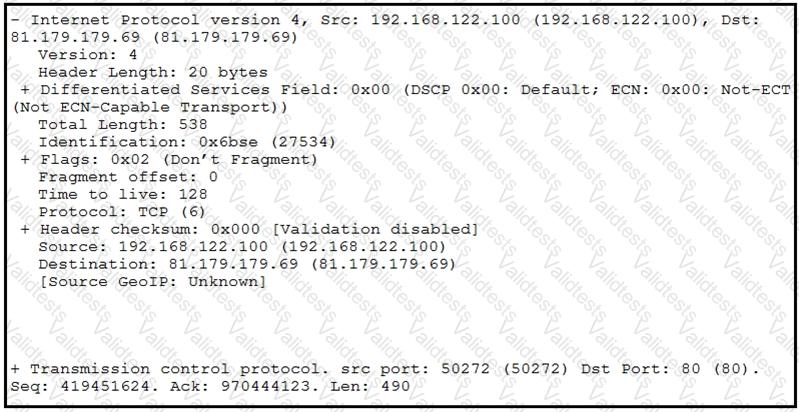
Refer to the exhibit.

Question # 149

What should be interpreted from this packet capture?

Options:

A.

81.179.179.69 is sending a packet from port 80 to port 50272 of IP address 192.168.122.100 using UDP protocol.

B.

192.168.122.100 is sending a packet from port 50272 to port 80 of IP address 81.179.179.69 using TCP protocol.

C.

192.168.122.100 is sending a packet from port 80 to port 50272 of IP address 81.179.179.69 using UDP protocol.

D.

81.179.179.69 is sending a packet from port 50272 to port 80 of IP address 192.168.122.100 using TCP UDP protocol.

Questions # 150:

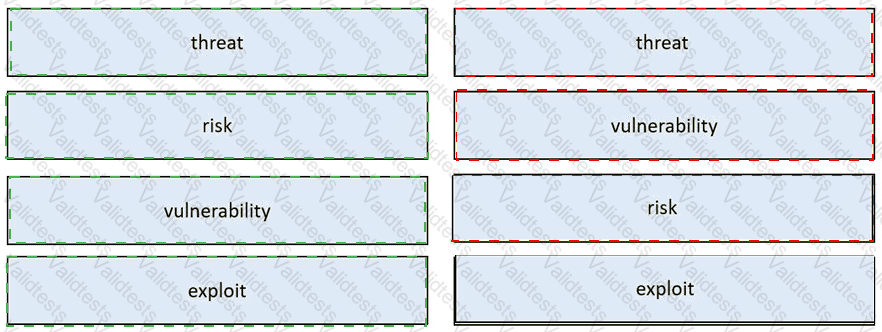
Drag and drop the security concept from the left onto the example of that concept on the right.
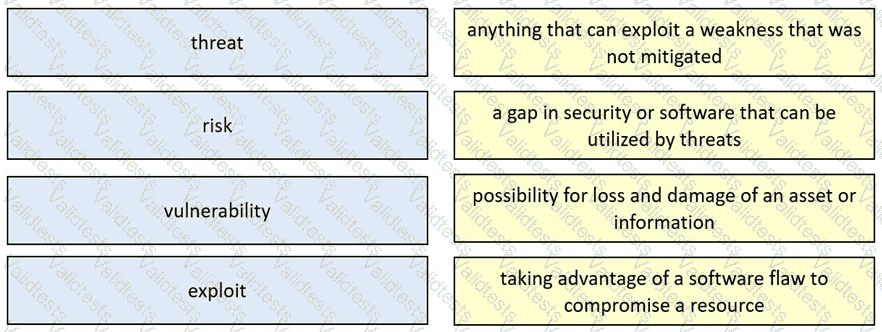
Question # 150

Options:

Viewing page 15 out of 15 pages
Viewing questions 141-150 out of questions