Summer Certification Special Limited Time 70% Discount Offer - Ends in 0d 00h 00m 00s - Coupon code: validbest

Pass the CSI Canadian Securities Course CSC2 Questions and answers with ValidTests

Exam CSC2 All Questions
Exam CSC2 Premium Access

View all detail and faqs for the CSC2 exam

Viewing page 2 out of 7 pages
Viewing questions 11-20 out of questions
Questions # 11:

What is the main benefit of investing in preferred shares?

Options:

A.

Priority to receive fixed dividends ahead of common shareholders.

B.

Priority to claim assets ahead of debt holders.

C.

Higher potential for capital appreciation than common shares.

D.

Guaranteed dividend payment.

Questions # 12:

What is the likely outcome at the end of a five-year term of a rate-reset preferred share if the issuer does not redeem the shares?

Options:

A.

The shareholder exchanges the rate-reset preferred share for a specified number of common shares.

B.

The shareholder exchanges the rate-reset preferred share for a fixed-rate preferred share.

C.

The shareholder exchanges the rate-reset preferred share for an unsecured bond

D.

The shareholder exchanges the rate-reset preferred share for a floating-rate preferred share

Questions # 13:

What client’s characteristics and investment priorities would lead an advisor to recognize that liquid alternatives are unsuitable for this client?

Options:

A.

Short-term time horizon.

B.

Focused on specific outcomes.

C.

Good understanding of portfolio theory.

D.

Short-term liquidity needs.

Questions # 14:

Why would a corporation choose to issue preferred shares rather than debt?

Options:

A.

Existing assets have excess financing capacity to justify the issue of preferred shares.

B.

The preferred dividend rate usually varies with the market interest rates

C.

issuing preferred shares would reduce the amount of leverage.

D.

The costs for issuing preferred shares are usually kwh than debt.

Questions # 15:

Which fiscal policy measure was designed to encourage individuals to save?

Options:

A.

First Home Savings Account.

B.

Capital gain inclusion rate.

C.

Dividend tax credit.

D.

Tax Free Savings Account.

Questions # 16:

An advisor wants to explain the benefits of labour sponsored funds (LSVCC) to some of his clients. With which client should the advisor have this discussion?
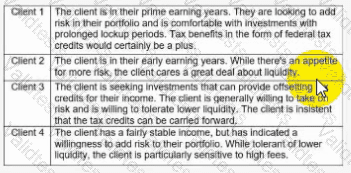
Question # 16

Options:

A.

Client 1.

B.

Client 4.

C.

Client 2.

D.

Client 3.

Questions # 17:

What is margin in an equity transaction?

Options:

A.

Loan that a dealer extends to a client to buy securities.

B.

Amount paid by a client when he uses credit to buy securities

C.

Good-faith deposit to ensure the client will make future financial obligations

D.

interest paid by the client to borrows securities.

Questions # 18:

What is the best description of growth-style investment managers?

Options:

A.

Managers focus on identifying the current phase of the economic cycle, the direction the economy is headed in, and the various sectors affected

B.

Managers buy discounted stocks that should eventually rise in price by screening stocks for cheap fundamentals

C.

Managers are usually concerned with quarterly portfolio fluctuations

D.

Managers deliver long-term total return mostly through capital appreciation

Questions # 19:

Which primary value is violated if an advisor places an unsuitable order requested by a client?

Options:

A.

Compliance.

B.

Integrity.

C.

Duty of care.

D.

Professionalism.

Questions # 20:

The consumer price index was 125.9 in December of last year and 123.0 in December of the year before What was the inflation rate last year?

Options:

A.

2.36%

B.

2.30%

C.

0.98%

D.

1.02%

Viewing page 2 out of 7 pages
Viewing questions 11-20 out of questions