Summer Certification Special Limited Time 70% Discount Offer - Ends in 0d 00h 00m 00s - Coupon code: validbest

Pass the CSI Canadian Securities Course CSC2 Questions and answers with ValidTests

Exam CSC2 All Questions
Exam CSC2 Premium Access

View all detail and faqs for the CSC2 exam

Viewing page 3 out of 7 pages
Viewing questions 21-30 out of questions
Questions # 21:

What is a leveraged ETF?

Options:

A.

A fund that seeks to match the performance returns of the underlying index tracked

B.

An option designed to achieve multiple returns of inverse performance of the tracked underlying index

C.

A contract using borrowed funds to buy the underlying stock or portfolio

D.

A fund that uses an option strategy to reduce the volatility of the underlying portfolio

Questions # 22:

Companies W, X, Y, and Z ail issue preferred shares and have experienced the following conditions

Over the last five years:
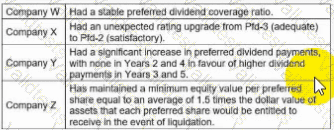
Question # 22

Based on the above, which company is most likely to experience an increase in the market price of its preferred shares?

Options:

A.

Company W.

B.

Company Z.

C.

Company Y.

D.

Company X.

Questions # 23:

In what way do ETFs differ from mutual funds?

Options:

A.

Primarily trade liquid securities.

B.

Provider works with a designated broker to create and redeem units.

C.

Invest in emerging markets.

D.

Subject to National Instrument 81-102 regulations.

Questions # 24:

If a mutual fund is set up as a corporation, how much of income generated by the fund flows through directly to the shareholders?

Options:

A.

100% of dividends

B.

100% of interest

C.

None

D.

50% of capital gain

Questions # 25:

What information must be disclosed in ETF Facts documents that may be excluded from Fund Facts documents?

Options:

A.

The management fee

B.

The total value of all units within the fund

C.

The investment exposure.

D.

The market price and bid-ask spread.

Questions # 26:

Ella has invested her RRSP in a mutual fund where the distributions are automatically reinvested in the same fund. What will be the consequences of these distributions?

Options:

A.

Ella will be sent a T3 form reporting the types of income distributed that year.

B.

Ella’s income from distributions will be taxed at her personal rate in the year received.

C.

Ella will have more mutual fund units worth less each.

D.

Ella will be sent a T5 form reporting the types of income distributed that year.

Questions # 27:

Which type of ETF is also referred to as smart beta ETF?

Options:

A.

Rules-based

B.

Standard

C.

Synthetic

D.

Index-based

Questions # 28:

A firm implements a comprehensive due diligence process before allowing their firm to sell a few funds. The fund’s high-water mark falls within what primary area of inquiry?

Options:

A.

Fund structure.

B.

Fees.

C.

Risk analysis.

D.

Operations.

Questions # 29:

What is most likely true of a portfolio that is managed from a value basis?

Options:

A.

Portfolio turnover is high, so investors can expect to incur frequent capital gains

B.

The portfolio will realize higher dividend yields than a growth equity portfolio

C.

Stock selections tend to have a higher beta than those chosen by a growth manager

D.

This portfolio style tends to perform best in up markets, with minimal gains in down markets

Questions # 30:

Maya invested $5,000 in a three-year ABC market-linked GIC for her non-registered account. Her GIC just matured and the return was based on the performance of the S & P/TSX Composite Index, with a 70% participation rate. Initial and ending reference index levels were 13,600 and 19,000, respectively. What amount of GIC return will be taxable for Maya in the year of maturity?

Options:

A.

$1,985.00.

B.

$694.75.

C.

$992.50.

D.

$1,389.71.

Viewing page 3 out of 7 pages
Viewing questions 21-30 out of questions