Pre-Summer Special Limited Time 70% Discount Offer - Ends in 0d 00h 00m 00s - Coupon code: validbest

Pass the Google Cloud Developer Professional-Cloud-Developer Questions and answers with ValidTests

Exam Professional-Cloud-Developer All Questions
Exam Professional-Cloud-Developer Premium Access

View all detail and faqs for the Professional-Cloud-Developer exam

Viewing page 3 out of 6 pages
Viewing questions 21-30 out of questions
Questions # 21:

Your team is setting up a build pipeline for an application that will run in Google Kubernetes Engine (GKE). For security reasons, you only want images produced by the pipeline to be deployed to your GKE cluster. Which combination of Google Cloud services should you use?

Options:

A.

Google Cloud Deploy. Artifact Registry, and Google Cloud Armor

B.

Google Cloud Deploy, Cloud Storage and Google Cloud Armor

C.

Cloud Build, Cloud Storage, and Binary Authorization

D.

Cloud Build. Artifact Registry and Binary Authorization

Expert Solution
Questions # 22:

Your operations team has asked you to create a script that lists the Cloud Bigtable, Memorystore, and Cloud SQL databases running within a project. The script should allow users to submit a filter expression to limit the results presented. How should you retrieve the data?

Options:

A.

Use the HBase API, Redis API, and MySQL connection to retrieve database lists. Combine the results, and then apply the filter to display the results

B.

Use the HBase API, Redis API, and MySQL connection to retrieve database lists. Filter the results individually, and then combine them to display the results

C.

Run gcloud bigtable instances list, gcloud redis instances list, and gcloud sql databases list. Use a filter within the application, and then display the results

D.

Run gcloud bigtable instances list, gcloud redis instances list, and gcloud sql databases list. Use --filter flag with each command, and then display the results

Expert Solution
Questions # 23:

Your development team is using Cloud Build to promote a Node.js application built on App Engine from your staging environment to production. The application relies on several directories of photos stored in a Cloud Storage bucket named webphotos-staging in the staging environment. After the promotion, these photos must be available in a Cloud Storage bucket named webphotos-prod in the production environment. You want to automate the process where possible. What should you do?

A)

Manually copy the photos to webphotos-prod.

B)

Add a startup script in the application’s app.yami file to move the photos from webphotos-staging to webphotos-prod.

C)

Add a build step in the cloudbuild.yaml file before the promotion step with the arguments:

Question # 23

D)

Add a build step in the cloudbuild.yaml file before the promotion step with the arguments:

Question # 23

Options:

A.

Option A

B.

Option B

C.

Option C

D.

Option D

Expert Solution
Questions # 24:

You have an analytics application that runs hundreds of queries on BigQuery every few minutes using BigQuery API. You want to find out how much time these queries take to execute. What should you do?

Options:

A.

Use Stackdriver Monitoring to plot slot usage.

B.

Use Stackdriver Trace to plot API execution time.

C.

Use Stackdriver Trace to plot query execution time.

D.

Use Stackdriver Monitoring to plot query execution times.

Expert Solution
Questions # 25:

Your website is deployed on Compute Engine. Your marketing team wants to test conversion rates between 3

different website designs.

Which approach should you use?

Options:

A.

Deploy the website on App Engine and use traffic splitting.

B.

Deploy the website on App Engine as three separate services.

C.

Deploy the website on Cloud Functions and use traffic splitting.

D.

Deploy the website on Cloud Functions as three separate functions.

Expert Solution
Questions # 26:

You want to re-architect a monolithic application so that it follows a microservices model. You want to

accomplish this efficiently while minimizing the impact of this change to the business.

Which approach should you take?

Options:

A.

Deploy the application to Compute Engine and turn on autoscaling.

B.

Replace the application's features with appropriate microservices in phases.

C.

Refactor the monolithic application with appropriate microservices in a single effort and deploy it.

D.

Build a new application with the appropriate microservices separate from the monolith and replace it when

it is complete.

Expert Solution
Questions # 27:

You have an application written in Python running in production on Cloud Run. Your application needs to read/write data stored in a Cloud Storage bucket in the same project. You want to grant access to your application following the principle of least privilege. What should you do?

Options:

A.

Create a user-managed service account with a custom Identity and Access Management (IAM) role.

B.

Create a user-managed service account with the Storage Admin Identity and Access Management (IAM) role.

C.

Create a user-managed service account with the Project Editor Identity and Access Management (IAM) role.

D.

Use the default service account linked to the Cloud Run revision in production.

Expert Solution
Questions # 28:

You plan to deploy a new application revision with a Deployment resource to Google Kubernetes Engine (GKE) in production. The container might not work correctly. You want to minimize risk in case there are issues after deploying the revision. You want to follow Google-recommended best practices. What should you do?

Options:

A.

Perform a rolling update with a PodDisruptionBudget of 80%.

B.

Perform a rolling update with a HorizontalPodAutoscaler scale-down policy value of 0.

C.

Convert the Deployment to a StatefulSet, and perform a rolling update with a PodDisruptionBudget of 80%.

D.

Convert the Deployment to a StatefulSet, and perform a rolling update with a HorizontalPodAutoscaler scale-down policy value of 0.

Expert Solution
Questions # 29:

You are deploying a Python application to Cloud Run using Cloud Build. The Cloud Build pipeline is shown below:
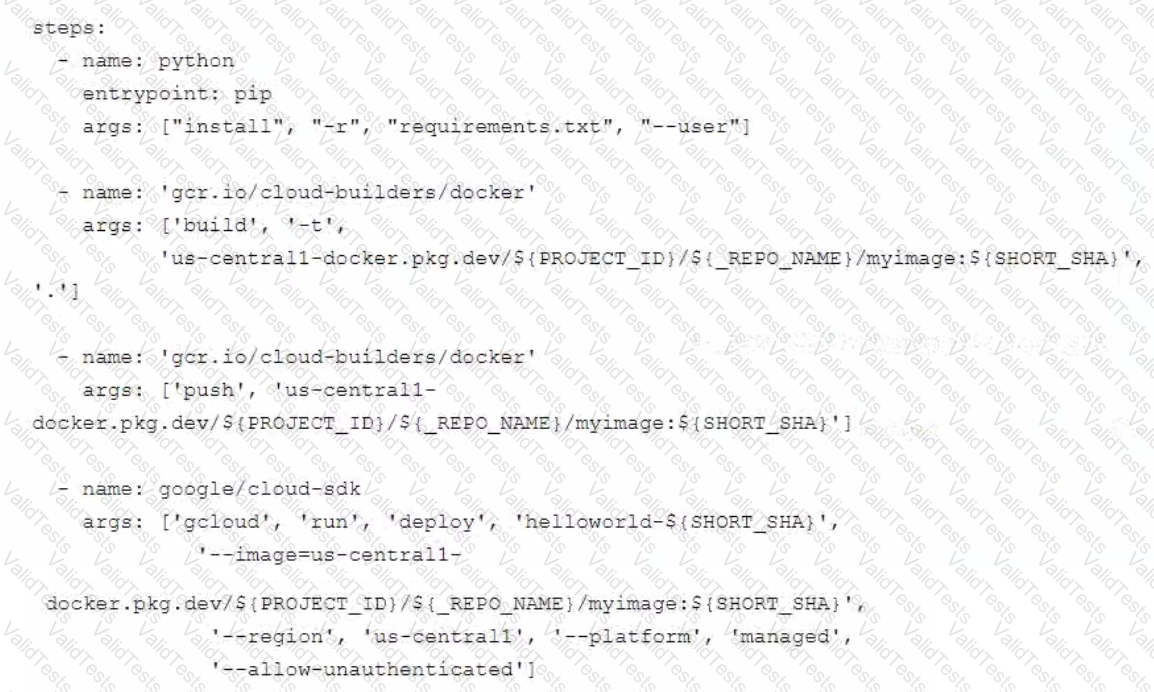
Question # 29

You want to optimize deployment times and avoid unnecessary steps What should you do?

Options:

A.

Remove the step that pushes the container to Artifact Registry.

B.

Add the —cache-from argument to the Docker build step in your build config file.

C.

Store image artifacts in a Cloud Storage bucket in the same region as the Cloud Run instance.

D.

Deploy a new Docker registry in a VPC and use Cloud Build worker pools inside the VPC to run the build pipeline.

Expert Solution
Questions # 30:

You are building a highly available and globally accessible application that will serve static content to users. You need to configure the storage and serving components. You want to minimize management overhead and latency while maximizing reliability for users. What should you do?

Options:

A.

1) Create a managed instance group. Replicate the static content across the virtual machines (VMs)

2) Create an external HTTP(S) load balancer.

3) Enable Cloud CDN, and send traffic to the managed instance group.

B.

1) Create an unmanaged instance group. Replicate the static content across the VMs.

2) Create an external HTTP(S) load balancer

3) Enable Cloud CDN, and send traffic to the unmanaged instance group.

C.

1) Create a Standard storage class, regional Cloud Storage bucket. Put the static content in the bucket

2) Reserve an external IP address, and create an external HTTP(S) load balancer

3) Enable Cloud CDN, and send traffic to your backend bucket

D.

1) Create a Standard storage class, multi-regional Cloud Storage bucket. Put the static content in the bucket.

2) Reserve an external IP address, and create an external HTTP(S) load balancer.

3) Enable Cloud CDN, and send traffic to your backend bucket.

Expert Solution
Viewing page 3 out of 6 pages
Viewing questions 21-30 out of questions