Pre-Summer Special Limited Time 70% Discount Offer - Ends in 0d 00h 00m 00s - Coupon code: validbest

Pass the Google Cloud Developer Professional-Cloud-Developer Questions and answers with ValidTests

Exam Professional-Cloud-Developer All Questions
Exam Professional-Cloud-Developer Premium Access

View all detail and faqs for the Professional-Cloud-Developer exam

Viewing page 4 out of 6 pages
Viewing questions 31-40 out of questions
Questions # 31:

You are using Cloud Build to create a new Docker image on each source code commit to a Cloud Source Repositoties repository. Your application is built on every commit to the master branch. You want to release specific commits made to the master branch in an automated method. What should you do?

Options:

A.

Manually trigger the build for new releases.

B.

Create a build trigger on a Git tag pattern. Use a Git tag convention for new releases.

C.

Create a build trigger on a Git branch name pattern. Use a Git branch naming convention for new releases.

D.

Commit your source code to a second Cloud Source Repositories repository with a second Cloud Build trigger. Use this repository for new releases only.

Expert Solution
Questions # 32:

Your development team has built several Cloud Functions using Java along with corresponding integration and service tests. You are building and deploying the functions and launching the tests using Cloud Build. Your Cloud Build job is reporting deployment failures immediately after successfully validating the code. What should you do?

Options:

A.

Check the maximum number of Cloud Function instances.

B.

Verify that your Cloud Build trigger has the correct build parameters.

C.

Retry the tests using the truncated exponential backoff polling strategy.

D.

Verify that the Cloud Build service account is assigned the Cloud Functions Developer role.

Expert Solution
Questions # 33:

You are a developer at a financial institution You use Cloud Shell to interact with Google Cloud services. User data is currently stored on an ephemeral disk however a recently passed regulation mandates that you can no longer store sensitive information on an ephemeral disk. You need to implement a new storage solution for your user data You want to minimize code changes Where should you store your user data'?

Options:

A.

Store user data on a Cloud Shell home disk and log in at least every 120 days to prevent its deletion

B.

Store user data on a persistent disk in a Compute Engine instance

C.

Store user data m BigQuery tables

D.

Store user data in a Cloud Storage bucket

Expert Solution
Questions # 34:

You are designing a schema for a table that will be moved from MySQL to Cloud Bigtable. The MySQL table is as follows:
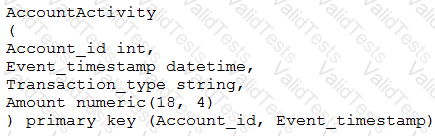
Question # 34

How should you design a row key for Cloud Bigtable for this table?

Options:

A.

Set Account_id as a key.

B.

Set Account_id_Event_timestamp as a key.

C.

Set Event_timestamp_Account_id as a key.

D.

Set Event_timestamp as a key.

Expert Solution
Questions # 35:

Your security team is auditing all deployed applications running in Google Kubernetes Engine. After completing the audit, your team discovers that some of the applications send traffic within the cluster in clear text. You need to ensure that all application traffic is encrypted as quickly as possible while minimizing changes to your applications and maintaining support from Google. What should you do?

Options:

A.

Use Network Policies to block traffic between applications.

B.

Install Istio, enable proxy injection on your application namespace, and then enable mTLS.

C.

Define Trusted Network ranges within the application, and configure the applications to allow traffic only from those networks.

D.

Use an automated process to request SSL Certificates for your applications from Let’s Encrypt and add them to your applications.

Expert Solution
Questions # 36:

You are developing a new public-facing application that needs to retrieve specific properties in the metadata of users’ objects in their respective Cloud Storage buckets. Due to privacy and data residency requirements, you must retrieve only the metadata and not the object data. You want to maximize the performance of the retrieval process. How should you retrieve the metadata?

Options:

A.

Use the patch method.

B.

Use the compose method.

C.

Use the copy method.

D.

Use the fields request parameter.

Expert Solution
Questions # 37:

You are supporting a business-critical application in production deployed on Cloud Run. The application is reporting HTTP 500 errors that are affecting the usability of the application. You want to be alerted when the number of errors exceeds 15% of the requests within a specific time window. What should you do?

Options:

A.

Navigate to the Cloud Run page in the Google Cloud console, and select the service from the services list.

Use the Metrics tab to visualize the number of errors for that revision and refresh the page daily.

B.

Create a Cloud Function that consumes the Cloud Monitoring API Use Cloud Composer to trigger the Cloud

Function daily and alert you if the number of errors is above the defined threshold.

C.

Create an alerting policy in Cloud Monitoring that alerts you if the number of errors is above the defined

threshold.

D.

Create a Cloud Function that consumes the Cloud Monitoring API Use Cloud Scheduler to trigger the Cloud

Function daily and alert you if the number of errors is above the defined threshold

Expert Solution
Questions # 38:

Your web application is deployed to the corporate intranet. You need to migrate the web application to Google Cloud. The web application must be available only to company employees and accessible to employees as they travel. You need to ensure the security and accessibility of the web application while minimizing application changes. What should you do?

Options:

A.

Configure the application to check authentication credentials for each HTTP(S) request to the application.

B.

Configure Identity-Aware Proxy to allow employees to access the application through its public IP address.

C.

Configure a Compute Engine instance that requests users to log in to their corporate account. Change the web application DNS to point to the proxy Compute Engine instance. After authenticating, the Compute Engine instance forwards requests to and from the web application.

D.

Configure a Compute Engine instance that requests users to log in to their corporate account. Change the web application DNS to point to the proxy Compute Engine instance. After authenticating, the Compute Engine issues an HTTP redirect to a public IP address hosting the web application.

Expert Solution
Questions # 39:

You are developing an application that will allow clients to download a file from your website for a specific period of time. How should you design the application to complete this task while following Google-recommended best practices?

Options:

A.

Configure the application to send the file to the client as an email attachment.

B.

Generate and assign a Cloud Storage-signed URL for the file. Make the URL available for the client to download.

C.

Create a temporary Cloud Storage bucket with time expiration specified, and give download permissions to the bucket. Copy the file, and send it to the client.

D.

Generate the HTTP cookies with time expiration specified. If the time is valid, copy the file from the Cloud Storage bucket, and make the file available for the client to download.

Expert Solution
Questions # 40:

You need to deploy a new European version of a website hosted on Google Kubernetes Engine. The current and new websites must be accessed via the same HTTP(S) load balancer's external IP address, but have different domain names. What should you do?

Options:

A.

Define a new Ingress resource with a host rule matching the new domain

B.

Modify the existing Ingress resource with a host rule matching the new domain

C.

Create a new Service of type LoadBalancer specifying the existing IP address as the loadBalancerIP

D.

Generate a new Ingress resource and specify the existing IP address as the kubernetes.io/ingress.global-static-ip-name annotation value

Expert Solution
Viewing page 4 out of 6 pages
Viewing questions 31-40 out of questions