Pre-Summer Special Limited Time 70% Discount Offer - Ends in 0d 00h 00m 00s - Coupon code: validbest

Pass the Google Cloud DevOps Engineer Professional-Cloud-DevOps-Engineer Questions and answers with ValidTests

Exam Professional-Cloud-DevOps-Engineer All Questions
Exam Professional-Cloud-DevOps-Engineer Premium Access

View all detail and faqs for the Professional-Cloud-DevOps-Engineer exam

Viewing page 3 out of 7 pages
Viewing questions 21-30 out of questions
Questions # 21:

Your organization uses a change advisory board (CAB) to approve all changes to an existing service You want to revise this process to eliminate any negative impact on the software delivery performance What should you do?

Choose 2 answers

Options:

A.

Replace the CAB with a senior manager to ensure continuous oversight from development to deployment

B.

Let developers merge their own changes but ensure that the team's deployment platform can roll back changes if any issues are discovered

C.

Move to a peer-review based process for individual changes that is enforced at code check-in time and supported by automated tests

D.

Batch changes into larger but less frequent software releases

E.

Ensure that the team's development platform enables developers to get fast feedback on the impact of their changes

Expert Solution
Questions # 22:

You use Cloud Build to build your application. You want to reduce the build time while minimizing cost and development effort. What should you do?

Options:

A.

Use Cloud Storage to cache intermediate artifacts.

B.

Run multiple Jenkins agents to parallelize the build.

C.

Use multiple smaller build steps to minimize execution time.

D.

Use larger Cloud Build virtual machines (VMs) by using the machine-type option.

Expert Solution
Questions # 23:

The new version of your containerized application has been tested and is ready to be deployed to production on Google Kubernetes Engine (GKE) You could not fully load-test the new version in your pre-production environment and you need to ensure that the application does not have performance problems after deployment Your deployment must be automated What should you do?

Options:

A.

Deploy the application through a continuous delivery pipeline by using canary deployments Use Cloud Monitoring to look for performance issues, and ramp up traffic as supported by the metrics

B.

Deploy the application through a continuous delivery pipeline by using blue/green deployments Migrate traffic to the new version of the application and use Cloud Monitoring to look for performance issues

C.

Deploy the application by using kubectl and use Config Connector to slowly ramp up traffic between versions. Use Cloud Monitoring to look for performance issues

D.

Deploy the application by using kubectl and set the spec. updatestrategy. type field to RollingUpdate Use Cloud Monitoring to look for performance issues, and run the kubectl rollback command if there are any issues.

Expert Solution
Questions # 24:

You are currently planning how to display Cloud Monitoring metrics for your organization's Google Cloud projects. Your organization has three folders and six projects:
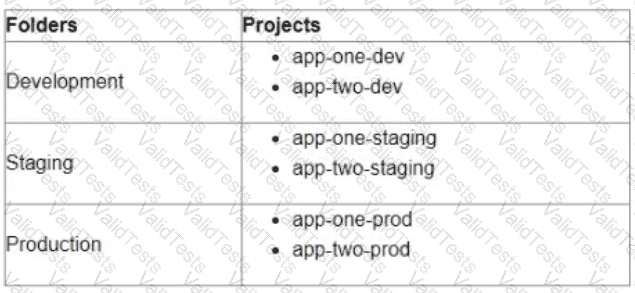
Question # 24

You want to configure Cloud Monitoring dashboards lo only display metrics from the projects within one folder You need to ensure that the dashboards do not display metrics from projects in the other folders You want to follow Google-recommended practices What should you do?

Options:

A.

Create a single new scoping project

B.

Create new scoping projects for each folder

C.

Use the current app-one-prod project as the scoping project

D.

Use the current app-one-dev, app-one-staging and app-one-prod projects as the scoping project for each folder

Expert Solution
Questions # 25:

You need to reduce the cost of virtual machines (VM| for your organization. After reviewing different options, you decide to leverage preemptible VM instances. Which application is suitable for preemptible VMs?

Options:

A.

A scalable in-memory caching system

B.

The organization's public-facing website

C.

A distributed, eventually consistent NoSQL database cluster with sufficient quorum

D.

A GPU-accelerated video rendering platform that retrieves and stores videos in a storage bucket

Expert Solution
Questions # 26:

Your company runs services by using Google Kubernetes Engine (GKE). The GKE clusters in the development environment run applications with verbose logging enabled. Developers view logs by using the kubect1 logs

command and do not use Cloud Logging. Applications do not have a uniform logging structure defined. You need to minimize the costs associated with application logging while still collecting GKE operational logs. What should you do?

Options:

A.

Run the gcloud container clusters update --logging—SYSTEM command for the development cluster.

B.

Run the gcloud container clusters update logging=WORKLOAD command for the development cluster.

C.

Run the gcloud logging sinks update _Defau1t --disabled command in the project associated with the development environment.

D.

Add the severity >= DEBUG resource. type "k83 container" exclusion filter to the Default logging sink in the project associated with the development environment.

Expert Solution
Questions # 27:

Your company runs services by using multiple globally distributed Google Kubernetes Engine (GKE) clusters Your operations team has set up workload monitoring that uses Prometheus-based tooling for metrics alerts: and generating dashboards This setup does not provide a method to view metrics globally across all clusters You need to implement a scalable solution to support global Prometheus querying and minimize management overhead What should you do?

Options:

A.

Configure Prometheus cross-service federation for centralized data access

B.

Configure workload metrics within Cloud Operations for GKE

C.

Configure Prometheus hierarchical federation for centralized data access

D.

Configure Google Cloud Managed Service for Prometheus

Expert Solution
Questions # 28:

Your company wants to implement a CD pipeline in Cloud Deploy for a web service deployed to GKE. The web service currently does not have any automated testing. The Quality Assurance team must manually verify any new releases of the web service before any production traffic is processed. You need to design the CD pipeline. What should you do?

Options:

A.

Create two pipeline stages, and use a canary deployment strategy.

B.

Create a single pipeline stage, and use a standard deployment strategy.

C.

Create a single pipeline stage, and use a canary deployment strategy.

D.

Create two pipeline stages, and use a standard deployment strategy.

Expert Solution
Questions # 29:

Your company is creating a new cloud-native Google Cloud organization. You expect this Google Cloud organization to first be used by a small number of departments and then expand to be used by a large number of departments. Each department has a large number of applications varying in size. You need to design the VPC network architecture. Your solution must minimize the amount of management required while remaining flexible enough for development teams to quickly adapt to their evolving needs. What should you do?

Options:

A.

Create a separate VPC for each department and connect the VPCs with VPC Network Peering.

B.

Create a separate VPC for each department and use Private Service Connect to connect the VPCs.

C.

Create a separate VPC for each application and use Private Service Connect to connect the VPCs.

D.

Create a separate VPC for each department and connect the VPCs with Cloud VPN.

Expert Solution
Questions # 30:

You are managing an application that exposes an HTTP endpoint without using a load balancer. The latency of the HTTP responses is important for the user experience. You want to understand what HTTP latencies all of your users are experiencing. You use Stackdriver Monitoring. What should you do?

Options:

A.

• In your application, create a metric with a metricKind set to DELTA and a valueType set to DOUBLE.• In Stackdriver's Metrics Explorer, use a Slacked Bar graph to visualize the metric.

B.

• In your application, create a metric with a metricKind set to CUMULATIVE and a valueType set to DOUBLE.• In Stackdriver's Metrics Explorer, use a Line graph to visualize the metric.

C.

• In your application, create a metric with a metricKind set to gauge and a valueType set to distribution.• In Stackdriver's Metrics Explorer, use a Heatmap graph to visualize the metric.

D.

• In your application, create a metric with a metricKind. set toMETRlc_KIND_UNSPECIFIEDanda valueType set to INT64.• In Stackdriver's Metrics Explorer, use a Stacked Area graph to visualize the metric.

Expert Solution
Viewing page 3 out of 7 pages
Viewing questions 21-30 out of questions