What is the correct sequence of events that occurs when a user device connects to a network using Dynamic Segmentation?


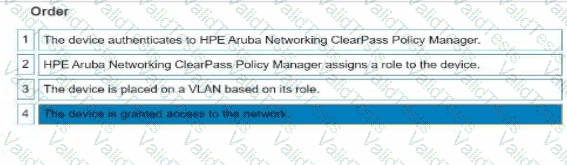
This question asks for the sequence of events when a user device connects to a network utilizing Dynamic Segmentation, which typically involves authentication via ClearPass and role-based policy assignment.
Authentication:When a device connects (wired or wireless), the first step in gaining secure access is authentication. The switch or AP (authenticator) facilitates this process, usually communicating via RADIUS with ClearPass Policy Manager (RADIUS server). The device provides credentials or uses certificates (e.g., 802.1X, MAC Auth).
Role Assignment:Upon successful authentication, ClearPass evaluates policies based on the device/user context (identity, posture, time of day, etc.) and sends back RADIUS attributes to the authenticator. A crucial attribute is the assigned User Role. This role encapsulates the access privileges and network configuration for the device.
Network Placement/Segmentation:The authenticator (switch/AP) uses the assigned role information received from ClearPass to place the device into the appropriate network segment. This might involve assigning a specific VLAN ID to the port/client or, in User-Based Tunneling (UBT) scenarios, establishing a tunnel to an Aruba Gateway associated with that role. The step "placed on a VLAN based on its role" describes one common method of segmentation based on the assigned role.
Access Granted:Once the device is authenticated, assigned a role, and placed in the correct network segment (VLAN or tunnel), access is granted according to the firewall rules, QoS settings, and other policies defined within that assigned role. Traffic can now flow subject to these enforced policies.
Refer to thefour numbered steps in theexhibit.
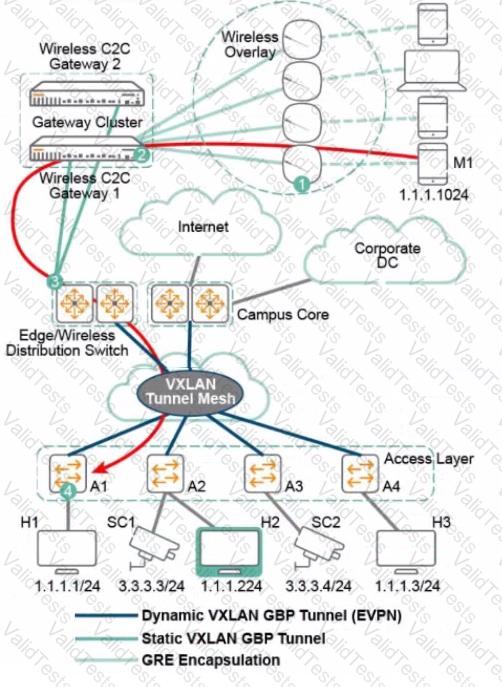
Which action is the first step in applying a role-to-role ACL on thetraffic from mobile device M1 to role H2?
The edge switch acts as the intermediate node and transfers theGroup Policy ID over static VXLAN to dynamic VXLAN tunnel and forwards the packet to switch A1.
The AP forwards the pocket from M1 to gateway 1.
Switch A1 determines the destination role based on destination MAC or destination IP and enforces role-to-role ACLs.
Gateway 1 forwards the traffic over the static VXLAN tunnel to the edge switch, this packet carries the Group Policy ID corresponding to the role of M1.
The question asks for the first step in applying a role-to-role ACL (Access Control List) on traffic from a mobile device (M1) to a role (H2) in a network using Dynamic Segmentation with VXLAN and role-based policies.
Analysis of Options:
Option A:Describes an intermediate step where the edge switch transfers the Group Policy ID over VXLAN, which occurs later in the process.
Option B:Correct. The first step is the AP forwarding the packet from the mobile device (M1) to the gateway, which initiates the traffic flow in a tunneled Dynamic Segmentation setup.
Option C:Describes a later step where the destination switch (A1) enforces the role-to-role ACL, after the packet has traversed the network.
Option D:Describes a step where the gateway forwards traffic over a VXLAN tunnel, which occurs after the AP forwards the packet.
Why Option B is Correct:In HPE Aruba Networking’s Dynamic Segmentation architecture, wireless clients (e.g., M1) connect to an AP, which tunnels traffic to a gateway (e.g., in tunneled mode). The first step in the traffic flow is the AP forwarding the client’s packet to the gateway, which then processes the packet for role assignment and policy enforcement. This aligns with the role-to-role ACL application process, where the gateway applies policies based on the source (M1’s role) and destination (H2’s role) using Group Policy IDs over VXLAN.
Relevance to Certification Objectives:
Security (10%):Involves designing and troubleshooting role-based security policies in customer networks.
WLAN (9%):Includes implementing and troubleshooting wireless traffic flows in Dynamic Segmentation.
Switching (19%):Covers Layer 2/3 interconnection technologies like VXLAN for policy enforcement.
Refer to the exhibit.
IGMP v3 was enabled on both VSX switches. Which switch becomes the IGMP querier forclients connected to Ace-1 switch?
Agg-2
both Agg-1 and Agg-2
Agg-1
Active gateway IP will be used as IGMP querier.
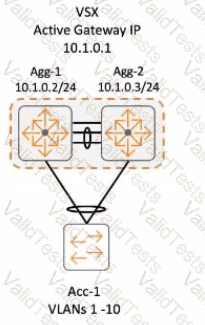
The setup has Agg-1 and Agg-2 as a VSX pair with IGMPv3 enabled. Ace-1 is a downstream switch connected to clients. The question asks which switch becomes the IGMP querier for clients connected to Ace-1.
IGMP Snooping & Querier:In a Layer 2 network using IGMP snooping, an IGMP querier is required on each VLAN to periodically send general queries. This prompts hosts to send membership reports, allowing snooping switches to learn which ports need which multicast streams.
Querier Election:If multiple devices capable of querying exist on a VLAN (like routers or capable switches), an election occurs. Typically, the device with the lowest IP address on the VLAN becomes the querier.
VSX & IGMP Querier:In an ArubaOS-CX VSX environment, the IGMP querier functionality is managed by the VSX pair. Documentation indicates that theprimary VSX switchtypically assumes the role of the IGMP querier for the VLANs it serves, including those extended via MC-LAG to downstream switches.
Analysis of Options:
A. Agg-2: Would only be the querier if it were the primary VSX switch.
B. Both Agg-1 and Agg-2: Incorrect, only one active querier per VLAN is standard.
C. Agg-1: Likely the primary VSX switch (often designated or wins election based on priority/lower system MAC/IP) and thus becomes the querier.
D. Active gateway IP: This is the virtual IP used for unicast routing, but the querier function runs on a physical switch, usually the primary.
Conclusion:Assuming Agg-1 is the primary VSX switch (as is common convention or based on default election parameters if not explicitly configured), it will act as the IGMP querier for the VLAN serving clients connected to Ace-1.
What is the best practice for using Dynamic Segmentation?
Use UBT to create isolated networks foe specific typos of devices.
Use a combination of role-based access and overlay technologies to create a layered security approach.
Use Dynamic Segmentation only on devices thatare connected to the network via Wi-Fi.
Use LUR to assign roles to devices based on their location and DUR to assign roles to devices based on their user identity.
The question asks for the best practice for using Dynamic Segmentation.
Dynamic Segmentation Overview:It's an architecture that provides unified policy and segmentation for wired and wireless clients by combining role-based access control, traffic tunneling (like UBT), and overlay technologies (like VXLAN/GRE). Policies are enforced centrally, typically at an Aruba Gateway.
Analysis of Options:
A: UBT is a component, but Dynamic Segmentation encompasses more than just creating isolated networks with UBT.
B: Correctly describes the core principle: using a combination of role-based access (for definingwhogetswhatpolicy) and overlay technologies (for transporting traffic to the policy enforcement point and providing segmentation). This creates a layered security approach.
C: Incorrect. A key benefit isunifiedpolicy across both wired and wireless access.
D: LUR and DUR are role types, but how they are assigned isn't the fundamental description of Dynamic Segmentation itself.
Conclusion:Option B accurately captures the essence of Dynamic Segmentation as a best practice approach, integrating role-based policies with overlay networking for secure, unified access control.
Which minimal configurations must becompleted for MSTP to work correctly? (Select two.)
MSTPregion
bridge priority number
revision number
MSTP enabled interfaces
creating MSTP instances
The question asks for the minimal configurations required for Multiple Spanning Tree Protocol (MSTP) to work correctly on AOS-CX switches.
Analysis of Options:
Option A:Correct. The MSTP region name must be configured to define the MSTP region and ensure switches belong to the same region.
Option B:Incorrect. Bridge priority is optional and defaults to 32768; it’s not mandatory for MSTP functionality.
Option C:Correct. The MSTP revision number is required to ensure consistency across switches in the same region.
Option D:Incorrect. Enabling MSTP on interfaces is automatic for VLAN-enabled ports; explicit configuration is not mandatory.
Option E:Incorrect. Creating MSTP instances is optional and only needed for specific VLAN-to-instance mappings.
Why A and C are Correct:MSTP requires a consistent region configuration across all switches to function correctly. The minimal configuration includes:
MSTP region name:Defines the region (e.g., spanning-tree config-name REGION1) to group switches.
Revision number:Ensures region consistency (e.g., spanning-tree config-revision 1).
These settings ensure switches form a single MSTP region, allowing VLAN-to-instance mappings (default instance 0 if not specified) and loop prevention. Other settings, like bridge priority or explicit instance creation, are optional and not strictly required for basic MSTP operation.
Relevance to Certification Objectives:
Network Resiliency and Virtualization (8%):Designing and troubleshooting MSTP for redundancy and fault tolerance.
Switching (19%):Implementing Layer 2 technologies like MSTP for loop prevention.
Which tables arc synchronized between a pair ofCX 8325 switches in a VSX cluster? (Select two.)
BGP Neighbors
MAC address
Spanning-TreeProtocol (STP)
IP Routing
Link Layer Discovery Protocol (LLDP)
The question asks which tables are synchronized between a pair of CX 8325 switches in a Virtual Switching Extension (VSX) cluster. VSX is a high-availability solution that synchronizes specific tables to ensure consistent operation across both switches.
Analysis of Options:
A. BGP Neighbors:BGP neighbor tables are not synchronized in VSX; each switch maintains its own BGP sessions.
B. MAC address:Correct. VSX synchronizes the MAC address table to ensure consistent Layer 2 forwarding across both switches.
C. Spanning-Tree Protocol (STP):STP states are not synchronized; each switch runs its own STP instance, though they coordinate to avoid loops.
D. IP Routing:Correct. VSX synchronizes the IP routing table to ensure consistent Layer 3 forwarding.
E. Link Layer Discovery Protocol (LLDP):LLDP information is not synchronized; each switch maintains its own neighbor information.
Why B and D are Correct:In a VSX cluster, the MAC address table and IP routing table are synchronized to ensure seamless Layer 2 and Layer 3 operations. This synchronization allowsboth switches to share a common view of the network, enabling features like active-active forwarding and hitless failover. The vsx-sync feature in AOS-CX ensures these tables are kept consistent across the VSX pair.
Relevance to Certification Objectives:
Network Resiliency and Virtualization (8%):Involves designing and troubleshooting VSX for resiliency and redundancy.
Switching (19%):Includes implementing and troubleshooting Layer 2 technologies like MAC address tables.
Routing (16%):Covers IP routing table synchronization in VSX environments.
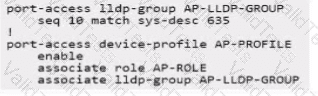
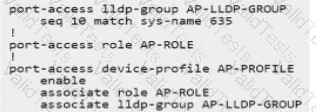
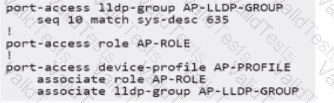
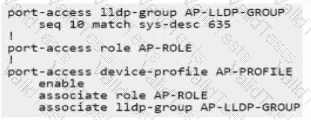
Which setof commands willapply the device profile 'AP'to the device shown in the LLDP neighbor output below?
A)
B)
C)
D)
Option A
Option B
Option C
Option D
The goal is to configure the switch to automatically apply a specific device profile (named AP-PROFILE in the options) to ports where an Aruba AP Model 635 connects, using LLDP information for detection.
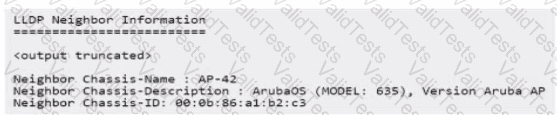
LLDP Information:The LLDP neighbor output shows:
Neighbor Chassis-Description: ArubaOS (MODEL: 635), Version Aruba AP
Neighbor Chassis-Name: AP-42
Device Profile Mechanism:This involves creating an LLDP group that matches specific attributes of the desired device, creating a device profile containing the desired port configurations (VLAN, PoE, QoS, Role, etc.), associating the profile with the LLDP group, and enabling the feature globally.
Analyzing Configuration Options:All options configure an LLDP group AP-LLDP-GROUP and a device profile AP-PROFILE. The key is the matching condition within the LLDP group and the completeness of the profile configuration.
Matching Condition:
Options A, C, D use seq 10 match sys-desc 635. This condition checks if the LLDP System Description contains the string "635". Based on the output (...MODEL: 635...), this conditionwill matchthe target AP.
Option B uses seq 10 match sys-name 635. This checks if the LLDP System Name contains "635". The output shows Neighbor Chassis-Name: AP-42. This conditionwill not match.
Match the BGP connection slates to the conditions thatcould have caused that state.


The router is able to process update messages. -->established
The router is waiting for the neighbor's open message. -->open sent
Routers have agreed on matching feature sets. -->open confirm
The session establishment has timed out. -->idle
This question requires matching BGP connection states from the BGP Finite State Machine (FSM) to descriptions of conditions that occur within or lead to those states.
Idle:This is the initial state where BGP awaits a start event or retries after a failure. It's also the state entered upon error detection or session closure, including timeouts during connection attempts.
Matches:"The session establishment has timed out." - A timeout during the connection process forces the BGP process back to the Idle state to potentially retry later.
OpenSent:After a TCP connection is established, the local router sends a BGP OPEN message with its parameters (AS number, capabilities, etc.) and transitions to the OpenSent state while waiting to receive an OPEN message from its BGP neighbor.
Matches:"The router is waiting for the neighbor's open message."
OpenConfirm:Once the router receives an OPEN message from its neighbor and validates the parameters (e.g., matching AS, compatible capabilities), it sends a KEEPALIVE message and moves to the OpenConfirm state. It waits for a KEEPALIVE from the neighbor to confirm the session. Basic parameter checks and capability negotiations are successfully completed in this phase.
Matches:"Routers have agreed on matching feature sets." - This agreement happens upon successful validation of the OPEN messages exchanged.
Established:This is the final, stable state where BGP peering is successful. Both routers have accepted each other's parameters via the OPEN messages and confirmed the session with KEEPALIVEs. In this state, the routers can exchange UPDATE messages containing routing information.
Matches:"The router is able to process update messages."
Refer to the exhibit.
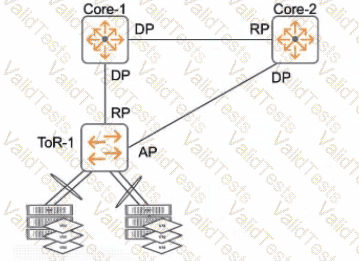
Acme Corp has VM workload running downstream of ToR-1 and has noticed performance degradation. They suspect ToR-1 uplinks are periodically over utilized. A partner has suggested you migrate your legacy 1U Coie-1 and Cote-2 to the CX 6400 series.
Which aspects of this platform would solve the customer's problem, while focusing on implementing HPE Aruba Networking best practices? (Select two.)
The CX 6400 series supports multiple active forwardingpathways from ToR-1 based on multi-region design.
The proposed new core's VSF capabilityallows multiple active forwarding pathways from ToR-1 based while eliminating the need for STP.
The proposed solutions backplane stacking permits the directly connected ESXI hosts to load balance using active LACP.
MC-LAG permits Core-1 and Core-2 to present the edge 602.3ad device as a common system ID"
The question involves a customer experiencing performance degradation due to periodic overutilization of ToR-1 uplinks to legacy Core-1 and Core-2 switches. The proposed solution is to migrate to CX 6400 series switches, and the task is to identify which aspects of the CX 6400 platform address the issue while adhering to HPE Aruba Networking best practices.
Analysis of Options:
Option A:Incorrect. The CX 6400 does not support “multi-region design” as a feature for active forwarding pathways.
Option B:Correct. Virtual Switching Framework (VSF) on the CX 6400 allows multiple active forwarding pathways by creating a single logical switch from multiple physical switches, eliminating the need for STP in the core and reducing uplink congestion.
Option C:Incorrect. Backplane stacking does not directly enable ESXi hosts to load balance using active LACP; this is unrelated to uplink utilization.
Option D:Correct. Multi-Chassis Link Aggregation (MC-LAG) allows Core-1 and Core-2 to form a single logical 802.3ad (LACP) device, enabling active-active uplinks from ToR-1 and load balancing traffic to prevent overutilization.
Why B and D are Correct:The performance degradation is caused by uplink overutilization, likely due to STP blocking redundant paths or inefficient load balancing. The CX 6400’s VSF capability combines multiple switches into a single logical device, allowing all uplinks from ToR-1 to be active without relying on STP, which often blocks redundant paths. MC-LAG further enhances this by presenting Core-1 and Core-2 as a single LACP system, enabling ToR-1 to use all uplinks actively via LACP load balancing. These features align with HPE Aruba Networking best practices for high-availability and performance in campus core deployments.
Relevance to Certification Objectives:
Network Resiliency and Virtualization (8%):Designing and troubleshooting VSF and MC-LAG for resiliency and redundancy.
Performance Optimization (6%):Analyzing and remediating uplink utilization issues.
Connectivity (9%):Applying advanced networking architectures like VSF and MC-LAG.
Which is a best practice for configuringGBP?
Configure GBP classes to have a destination role that is different from theassociated user role.
Use static user roles (SUR) to configure GBP
Configure GBP classes to have a destination role that is the same as the associated user rote.
Use downloadable user roles (DUR) to configure GBP.
The question asks for a best practice when configuring Group-Based Policy (GBP). GBP simplifies policy management by assigning users/devices to roles and defining policies between these roles, often leveraging dynamic assignment from an authentication server.
GBP Concepts:Policies are typically defined based on source and destination roles. Roles can be assigned statically on the switch or dynamically via an authentication server like ClearPass.
Analysis of Options:
A & C: Policies define interactionsbetweenroles (source role to destination role). These roles can be the same (intra-role policy) or different (inter-role policy). Neither option represents a singular "best practice" for all configurations.
B: Using Static User Roles (SUR) is possible but less flexible and scalable than dynamic assignment for large or complex environments.
D: Using Downloadable User Roles (DUR) is generally considered a best practice. DUR allows roles and associated policies (including GBP attributes like GPID) to be centrally defined on an authentication server (e.g., ClearPass) and dynamically assigned to users/devices uponsuccessful authentication. This provides scalability, consistency, and easier management.
Conclusion:Leveraging Downloadable User Roles (DUR) from a central authentication server like ClearPass is a best practice for implementing scalable and manageable Group-Based Policies.


