Pre-Summer Special Limited Time 70% Discount Offer - Ends in 0d 00h 00m 00s - Coupon code: validbest

Pass the HP Aruba Certified Professional - Campus Access HPE7-A07 Questions and answers with ValidTests

Exam HPE7-A07 All Questions
Exam HPE7-A07 Premium Access

View all detail and faqs for the HPE7-A07 exam

Viewing page 3 out of 4 pages
Viewing questions 21-30 out of questions
Questions # 21:

A customer’s infrastructure is set up to use both primary and secondary gateway clusters on the SSID profile cased on best practices. Why do they have an equal split of their 120 APs across the primary and secondary gateway clusters?

Options:

A.

The primary gateway cluster is a heterogeneous cluster with six nodes.

B.

The primary and secondary gateway clusters are up. and the cluster preemption is enabled

C.

The secondary gateway cluster is a homogeneous cluster with six nodes.

D.

The primary and secondary gateway clusters are up. but the cluster preemption Is not enabled

Expert Solution
Questions # 22:

After onboarding three new AOS 10 gateways using the full-setup method into the same Central group, a customer cannot log in to one of the gateways using the HPE Aruba Networking Central remote console due to an incorrect password.

Options:

A.

The admin password created using full-setup does not match the global Central admin password.

B.

The admin password created during the run-setup process is not configured to allow me remote console access

C.

The admin password created during the full-setup process does not match the Central group admin password

D.

The admin password created at the Central group level has expired

Questions # 23:

in a WLAN network with a tunneled SSID. you see the following events in HPE Aruba Networking Central:
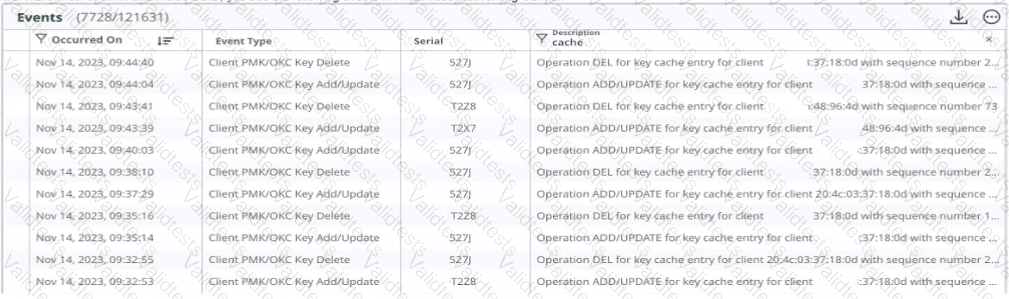
Question # 23

The customer asks you to investigate log messages What should you tell them?

Options:

A.

This indicates a security issue. The client with a MAC address ending with 37 18;0d Is performing a Denial-of-Service attack on your network. You should track down the client and remove it from the network.

B.

This is normal, expected behavior. No further actions are needed.

C.

This indicates a client WLAN driver issue for the client with a MAC address ending with 37:18

:Od. You should upgrade the client WLAN driver.

D.

There is a roaming issue Enable Fast Roaming 802.11r and OKC to resolve the issue.

Questions # 24:

The wireless administrator for a college campus is gelling reports of connectivity issues when students are working outdoors.
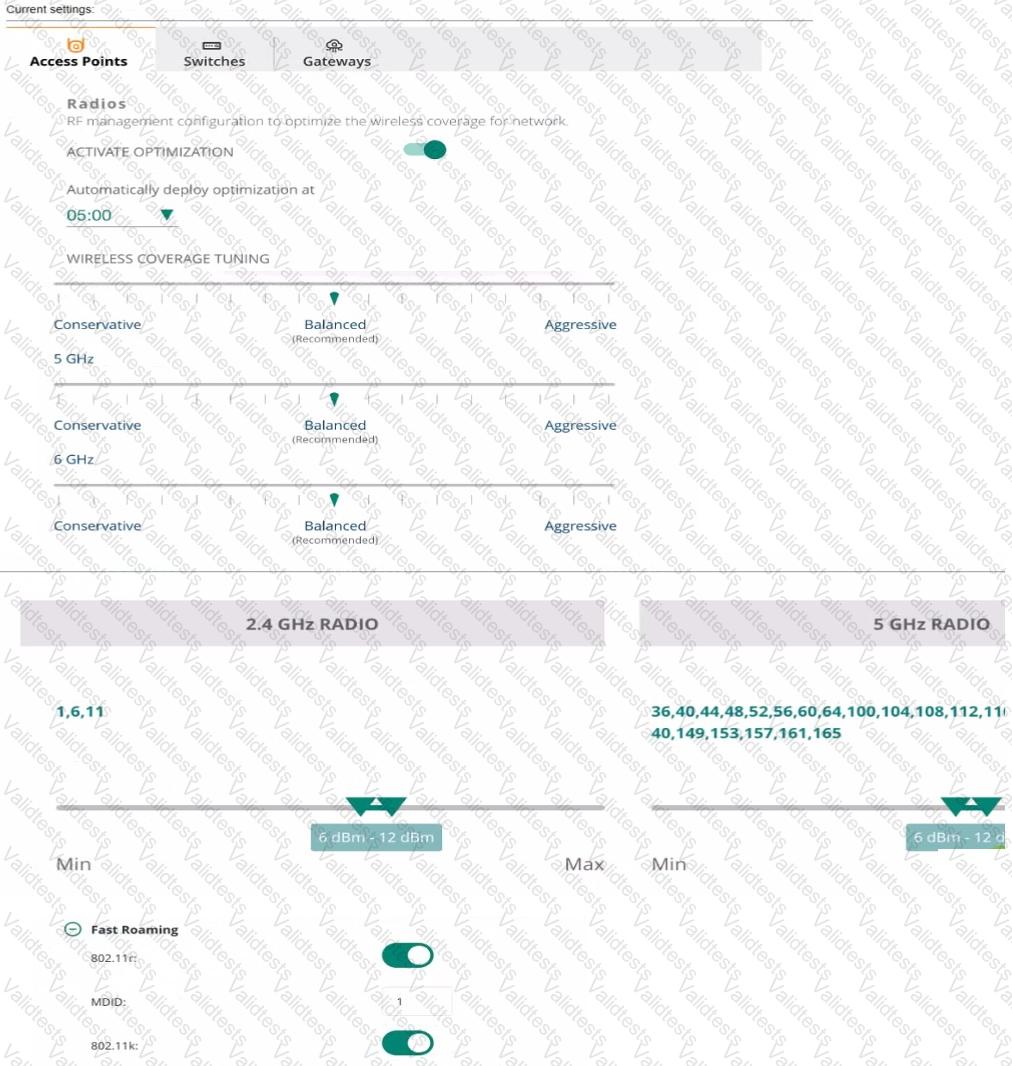
Question # 24

Reviewing the settings above, watch change is needed to align with best practices?

Options:

A.

Disable 802 11r.

B.

Disable 802 11k.

C.

increase 5Gnz TX power range Min/Max.

D.

increase 5 GHz wireless coverage tuning to Aggressive.

Questions # 25:

A customer is installing CX 6300 switches, mobility gateways, and AP-635s.

The customer's VoIP system uses both wired and wireless handsets.

The handsets are configured to mark voice traffic using a DSCP value of 46.

The wireless handsets connect to a bridged SSID using WPA3-SAE.

What will allow the switch to honor the QoS mark set by the handset?

Options:

A.

Configure Voice Wi-Fi Multimedia Share for DSCP 46 on the voice SSID

B.

Activate UCC for the HPE Aruba Networking Central Group managing the APs

C.

Enable QoS trust DSCP

D.

Enable WMM on the voice SSID

Questions # 26:

A customer is evaluating device profiles on a CX 6300 switch. The test device has the following attribute:
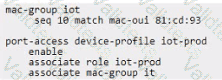
Question # 26

• MAC address=81:cd:93:13:ab:31

The test device needs to be assigned the "lot-prod'' role, in addition the "lot-default" role must be applied for any other device connected lo interface 1/1/1. This is a lab environment with no configuration of any external authentication server for the test.

Given the configuration example, what is required to meet this testing requirement?

Options:

A.

Enter the command "pot-access device-profile mode block-until-profile-applied"" for interface 1/1/1.

B.

Enter the command "port-access fallback-role lot-default globally

C.

Enter the command "port-access onboarding-method precedence" to set device profiles with a lower precedence.

D.

Enter the command "port-access device-profile mode block-until-profile-applied" globally.

Questions # 27:

A customer’s infrastructure is set up to use both primary and secondary gateway clusters on the SSID profile based on best practices What is a valid cause tor having an equal spirt in APs connected to the primary and secondary gateway clusters?

Options:

A.

The secondary gateway cluster is heterogeneous

B.

The secondary gateway cluster is homogeneous

C.

The primary gateway cluster is up. out some APs are unable to reach the primary gateway cluster. These APs would connect to the secondary gateway cluster

D.

The primary gateway cluster is up. out some APs cannot reach the secondary gateway cluster. These APs would connect to the secondary gateway cluster

Questions # 28:

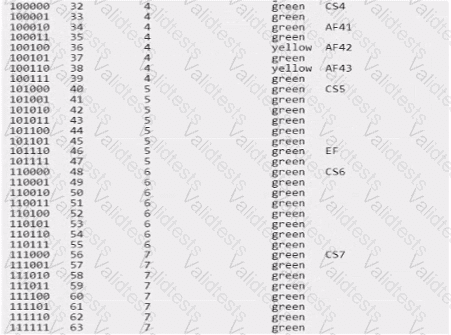
The ACME company has an AOS-CX 6200 VSF switch slack with an uplink over subscription ratio of 9.6:1. They have indicated that their low-priority TCP traffic has been flagged with a DSCP marking coloring them yellow.

Refer to the exhibit.
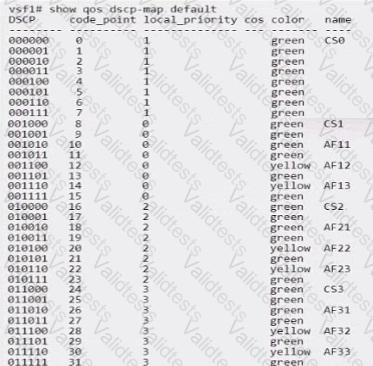
Question # 28

Question # 28

They are considering adding two more nodes to the stack without adding any additional uplinks due to existing wiring constraints. One of their architects has suggested adding the following configuration:

Question # 28

What would be the impact of applying the acmethreshold profile as shown? (Select two.)

Options:

A.

All upper-layer protocol traffic egressing LAG1 will be subject to drop probability.

B.

All TCP traffic egressing LAG1 wail be subject to drop probability

C.

Only VoIP packets egressing queue 5 on LAG1 will likely be protected from uplink over-utilization.

D.

VoIP packets egressing any queue on LAG1 will more likely be protected from uplink over-utilization

E.

Yellow-flagged TCP traffic egressing LAG1 will be subject to drop probability

Questions # 29:

You deployed UBT to securely tunnel traffic from user desktop PCs connected behind VOIP phones Ail other non-UBT dents are connected to a different network. After the deployment users reported interruptions lo their phone service

Options:

A.

The VLAN on which UBT clients are placed is not configured on the switch uplink and traffic from the VoIP phones is being dropped

B.

You tailed to correctly configure a user-defined VRF to support the UBT clients behind the VoIP phones, causing traffic to drop.

C.

Broadcast/multicast packets are copied to both the tunnel and locally, causing duplicate packets and network instability

D.

The UBT client broadcast/multicast packets returned to the same switch port and corrupted the phones IMC table

Questions # 30:

A customer's infrastructure is set up to use both primary and secondary gateway clusters on the SSID profile based on best practices. Why do they have an equal split of their 260 APs across the primary and secondary gateway clusters?

Options:

A.

The primary gateway cluster is up, but some APs cannot reach the secondary gateway cluster. These APs would connect to the secondary gateway cluster

B.

The secondary gateway cluster is homogeneous

C.

The secondary gateway cluster is heterogeneous

D.

The primary gateway cluster is up, but some APs cannot reach the primary gateway cluster. These APs would connect to the secondary gateway cluster

Viewing page 3 out of 4 pages
Viewing questions 21-30 out of questions