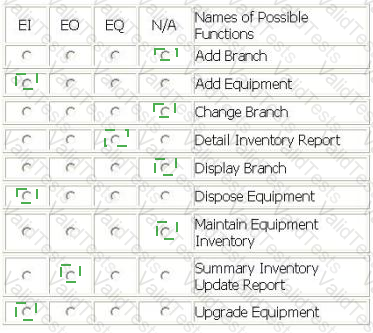
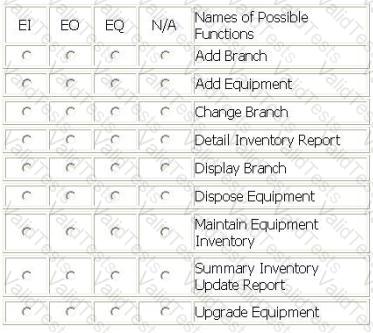
An Assets Tracking application has a batch update process. Twice a month each of the branch offices sends a transaction file to the headquarters.
Records are flagged with an "A" for equipment that is Added to the inventory; "C" for equipment that has been Upgraded or refurbished; "D" for equipment that has been Disposed of and is to be removed from inventory.
A summary inventory update report will be created that totals number of inventory records added, changed and deleted broken out by equipment type. The report will be sorted by branch and will start on a new page for each change of branch.
A detail inventory report will be available to the branches with the detail of inventory records updated.
From the Names of Possible Functions listed identify the transactional functions for the Assets Tracking application. Select N/A if a Name of Possible Functions does not apply.
Identify the functions used.
PAYROLL APPLICATION - MAINTAIN EMPLOYEE TIME SCREEN
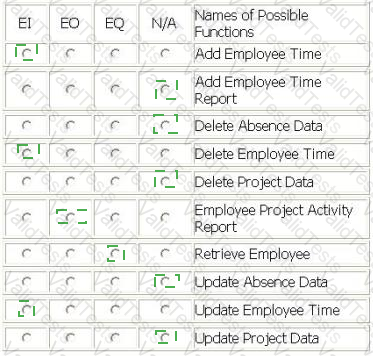
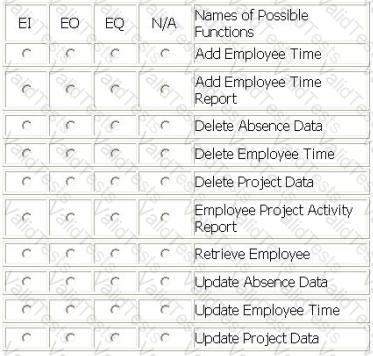
Employees can Add or Update their weekly hours information by entering the project and absence data on the Maintain Employee Time screen. Data is saved to the Employee Payroll ILF.
To begin the Add or Update from the Maintain Employee Time screen, the employee enters his/her employee badge number presses the Retrieve button. Retrieve will fill in the employee name and supervisor badge number from the Employee Master ILF, and will display the current pay period start date and end date from the Payroll Master ILF.
Employees can Delete existing weekly hours information by entering his/her employee badge number and pressing the delete button on the Maintain Employee Time screen. When the employee presses the delete button the current pay period hours will be removed from the Employee Payroll ILF.
PAYROLL APPLICATION - EMPLOYEE PROJECT ACTIVITY REPORT
The Employee Project Activity report is produced for each employee and routed electronically to that employee's email address. Each employee's project task hours for the current pay period are read from the Employee Payroll ILF. The report calculates and displays both daily and weekly total hours for the current pay period.
From the Names of Possible Functions listed identify the transactional functions for the Payroll application. Select N/A if a Name of Possible Functions does not apply.
Identify the functions used.
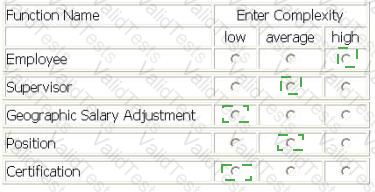
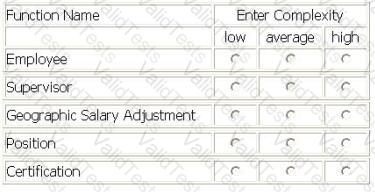
The Human Resources (HR) application contains 5 data functions.
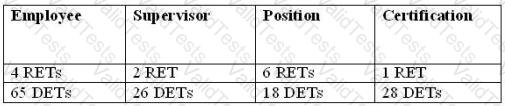
Determine the complexity of data functions:
Select the complexity for each function:
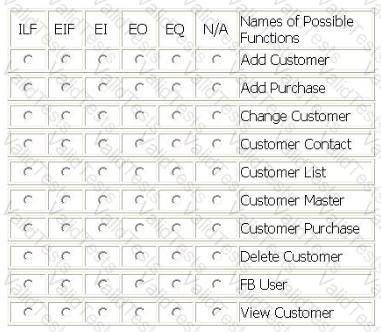
The High Point grocery store has implemented a frequent buyer program. Discounts on various products will be provided as an incentive for customers to register in the program. The Frequent Buyer (FB) application is being built to collect and store the customer information and to keep track of the purchasing patterns of the customers.
The customers will fill out a form providing their contact information and other demographic information
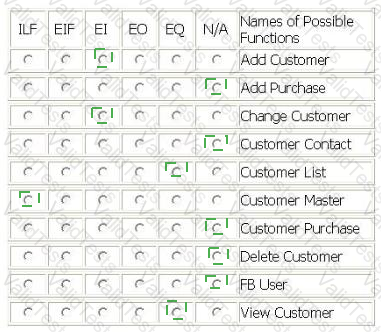
FB users will use the Customer screen to Add Customer information in the Customer Master logical file.
FB users also use the Customer screen to View Customer information and Change Customer Information.
The Customer List report lists all customers and is available for display by selecting the Customer List report option from the Main Menu.
From the Names of Possible Functions listed identify the base functional components for the FB application. Select N/A if a Name of Possible Function Type does not apply.
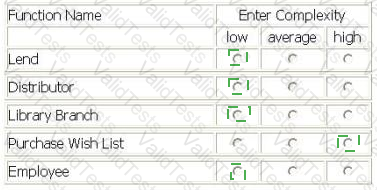
LIBRARY INFORMATION SYSTEM (LIS)
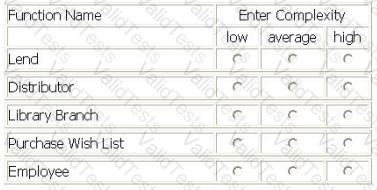
The Lend Text functions allow the LIS user to register information about the texfs lending in the Lend logical file. Data stored and maintained in Lend are: ISBN code, enroll code, lend date, due date, return date.
LIS maintains information about the Distributors from whom the library orders books, magazines and other publications. Account number, distributor name and 10 other logical pieces of information are maintained.
Library Branch data is stored in LIS and is maintainable by the library staff. Information Is maintained on 10 branches. Data maintained includes branch id, branch name, location, directions, hours of operation, and 17 other logical pieces of information.
Purchase Wish List logical file is maintained by LIS. Employees enter books, magazines, video recordings, audio recordings and personal computer software that they believe the library patrons would be interested in borrowing. This list is used as a source when making purchase decisions. The information is grouped by media type and information is collected based on the media type.
There are 8 common pieces of data collected for all media types
book information contains 10 additional logical pieces
of data o magazine information contains 13 additional logical
pieces of data o video recordings information contains 12 additional
logical pieces of data o audio recordings information contains 14 additional
logical pieces of data
Employee logical file is maintained in the LIS application and contains information about the library staff, including employee id, name, address, full or part time status, and title.
Determine the complexity of the following functions:
Select the complexity for each function
An External Input is an elementary process that:
In which life cycle phase can size NOT be measured?
The functional complexity of an EO is based upon which of the following?
An example of the purpose of an FP count is to provide:
What is a user identifiable group of logically related data or control information referenced by the application, but maintained within the boundary of another application?