Which of the following usually provides reliable, real-time information without consuming network or host resources?
network-based IDS
host-based IDS
application-based IDS
firewall-based IDS
A network-based IDS usually provides reliable, real-time information without consuming network or host resources.
Source: KRUTZ, Ronald L. & VINES, Russel D., The CISSP Prep Guide: Mastering the Ten Domains of Computer Security, 2001, John Wiley & Sons, Page 48.
Which of the following best describes signature-based detection?
Compare source code, looking for events or sets of events that could cause damage to a system or network.
Compare system activity for the behaviour patterns of new attacks.
Compare system activity, looking for events or sets of events that match a predefined pattern of events that describe a known attack.
Compare network nodes looking for objects or sets of objects that match a predefined pattern of objects that may describe a known attack.
Misuse detectors compare system activity, looking for events or sets of events that match a predefined pattern of events that describe a known attack. As the patterns corresponding to known attacks are called signatures, misuse detection is sometimes called "signature-based detection."
The most common form of misuse detection used in commercial products specifies each pattern of events corresponding to an attack as a separate signature. However, there are more sophisticated approaches to doing misuse detection (called "state-based" analysis techniques) that can leverage a single signature to detect groups of attacks.
Which of the following Intrusion Detection Systems (IDS) uses a database of attacks, known system vulnerabilities, monitoring current attempts to exploit those vulnerabilities, and then triggers an alarm if an attempt is found?
Knowledge-Based ID System
Application-Based ID System
Host-Based ID System
Network-Based ID System
Knowledge-based Intrusion Detection Systems use a database of previous attacks and known system vulnerabilities to look for current attempts to exploit their vulnerabilities, and trigger an alarm if an attempt is found.
Source: KRUTZ, Ronald L. & VINES, Russel D., The CISSP Prep Guide: Mastering the Ten Domains of Computer Security, 2001, John Wiley & Sons, Page 87.
Application-Based ID System - "a subset of HIDS that analyze what's going on in an application using the transaction log files of the application." Source: Official ISC2 CISSP CBK Review Seminar Student Manual Version 7.0 p. 87
Host-Based ID System - "an implementation of IDS capabilities at the host level. Its most significant difference from NIDS is intrusion detection analysis, and related processes are limited to the boundaries of the host." Source: Official ISC2 Guide to the CISSP CBK - p. 197
Network-Based ID System - "a network device, or dedicated system attached to teh network, that monitors traffic traversing teh network segment for which it is integrated." Source: Official ISC2 Guide to the CISSP CBK - p. 196
Which of the following is used to monitor network traffic or to monitor host audit logs in real time to determine violations of system security policy that have taken place?
Intrusion Detection System
Compliance Validation System
Intrusion Management System (IMS)
Compliance Monitoring System
An Intrusion Detection System (IDS) is a system that is used to monitor network traffic or to monitor host audit logs in order to determine if any violations of an organization's system security policy have taken place.
Source: KRUTZ, Ronald L. & VINES, Russel D., The CISSP Prep Guide: Mastering the Ten Domains of Computer Security, 2001, John Wiley & Sons, Page 48.
Which of the following is NOT a valid reason to use external penetration service firms rather than corporate resources?
They are more cost-effective
They offer a lack of corporate bias
They use highly talented ex-hackers
They ensure a more complete reporting
Two points are important to consider when it comes to ethical hacking: integrity and independence.
By not using an ethical hacking firm that hires or subcontracts to ex-hackers of others who have criminal records, an entire subset of risks can be avoided by an organization. Also, it is not cost-effective for a single firm to fund the effort of the ongoing research and development, systems development, and maintenance that is needed to operate state-of-the-art proprietary and open source testing tools and techniques.
External penetration firms are more effective than internal penetration testers because they are not influenced by any previous system security decisions, knowledge of the current system environment, or future system security plans. Moreover, an employee performing penetration testing might be reluctant to fully report security gaps.
Source: KRUTZ, Ronald L. & VINES, Russel D., The CISSP Prep Guide: Mastering the Ten Domains of Computer Security, John Wiley & Sons, 2001, Appendix F: The Case for Ethical Hacking (page 517).
Attributable data should be:
always traced to individuals responsible for observing and recording the data
sometimes traced to individuals responsible for observing and recording the data
never traced to individuals responsible for observing and recording the data
often traced to individuals responsible for observing and recording the data
As per FDA data should be attributable, original, accurate, contemporaneous and legible. In an automated system attributability could be achieved by a computer system designed to identify individuals responsible for any input.
Source: U.S. Department of Health and Human Services, Food and Drug Administration, Guidance for Industry - Computerized Systems Used in Clinical Trials, April 1999, page 1.
Which of the following is needed for System Accountability?
Audit mechanisms.
Documented design as laid out in the Common Criteria.
Authorization.
Formal verification of system design.
Is a means of being able to track user actions. Through the use of audit logs and other tools the user actions are recorded and can be used at a later date to verify what actions were performed.
Accountability is the ability to identify users and to be able to track user actions.
The following answers are incorrect:
Documented design as laid out in the Common Criteria. Is incorrect because the Common Criteria is an international standard to evaluate trust and would not be a factor in System Accountability.
Authorization. Is incorrect because Authorization is granting access to subjects, just because you have authorization does not hold the subject accountable for their actions.
Formal verification of system design. Is incorrect because all you have done is to verify the system design and have not taken any steps toward system accountability.
References:
OIG CBK Glossary (page 778)
Several analysis methods can be employed by an IDS, each with its own strengths and weaknesses, and their applicability to any given situation should be carefully considered. There are two basic IDS analysis methods that exists. Which of the basic method is more prone to false positive?
Pattern Matching (also called signature analysis)
Anomaly Detection
Host-based intrusion detection
Network-based intrusion detection
Several analysis methods can be employed by an IDS, each with its own strengths and weaknesses, and their applicability to any given situation should be carefully considered.
There are two basic IDS analysis methods:
1. Pattern Matching (also called signature analysis), and
2. Anomaly detection
PATTERN MATCHING
Some of the first IDS products used signature analysis as their detection method and simply looked for known characteristics of an attack (such as specific packet sequences or text in the data stream) to produce an alert if that pattern was detected. If a new or different attack vector is used, it will not match a known signature and, thus, slip past the IDS.
ANOMALY DETECTION
Alternately, anomaly detection uses behavioral characteristics of a system’s operation or network traffic to draw conclusions on whether the traffic represents a risk to the network or host. Anomalies may include but are not limited to:
Multiple failed log-on attempts
Users logging in at strange hours
Unexplained changes to system clocks
Unusual error messages
Unexplained system shutdowns or restarts
Attempts to access restricted files
An anomaly-based IDS tends to produce more data because anything outside of the expected behavior is reported. Thus, they tend to report more false positives as expected behavior patterns change. An advantage to anomaly-based IDS is that, because they are based on behavior identification and not specific patterns of traffic, they are often able to detect new attacks that may be overlooked by a signature-based system. Often information from an anomaly-based IDS may be used to create a pattern for a signature-based IDS.
Host Based Intrusion Detection (HIDS)
HIDS is the implementation of IDS capabilities at the host level. Its most significant difference from NIDS is that related processes are limited to the boundaries of a single-host system. However, this presents advantages in effectively detecting objectionable activities because the IDS process is running directly on the host system, not just observing it from the network. This offers unfettered access to system logs, processes, system information, and device information, and virtually eliminates limits associated with encryption. The level of integration represented by HIDS increases the level of visibility and control at the disposal of the HIDS application.
Network Based Intrustion Detection (NIDS)
NIDS are usually incorporated into the network in a passive architecture, taking advantage of promiscuous mode access to the network. This means that it has visibility into every packet traversing the network segment. This allows the system to inspect packets and monitor sessions without impacting the network or the systems and applications utilizing the network.
Below you have other ways that instrusion detection can be performed:
Stateful Matching Intrusion Detection
Stateful matching takes pattern matching to the next level. It scans for attack signatures in the context of a stream of traffic or overall system behavior rather than the individual packets or discrete system activities. For example, an attacker may use a tool that sends a volley of valid packets to a targeted system. Because all the packets are valid, pattern matching is nearly useless. However, the fact that a large volume of the packets was seen may, itself, represent a known or potential attack pattern. To evade attack, then, the attacker may send the packets from multiple locations with long wait periods between each transmission to either confuse the signature detection system or exhaust its session timing window. If the IDS service is tuned to record and analyze traffic over a long period of time it may detect such an attack. Because stateful matching also uses signatures, it too must be updated regularly and, thus, has some of the same limitations as pattern matching.
Statistical Anomaly-Based Intrusion Detection
The statistical anomaly-based IDS analyzes event data by comparing it to typical, known, or predicted traffic profiles in an effort to find potential security breaches. It attempts to identify suspicious behavior by analyzing event data and identifying patterns of entries that deviate from a predicted norm. This type of detection method can be very effective and, at a very high level, begins to take on characteristics seen in IPS by establishing an expected baseline of behavior and acting on divergence from that baseline. However, there are some potential issues that may surface with a statistical IDS. Tuning the IDS can be challenging and, if not performed regularly, the system will be prone to false positives. Also, the definition of normal traffic can be open to interpretation and does not preclude an attacker from using normal activities to penetrate systems. Additionally, in a large, complex, dynamic corporate environment, it can be difficult, if not impossible, to clearly define “normal” traffic. The value of statistical analysis is that the system has the potential to detect previously unknown attacks. This is a huge departure from the limitation of matching previously known signatures. Therefore, when combined with signature matching technology, the statistical anomaly-based IDS can be very effective.
Protocol Anomaly-Based Intrusion Detection
A protocol anomaly-based IDS identifies any unacceptable deviation from expected behavior based on known network protocols. For example, if the IDS is monitoring an HTTP session and the traffic contains attributes that deviate from established HTTP session protocol standards, the IDS may view that as a malicious attempt to manipulate the protocol, penetrate a firewall, or exploit a vulnerability. The value of this method is directly related to the use of well-known or well-defined protocols within an environment. If an organization primarily uses well-known protocols (such as HTTP, FTP, or telnet) this can be an effective method of performing intrusion detection. In the face of custom or nonstandard protocols, however, the system will have more difficulty or be completely unable to determine the proper packet format. Interestingly, this type of method is prone to the same challenges faced by signature-based IDSs. For example, specific protocol analysis modules may have to be added or customized to deal with unique or new protocols or unusual use of standard protocols. Nevertheless, having an IDS that is intimately aware of valid protocol use can be very powerful when an organization employs standard implementations of common protocols.
Traffic Anomaly-Based Intrusion
Detection A traffic anomaly-based IDS identifies any unacceptable deviation from expected behavior based on actual traffic structure. When a session is established between systems, there is typically an expected pattern and behavior to the traffic transmitted in that session. That traffic can be compared to expected traffic conduct based on the understandings of traditional system interaction for that type of connection. Like the other types of anomaly-based IDS, traffic anomaly-based IDS relies on the ability to establish “normal” patterns of traffic and expected modes of behavior in systems, networks, and applications. In a highly dynamic environment it may be difficult, if not impossible, to clearly define these parameters.
Reference(s) used for this question:
Hernandez CISSP, Steven (2012-12-21). Official (ISC)2 Guide to the CISSP CBK, Third Edition ((ISC)2 Press) (Kindle Locations 3664-3686). Auerbach Publications. Kindle Edition.
and
Hernandez CISSP, Steven (2012-12-21). Official (ISC)2 Guide to the CISSP CBK, Third Edition ((ISC)2 Press) (Kindle Locations 3711-3734). Auerbach Publications. Kindle Edition.
and
Hernandez CISSP, Steven (2012-12-21). Official (ISC)2 Guide to the CISSP CBK, Third Edition ((ISC)2 Press) (Kindle Locations 3694-3711). Auerbach Publications. Kindle Edition.
What setup should an administrator use for regularly testing the strength of user passwords?
A networked workstation so that the live password database can easily be accessed by the cracking program.
A networked workstation so the password database can easily be copied locally and processed by the cracking program.
A standalone workstation on which the password database is copied and processed by the cracking program.
A password-cracking program is unethical; therefore it should not be used.
Poor password selection is frequently a major security problem for any system's security. Administrators should obtain and use password-guessing programs frequently to identify those users having easily guessed passwords.
Because password-cracking programs are very CPU intensive and can slow the system on which it is running, it is a good idea to transfer the encrypted passwords to a standalone (not networked) workstation. Also, by doing the work on a non-networked machine, any results found will not be accessible by anyone unless they have physical access to that system.
Out of the four choice presented above this is the best choice.
However, in real life you would have strong password policies that enforce complexity requirements and does not let the user choose a simple or short password that can be easily cracked or guessed. That would be the best choice if it was one of the choice presented.
Another issue with password cracking is one of privacy. Many password cracking tools can avoid this by only showing the password was cracked and not showing what the password actually is. It is masking the password being used from the person doing the cracking.
Source: National Security Agency, Systems and Network Attack Center (SNAC), The 60 Minute Network Security Guide, February 2002, page 8.
Which of the following would NOT violate the Due Diligence concept?
Security policy being outdated
Data owners not laying out the foundation of data protection
Network administrator not taking mandatory two-week vacation as planned
Latest security patches for servers being installed as per the Patch Management process
To be effective a patch management program must be in place (due diligence) and detailed procedures would specify how and when the patches are applied properly (Due Care). Remember, the question asked for NOT a violation of Due Diligence, in this case, applying patches demonstrates due care and the patch management process in place demonstrates due diligence.
Due diligence is the act of investigating and understanding the risks the company faces. A company practices by developing and implementing security policies, procedures, and standards. Detecting risks would be based on standards such as ISO 2700, Best Practices, and other published standards such as NIST standards for example.
Due Diligence is understanding the current threats and risks. Due diligence is practiced by activities that make sure that the protection mechanisms are continually maintained and operational where risks are constantly being evaluated and reviewed. The security policy being outdated would be an example of violating the due diligence concept.
Due Care is implementing countermeasures to provide protection from those threats. Due care is when the necessary steps to help protect the company and its resources from possible risks that have been identifed. If the information owner does not lay out the foundation of data protection (doing something about it) and ensure that the directives are being enforced (actually being done and kept at an acceptable level), this would violate the due care concept.
If a company does not practice due care and due diligence pertaining to the security of its assets, it can be legally charged with negligence and held accountable for any ramifications of that negligence. Liability is usually established based on Due Diligence and Due Care or the lack of either.
A good way to remember this is using the first letter of both words within Due Diligence (DD) and Due Care (DC).
Due Diligence = Due Detect
Steps you take to identify risks based on best practices and standards.
Due Care = Due Correct.
Action you take to bring the risk level down to an acceptable level and maintaining that level over time.
The Following answer were wrong:
Security policy being outdated:
While having and enforcing a security policy is the right thing to do (due care), if it is outdated, you are not doing it the right way (due diligence). This questions violates due diligence and not due care.
Data owners not laying out the foundation for data protection:
Data owners are not recognizing the "right thing" to do. They don't have a security policy.
Network administrator not taking mandatory two week vacation:
The two week vacation is the "right thing" to do, but not taking the vacation violates due diligence (not doing the right thing the right way)
Reference(s) used for this question
Shon Harris, CISSP All In One, Version 5, Chapter 3, pg 110
Which of the following would be LESS likely to prevent an employee from reporting an incident?
They are afraid of being pulled into something they don't want to be involved with.
The process of reporting incidents is centralized.
They are afraid of being accused of something they didn't do.
They are unaware of the company's security policies and procedures.
The reporting process should be centralized else employees won't bother.
The other answers are incorrect because :
They are afraid of being pulled into something they don't want to be involved with is incorrect as most of the employees fear of this and this would prevent them to report an incident.
They are afraid of being accused of something they didn't do is also incorrect as this also prevents them to report an incident.
They are unaware of the company's security policies and procedures is also incorrect as mentioned above.
Reference : Shon Harris AIO v3 , Ch-10 : Laws , Investigatio & Ethics , Page : 675.
Attributes that characterize an attack are stored for reference using which of the following Intrusion Detection System (IDS) ?
signature-based IDS
statistical anomaly-based IDS
event-based IDS
inferent-based IDS
Source: KRUTZ, Ronald L. & VINES, Russel D., The CISSP Prep Guide: Mastering the Ten Domains of Computer Security, 2001, John Wiley & Sons, Page 49.
Which of the following is NOT a VPN communications protocol standard?
Point-to-point tunnelling protocol (PPTP)
Challenge Handshake Authentication Protocol (CHAP)
Layer 2 tunnelling protocol (L2TP)
IP Security
CHAP is an authentication mechanism for point-to-point protocol connections that encrypt the user's password. It is a protocol that uses a three-way handshake. The server sends the client a challenge, which includes a random value (a nonce) to thwart replay attacks. The client responds with a MD5 hash of the nonce and the password. The authentication is successful if the client’s response is the one that the server expected.
The VPN communication protocol standards listed above are PPTP, L2TP and IPSec.
PPTP and L2TP operate at the data link layer (layer 2) of the OSI model and enable only a single point-to-point connection per session.
The following are incorrect answers:
PPTP uses native PPP authentication and encryption services. Point-to-Point Tunneling Protocol (PPTP) is a VPN protocol that runs over other protocols. PPTP relies on generic routing encapsulation (GRE) to build the tunnel between the endpoints. After the user authenticates, typically with Microsoft Challenge Handshake Authentication Protocol version 2 (MSCHAPv2), a Point-to-Point Protocol (PPP) session creates a tunnel using GRE.
L2TP is a combination of PPTP and the earlier Layer 2 Forwarding protocol (L2F). Layer 2 Tunneling Protocol (L2TP) is a hybrid of Cisco’s Layer 2 Forwarding (L2F) and Microsoft’s PPTP. It allows callers over a serial line using PPP to connect over the Internet to a remote network. A dial-up user connects to his ISP’s L2TP access concentrator (LAC) with a PPP connection. The LAC encapsulates the PPP packets into L2TP and forwards it to the remote network’s layer 2 network server (LNS). At this point, the LNS authenticates the dial-up user. If authentication is successful, the dial-up user will have access to the remote network.
IPSec operates at the network layer (layer 3) and enables multiple simultaneous tunnels. IP Security (IPSec) is a suite of protocols for communicating securely with IP by providing mechanisms for authenticating and encryption. Implementation of IPSec is mandatory in IPv6, and many organizations are using it over IPv4. Further, IPSec can be implemented in two modes, one that is appropriate for end-to-end protection and one that safeguards traffic between networks.
Reference used for this question:
Hernandez CISSP, Steven (2012-12-21). Official (ISC)2 Guide to the CISSP CBK, Third Edition ((ISC)2 Press) (Kindle Locations 7067-7071). Auerbach Publications. Kindle Edition.
and
Hernandez CISSP, Steven (2012-12-21). Official (ISC)2 Guide to the CISSP CBK, Third Edition ((ISC)2 Press) (Kindle Locations 6987-6990). Auerbach Publications. Kindle Edition.
What is called an attack in which an attacker floods a system with connection requests but does not respond when the target system replies to those requests?
Ping of death attack
SYN attack
Smurf attack
Buffer overflow attack
A SYN attack occurs when an attacker floods the target system's small "in-process" queue with connection requests, but it does not respond when the target system replies to those requests. This causes the target system to "time out" while waiting for the proper response, which makes the system crash or become unusable. A buffer overflow attack occurs when a process receives much more data than expected. One common buffer overflow attack is the ping of death, where an attacker sends IP packets that exceed the maximum legal length (65535 octets). A smurf attack is an attack where the attacker spoofs the source IP address in an ICMP ECHO broadcast packet so it seems to have originated at the victim's system, in order to flood it with REPLY packets.
Source: KRUTZ, Ronald L. & VINES, Russel D., The CISSP Prep Guide: Mastering the Ten Domains of Computer Security, John Wiley & Sons, 2001, Chapter 3: Telecommunications and Network Security (page 76).
Network cabling comes in three flavors, they are:
twisted pair, coaxial, and fiber optic.
tagged pair, coaxial, and fiber optic.
trusted pair, coaxial, and fiber optic.
twisted pair, control, and fiber optic.
Network cabling comes in three flavors: twisted pair, coaxial, and fiber optic.
Twisted pair
Twisted pair cabling is a form of wiring in which two wires (the forward and return conductors of a single circuit) are twisted together for the purposes of canceling out electromagnetic interference (EMI) from external sources. This type of cable is used for home and corporate Ethernet networks. Twisted pair cables consist of two insulated copper wires. There are three types of twisted pair cables: Shielded, Unshielded and Foil
Fiber Optic cable
An optical fiber cable consists of a center glass core surrounded by several layers of protective material. The outer insulating jacket is made of Teflon or PVC to prevent interference. It is expensive but has higher bandwidth and can transmit data over longer distances.
Coaxial cable
Coaxial lines confine the electromagnetic wave to area inside the cable, between the center conductor and the shield. The transmission of energy in the line occurs totally through the dielectric inside the cable between the conductors. Coaxial lines can therefore be bent and twisted (subject to limits) without negative effects, and they can be strapped to conductive supports without inducing unwanted currents in them and though.
The most common use for coaxial cables is for television and other signals with bandwidth of multiple megahertz. Although in most homes coaxial cables have been installed for transmission of TV signals, new technologies (such as the ITU-T G.hn standard) open the possibility of using home coaxial cable for high-speed home networking applications (Ethernet over coax).
See the following page for more details: http://fcit.usf.edu/network/chap4/chap4.htm
Reference used for this question:
KRUTZ, Ronald L. & VINES, Russel D., The CISSP Prep Guide: Mastering the Ten Domains of Computer Security, 2001, John Wiley & Sons, Page 101.
and
Wikipedia at http://en.wikipedia.org/wiki/Networking_cables
Secure Shell (SSH-2) supports authentication, compression, confidentiality, and integrity, SSH is commonly used as a secure alternative to all of the following protocols below except:
telnet
rlogin
RSH
HTTPS
HTTPS is used for secure web transactions and is not commonly replaced by SSH.
Users often want to log on to a remote computer. Unfortunately, most early implementations to meet that need were designed for a trusted network. Protocols/programs, such as TELNET, RSH, and rlogin, transmit unencrypted over the network, which allows traffic to be easily intercepted. Secure shell (SSH) was designed as an alternative to the above insecure protocols and allows users to securely access resources on remote computers over an encrypted tunnel. SSH’s services include remote log-on, file transfer, and command execution. It also supports port forwarding, which redirects other protocols through an encrypted SSH tunnel. Many users protect less secure traffic of protocols, such as X Windows and VNC (virtual network computing), by forwarding them through a SSH tunnel. The SSH tunnel protects the integrity of communication, preventing session hijacking and other man-in-the-middle attacks. Another advantage of SSH over its predecessors is that it supports strong authentication. There are several alternatives for SSH clients to authenticate to a SSH server, including passwords and digital certificates. Keep in mind that authenticating with a password is still a significant improvement over the other protocols because the password is transmitted encrypted.
The following were wrong answers:
telnet is an incorrect choice. SSH is commonly used as an more secure alternative to telnet. In fact Telnet should not longer be used today.
rlogin is and incorrect choice. SSH is commonly used as a more secure alternative to rlogin.
RSH is an incorrect choice. SSH is commonly used as a more secure alternative to RSH.
Reference(s) used for this question:
Hernandez CISSP, Steven (2012-12-21). Official (ISC)2 Guide to the CISSP CBK, Third Edition ((ISC)2 Press) (Kindle Locations 7077-7088). Auerbach Publications. Kindle Edition.
Which device acting as a translator is used to connect two networks or applications from layer 4 up to layer 7 of the ISO/OSI Model?
Bridge
Repeater
Router
Gateway
A gateway is used to connect two networks using dissimilar protocols at the lower layers or it could also be at the highest level of the protocol stack.
Important Note:
For the purpose of the exam, you have to remember that a gateway is not synonymous to the term firewall.
The second thing you must remembers is the fact that a gateway act as a translation device.
It could be used to translate from IPX to TCP/IP for example. It could be used to convert different types of applications protocols and allow them to communicate together. A gateway could be at any of the OSI layers but usually tend to be higher up in the stack.
For your exam you should know the information below:
Repeaters
A repeater provides the simplest type of connectivity, because it only repeats electrical signals between cable segments, which enables it to extend a network. Repeaters work at the physical layer and are add-on devices for extending a network connection over a greater distance. The device amplifies signals because signals attenuate the farther they have to travel.
Repeaters can also work as line conditioners by actually cleaning up the signals. This works much better when amplifying digital signals than when amplifying analog signals, because digital signals are discrete units, which makes extraction of background noise from them much easier for the amplifier. If the device is amplifying analog signals, any accompanying noise often is amplified as well, which may further distort the signal.
A hub is a multi-port repeater. A hub is often referred to as a concentrator because it is the physical communication device that allows several computers and devices to communicate with each other. A hub does not understand or work with IP or MAC addresses. When one system sends a signal to go to another system connected to it, the signal is broadcast to all the ports, and thus to all the systems connected to the concentrator.
Repeater
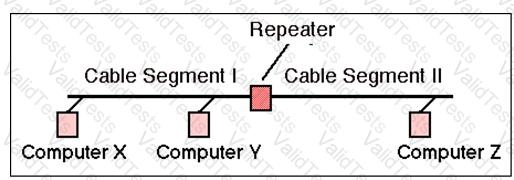
Image Reference- http://www.erg.abdn.ac.uk/~gorry/course/images/repeater.gif
Bridges
A bridge is a LAN device used to connect LAN segments. It works at the data link layer and therefore works with MAC addresses. A repeater does not work with addresses; it just forwards all signals it receives. When a frame arrives at a bridge, the bridge determines whether or not the MAC address is on the local network segment. If the MAC address is not on the local network segment, the bridge forwards the frame to the necessary network segment.
Bridge
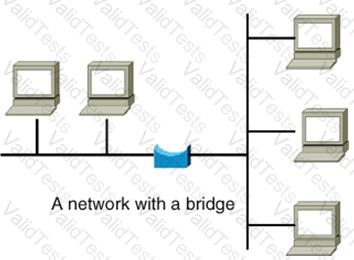
Image Reference- http://www.oreillynet.com/network/2001/01/30/graphics/bridge.jpg
Routers
Routers are layer 3, or network layer, devices that are used to connect similar or different networks. (For example, they can connect two Ethernet LANs or an Ethernet LAN to a Token Ring LAN.) A router is a device that has two or more interfaces and a routing table so it knows how to get packets to their destinations. It can filter traffic based on access control lists (ACLs), and it fragments packets when necessary. Because routers have more network-level knowledge, they can perform higher-level functions, such as calculating the shortest and most economical path between the sending and receiving hosts.
Router and Switch
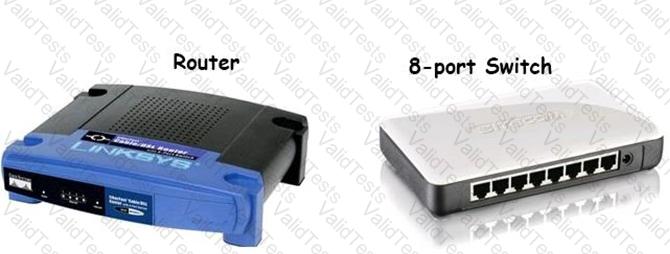
Image Reference- http://www.computer-networking-success.com/images/router-switch.jpg
Switches
Switches combine the functionality of a repeater and the functionality of a bridge. A switch amplifies the electrical signal, like a repeater, and has the built-in circuitry and intelligence of a bridge. It is a multi-port connection device that provides connections for individual computers or other hubs and switches.
Gateways
Gateway is a general term for software running on a device that connects two different environments and that many times acts as a translator for them or somehow restricts their interactions. Usually a gateway is needed when one environment speaks a different language, meaning it uses a certain protocol that the other environment does not understand. The gateway can translate Internetwork Packet Exchange (IPX) protocol
packets to IP packets, accept mail from one type of mail server and format it so another type of mail server can accept and understand it, or connect and translate different data link technologies such as FDDI to Ethernet.
Gateway Server
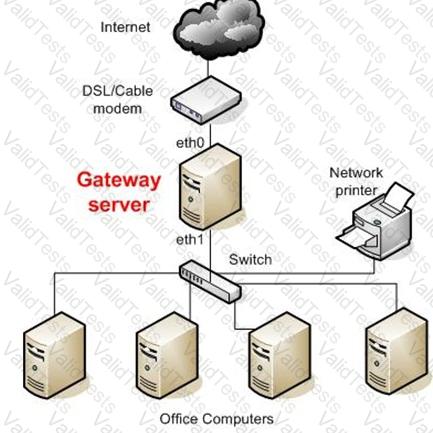
Image Reference- http://static.howtoforge.com/images/screenshots/556af08d5e43aa768260f9e589dc547f-3024.jpg
The following answers are incorrect:
Repeater - A repeater provides the simplest type of connectivity, because it only repeats electrical signals between cable segments, which enables it to extend a network. Repeaters work at the physical layer and are add-on devices for extending a network connection over a greater distance. The device amplifies signals because signals attenuate the farther they have to travel.
Bridges - A bridge is a LAN device used to connect LAN segments. It works at the data link layer and therefore works with MAC addresses. A repeater does not work with addresses; it just forwards all signals it receives. When a frame arrives at a bridge, the bridge determines whether or not the MAC address is on the local network segment. If the MAC address is not on the local network segment, the bridge forwards the frame to the necessary network segment.
Routers - Routers are layer 3, or network layer, devices that are used to connect similar or different networks. (For example, they can connect two Ethernet LANs or an Ethernet LAN to a Token Ring LAN.) A router is a device that has two or more interfaces and a routing table so it knows how to get packets to their destinations. It can filter traffic based on access control lists (ACLs), and it fragments packets when necessary.
Following reference(s) were/was used to create this question:
CISA review manual 2014 Page number 263
Official ISC2 guide to CISSP CBK 3rd Edition Page number 229 and 230
Secure Shell (SSH) is a strong method of performing:
client authentication
server authentication
host authentication
guest authentication
Secure shell (SSH) was designed as an alternative to some of the insecure protocols and allows users to securely access resources on remote computers over an encrypted tunnel. The Secure Shell Protocol (SSH) is a protocol for secure remote login and other secure network services over an insecure network. The SSH authentication protocol runs on top of the SSH transport layer protocol and provides a single authenticated tunnel for the SSH connection protocol.
SSH’s services include remote log-on, file transfer, and command execution. It also supports port forwarding, which redirects other protocols through an encrypted SSH tunnel. Many users protect less secure traffic of protocols, such as X Windows and VNC (virtual network computing), by forwarding them through a SSH tunnel.
The SSH tunnel protects the integrity of communication, preventing session hijacking and other man-in-the-middle attacks. Another advantage of SSH over its predecessors is that it supports strong authentication. There are several alternatives for SSH clients to authenticate to a SSH server, including passwords and digital certificates.
Keep in mind that authenticating with a password is still a significant improvement over the other protocols because the password is transmitted encrypted.
There are two incompatible versions of the protocol, SSH-1 and SSH-2, though many servers support both. SSH-2 has improved integrity checks (SSH-1 is vulnerable to an insertion attack due to weak CRC-32 integrity checking) and supports local extensions and additional types of digital certificates such as Open PGP. SSH was originally designed for UNIX, but there are now implementations for other operating systems, including Windows, Macintosh, and OpenVMS.
Is SSH 3.0 the same as SSH3?
The short answer is: NO SSH 3.0 refers to version 3 of SSH Communications SSH2 protocol implementation and it could also refer to OpenSSH Version 3.0 of its SSH2 software. The "3" refers to the software release version not the protocol version. As of this writing (July 2013), there is no SSH3 protocol.
"Server authentication" is incorrect. Though many SSH clients allow pre-caching of server/host keys, this is a minimal form of server/host authentication.
"Host authentication" is incorrect. Though many SSH clients allow pre-caching of server/host keys, this is a minimal form of server/host authentication.
"Guest authentication" is incorrect. The general idea of "guest" is that it is unauthenticated access.
Reference(s) used for this question:
http://www.ietf.org/rfc/rfc4252.txt
Hernandez CISSP, Steven (2012-12-21). Official (ISC)2 Guide to the CISSP CBK, Third Edition ((ISC)2 Press) (Kindle Locations 7080-7088). Auerbach Publications. Kindle Edition.
Why does fiber optic communication technology have significant security advantage over other transmission technology?
Higher data rates can be transmitted.
Interception of data traffic is more difficult.
Traffic analysis is prevented by multiplexing.
Single and double-bit errors are correctable.
It would be correct to select the first answer if the world "security" was not in the question.
Source: TIPTON, Hal, (ISC)2, Introduction to the CISSP Exam presentation.
SMTP can best be described as:
a host-to-host email protocol.
an email retrieval protocol.
a web-based e-mail reading protocol.
a standard defining the format of e-mail messages.
Simple Mail Transfer Protocol (SMTP) is a host-to-host email protocol. An SMTP server accepts email messages from other systems and stores them for the addressees. Stored email can be read in various ways. Users with interactive accounts on the email server machine can read the email using local email applications. Users on other systems can download their email via email clients using POP or IMAP email retrieval protocols. Sometimes mail can also be read through a web-based interface (using HTTP or HTTPS). MIME is a standard defining the format of e-mail messages, as stated in RFC2045.
Source: GUTTMAN, Barbara & BAGWILL, Robert, NIST Special Publication 800-xx, Internet Security Policy: A Technical Guide, Draft Version, May 25, 2000 (pages 91-92).


