
View all detail and faqs for the CTAL-TM_Syll2012 exam
Defect Management
Which of the following information would you expect to be the most useful to perform a defect clustering analysis?
Number of correct responses: 1
K21 credit
Defect Management
Assume you are working on a defect management process to be used by a software organization to track the current status of the defects reports for several projects.
When a defect is found for investigation a defect report is created in “Opened” state that is the unique initial state. The defect report status has also a unique finale state that is the “Closed” state.
The following state transition diagram describes the states of this defect management process:
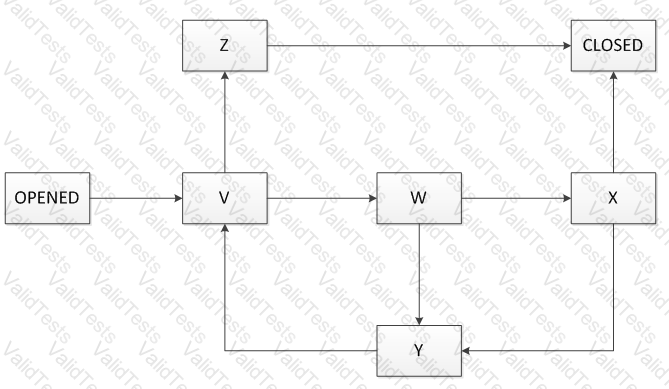
where only the initial (“Opened”) and final (“Closed”) states are indicated while the remaining states (V, W, X, Y, Z) have yet to be named.
Which of the following assignments would you expect to best complete the defect management process?
Number of correct responses: 1
K32 credits
Defect Management
Consider a defect report and assume that a part of its lifecycle includes the following states:
New: Is the initial state
Working: Means that the developers are addressing the defect in order to produce a fix for the defect
Clarification: Means that the developers need more information from the tester to address the defect and produce a fix for the defect and the tester is working to provide this information to the developers
Verification: Means that a fix for the defect has been produced and the tester is running the adequate tests to verify whether the fix solves the defect
Closed: is the final state
Which of the following answers represents an invalid sequence of states that can’t lead the bug report to the “Closed” state?
Number of correct responses: 1
K21 credit
Defect Management
During the system testing phase a tester from your test team observes a failure in the system under test and he/she decides to create an incident report. The incident report is currently in a “new” state, indicating it needs to be investigated.
Which THREE of the following information items can’t yet be present in the incident report?
Number of correct responses: 3
K32 credits (2 credits out of 3 credits correct, 1 credit point)
Test Management
Which of the following statements, about the test reporting activities for a project adopting an iterative lifecycle model with very short iterations (e.g. two weeks iterations), is correct?
Number of correct responses: 1
K21 credit
Your testing team has just received the test conditions for a new project. You are conducting Test Design activities for this project. Your team feels that it would be beneficial to create high-level test cases.
What should they do concurrently with creating these test cases? [2]
Which of the following should be considered the biggest risk to the schedule when trying to implement formal scripted test cases early in the SDLC for a system with a
large GUI front end? [2]
Which technique will assist you in determining targeted improvement areas to reduce the number of defects? [1]
You have done a comprehensive risk analysis. You have involved the appropriate people in assessing the risks and determining the likelihood and impact of those risks. You have been testing for three months and have been able to mitigate 75% of the high risk items. You have two weeks left in testing and you now do not expect to be able to complete all the items on the high-risk
mitigation list, never mind any from the medium or low-risk lists.
What is the most effective action you should take? [3]
You are the manager of a test team. You inherited most of these people from a previous manager who promoted technical skills, particularly
programming skills. As a result, your people are very strong in test automation skills, white box testing and complex test design
techniques. You have just been told that you can hire five new people. You want the new people to complement the existing skill sets and
you want to be sure the team will have a strong mutual respect.
Given the following options, who should you hire? [3]

