Pre-Summer Special Limited Time 70% Discount Offer - Ends in 0d 00h 00m 00s - Coupon code: validbest

Pass the Juniper JNCIS-ENT JN0-351 Questions and answers with ValidTests

Exam JN0-351 All Questions
Exam JN0-351 Premium Access

View all detail and faqs for the JN0-351 exam

Viewing page 2 out of 4 pages
Viewing questions 11-20 out of questions
Questions # 11:

In RSTP, which three port roles are associated with the discarding state? (Choose three.)

Options:

A.

root

B.

backup

C.

alternate

D.

disabled

E.

designated

Expert Solution
Questions # 12:

Which two statements about redundant trunk groups on EX Series switches are correct? (Choose two.)

Options:

A.

Redundant trunk groups use spanning tree to provide loop-free redundant uplinks.

B.

Redundant trunk groups load balance traffic across two designated uplink interfaces.

C.

Layer 2 control traffic is permitted on the secondary link.

D.

If the active link fails, then the secondary link automatically takes over.

Expert Solution
Questions # 13:

Which two statements about BGP facilitate the prevention of routing loops between two autonomous systems? (Choose two.)

Options:

A.

EBGP routers will append their AS number when advertising routes to their neighbors.

B.

EBGP routers will only accept routes that contain their own AS number in the AS_PATH.

C.

EBGP routers will drop routes that contain their own AS number in the AS_PATH

D.

EBGP routers will prepend their AS number when advertising routes to their neighbors

Expert Solution
Questions # 14:

After receiving a BGP route, which two conditions are verified by the receiving router to ensure that the received route is valid? (Choose two)

Options:

A.

The AS-path length is greater than 0.

B.

The loops do not exist.

C.

The next hop is reachable.

D.

The local preference is greater than 0.

Expert Solution
Questions # 15:

You have DHCP snooping enabled but no entries are automatically created in the snooping database for an interface on your EX Series switch. What are two reasons for the problem? (Choose two.)

Options:

A.

The device that is connected to the interface has performed a DHCPRELEASE.

B.

MAC limiting is enabled on the interface.

C.

The device that is connected to the interface has a static IP address.

D.

Dynamic ARP inspection is enabled on the interface.

Expert Solution
Questions # 16:

You are troubleshooting a BGP routing issue between your network and a customer router and are reviewing the BGP routing policies. Which two statements are correct in this scenario? (Choose two.)

Options:

A.

Export policies are applied to routes in the RIB-ln table.

B.

Import policies are applied to routes in the RIB-Local table.

C.

Import policies are applied after the RIB-ln table.

D.

Export policies are applied after the RIB-Local table.

Expert Solution
Questions # 17:

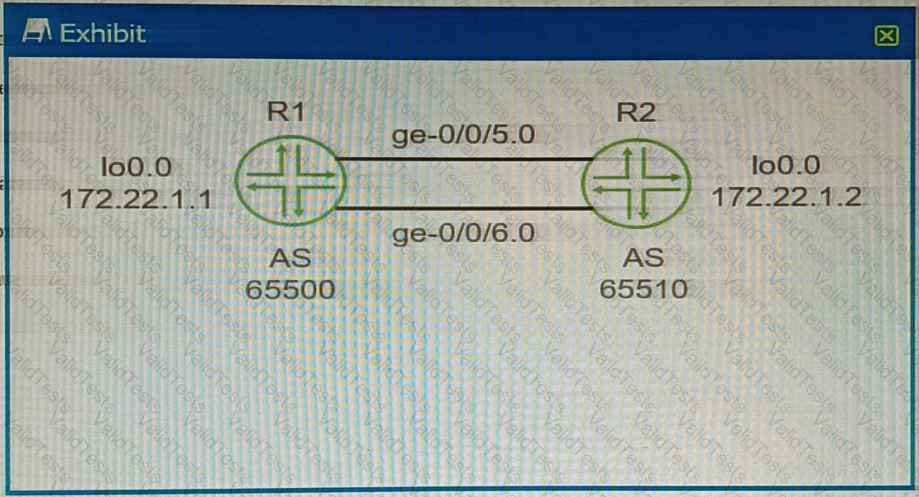
Exhibit.

Question # 17

You want to enable redundancy for the EBGP peering between the two routers shown in the exhibit. Which three actions will you perform in this scenario? (Choose three.)

Options:

A.

Configure BGP multihop.

B.

Configure loopback interface peering.

C.

Configure routes for the peer loopback interface IP addresses.

D.

Configure an MD5 peer authentication.

E.

Configure a cluster ID.

Expert Solution
Questions # 18:

Two routers share the same highest priority and start time.

Options:

A.

In this situation, what is evaluated next when determining the designated router? The router with the lowest router ID become the DR.

B.

The router with the highest router ID becomes the DR

C.

The routers perform another DR election.

D.

The router with the highest MAC address become the DR

Expert Solution
Questions # 19:

What is the maximum allowable MTU size for a default GRE tunnel without IPv4 traffic fragmentation?

Options:

A.

1496 bytes

B.

1480 bytes

C.

1500 bytes

D.

1476 bytes

Expert Solution
Questions # 20:

Which three actions are required for filter-based forwarding? (Choose three.)

Options:

A.

Create a firewall filter to match desired traffic.

B.

Create routing policies for source addresses.

C.

Create a RIB group for next-hop entries.

D.

Create a forwarding option for load balancing.

E.

Create routing instances for individual destinations.

Viewing page 2 out of 4 pages
Viewing questions 11-20 out of questions