Pre-Summer Special Limited Time 70% Discount Offer - Ends in 0d 00h 00m 00s - Coupon code: validbest

Pass the Juniper JNCIS-ENT JN0-351 Questions and answers with ValidTests

Exam JN0-351 All Questions
Exam JN0-351 Premium Access

View all detail and faqs for the JN0-351 exam

Viewing page 3 out of 4 pages
Viewing questions 21-30 out of questions
Questions # 21:

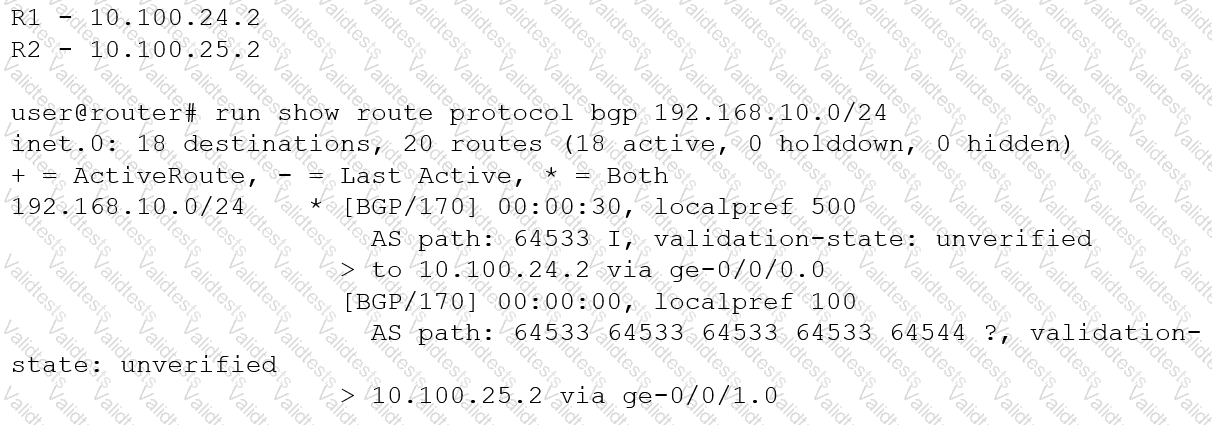
Exhibit

Question # 21

You are troubleshooting an issue where traffic to 192.168.10.0/24 is being sent to R1 instead of your desired path through R2.

Referring to the exhibit, what is the reason for the problem?

Options:

A.

R2 ' s route is not the best path due to loop prevention.

B.

R2 ' s route is not the best path due to a lower origin code.

C.

R1 ' s route is the best path due to a higher local preference

D.

R1 ' s route is the best path due to the shorter AS path.

Questions # 22:

You are asked to connect an IP phone and a user computer using the same interface on an EX Series switch. The traffic from the computer does not use a VLAN tag, whereas the traffic from the IP phone uses a VLAN tag.

Which feature enables the interface to receive both types of traffic?

Options:

A.

native VLAN

B.

DHCP snooping

C.

MAC limiting

D.

voice VLAN

Questions # 23:

Which two statements are correct about tunnels? (Choose two.)

Options:

A.

BFD cannot be used to monitor tunnels.

B.

Tunnel endpoints must have a valid route to the remote tunnel endpoint.

C.

IP-IP tunnels are stateful.

D.

Tunnels add additional overhead to packet size.

Questions # 24:

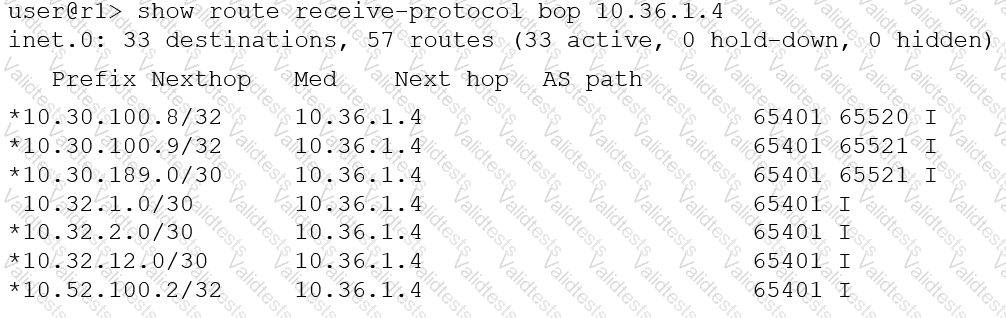
Exhibit.

Question # 24

You want to verify prefix information being sent from 10.36.1.4.

Which two statements are correct about the output shown in the exhibit? (Choose two.)

Options:

A.

The routes displayed have traversed one or more autonomous systems.

B.

The output shows routes that were received prior to the application of any BGP import policies.

C.

The output shows routes that are active and rejected by an import policy.

D.

The routes displayed are being learned from an I BGP peer.

Questions # 25:

Which statement is correct about graceful Routing Engine switchover (GRES)?

Options:

A.

The PFE restarts and the kernel and interface information is lost.

B.

GRES has a helper mode and a restarting mode.

C.

When combined with NSR, routing is preserved and the new master RE does not restart rpd.

D.

With no other high availability features enabled, routing is preserved and the new master RE does not restart rpd.

Questions # 26:

Exhibit

Question # 26

Referring to the exhibit, which statement is correct?

Options:

A.

The local device is using a bridge priority of 4k.

B.

The root bridge is using a bridge priority of 4k.

C.

The root bridge has not been elected for this RSTP topology.

D.

The local device is the root bridge for this RSTP topology.

Questions # 27:

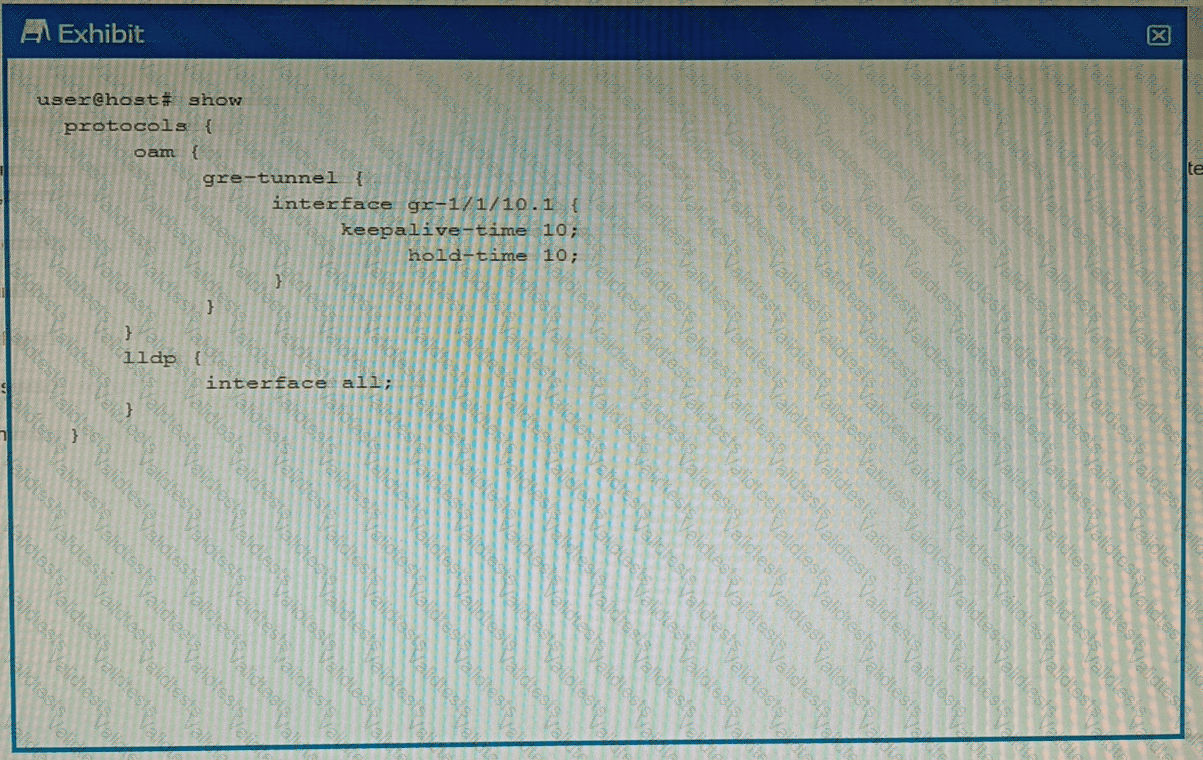
Exhibit

Question # 27

You have configured a GRE tunnel. To reduce the risk of dropping traffic, you have configured a keepalive OAM probe to monitor the state of the tunnel; however, traffic drops are still occurring.

Referring to the exhibit, what is the problem?

Options:

A.

For GRE tunnels, the OAM protocol requires that the BFD protocols also be used.

B.

The " event link-adjacency-loss " option must be set.

C.

LLDP needs to be removed from the gr-1/1/10.1 interface.

D.

The hold-time value must be two times the keepalive-time value

Questions # 28:

Which two statements are correct about link aggregation? (Choose two.)

Options:

A.

LAGs provide physical layer redundancy.

B.

Member links must use the same MTU.

C.

IP traffic is hashed using source and destination MAC addresses

D.

All RE-generated traffic traverses the lowest member link.

Questions # 29:

You are a network operator who wants to add a second ISP connection and remove the default route to the existing ISP You decide to deploy the BGP protocol in the network.

What two statements are correct in this scenario? (Choose two.)

Options:

A.

IBGP updates the next-hop attribute to ensure reachability within an AS.

B.

IBGP peers advertise routes received from EBGP peers to other IBGP peers.

C.

IBGP peers advertise routes received from IBGP peers to other IBGP peers.

D.

EBGP peers advertise routes received from IBGP peers to other EBGP peers.

Questions # 30:

Which two statements are correct about generated routes? (Choose two.)

Options:

A.

Generated routes require a contributing route.

B.

Generated routes show a next hop in the routing table.

C.

Generated routes appear in the routing table as static routes

D.

Generated routes cannot be redistributed into dynamic routing protocols.

Viewing page 3 out of 4 pages
Viewing questions 21-30 out of questions