Pre-Summer Special Limited Time 70% Discount Offer - Ends in 0d 00h 00m 00s - Coupon code: validbest

Pass the Juniper JNCIS-DC JN0-480 Questions and answers with ValidTests

Exam JN0-480 All Questions
Exam JN0-480 Premium Access

View all detail and faqs for the JN0-480 exam

Viewing page 2 out of 2 pages
Viewing questions 11-20 out of questions
Questions # 11:

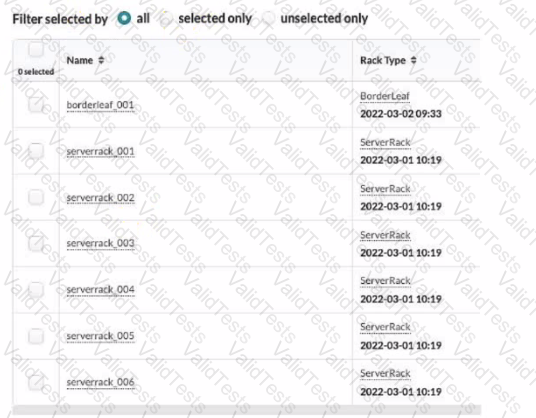
Exhibit.

Question # 11

Referring to the exhibit, how many tack types ate used in the staged blueprint?

Options:

A.

six

B.

three

C.

seven

D.

two

Expert Solution
Questions # 12:

You want to apply a configlet to a specific device using Juniper Apstra. Which two parameters would be used to accomplish this task? (Choose two.)

Options:

A.

form factor

B.

hostname

C.

port group

D.

tags

Expert Solution
Questions # 13:

Juniper Apstra has indicated an anomaly with respect to cabling.

What are two ways to remediate the issue? (Choose two.)

Options:

A.

Manually edit the cabling map.

B.

Redeploy the errant device.

C.

Set the invalid ports to a disabled state.

D.

Have Apstra autoremediate the cabling map using LLDP.

Expert Solution
Questions # 14:

Exhibit.

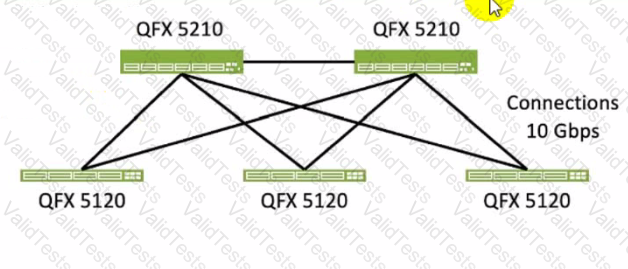
Question # 14

Referring to the exhibit, what needs to change in the IP fabric to make it a valid IP fabric?

Options:

A.

The IP fabric must consist of only one device model throughout the fabric.

B.

The connection between the two spine nodes must be increased to 40 Gbps.

C.

The IP fabric connections must be increased to a speed greater than 10 Gbps.

D.

The connection between the two spine nodes must be removed.

Expert Solution
Questions # 15:

You want to keep virtual networks isolated from each other within the Juniper Apstra system.

In this scenario, what are three ways to accomplish this task? (Choose three.)

Options:

A.

Disable IPv4 connectivity when creating the virtual network within the same Routing Zone.

B.

Enable Security Policy for virtual networks in the same Routing Zone.

C.

Disable Route Target exports when creating the Routing Zones.

D.

Use Connectivity Templates to block access within the same Routing Zone.

E.

Put each network in different Routing Zones.

Expert Solution
Questions # 16:

Exhibit.

Question # 16

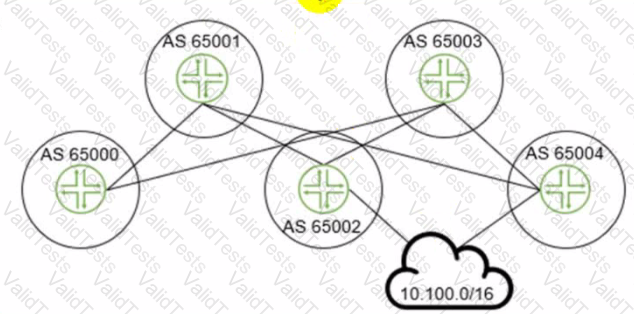
The 10.100.0.0/16 route is being advertised into your BGP IP fabric. ECMP load balancing has been properly enabled on all devices

In this scenario, how many routes will the leaf device in AS 65000 receive for the 10.100.0.0/16 prefix?

Options:

A.

3

B.

1

C.

2

D.

4

Expert Solution
Questions # 17:

What is the purpose of an interface map in Juniper Apstra?

Options:

A.

An interface map associates a logical device with a device profile.

B.

An interface map specifies a connection between the interfaces of two devices.

C.

An interface map specifies the number of ports and the port speeds of a logical device

D.

An interface map specifies the connections between racks in a template.

Expert Solution
Questions # 18:

Exhibit.

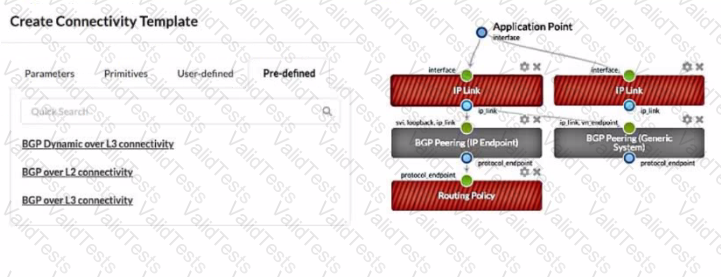
Question # 18

Referring to the exhibit, which statement is correct?

Options:

A.

The gray-solid primitives indicate further configuration is requited.

B.

The gray-solid primitives indicate that they ate incompatible with the connectivity template design.

C.

The red-striped primitives indicate that they are incompatible with the connectivity template design.

D.

The red-striped primitives indicate that further configuration is required.

Expert Solution
Questions # 19:

Using the Juniper Apstra multitenancy capabilities, which approach will allow a tenant to interconnect two different routing zones?

Options:

A.

Interconnection is the default behavior.

B.

Use interconnection through the fabric spine nodes.

C.

Interconnection cannot be enabled.

D.

Use interconnection through an external gateway.

Expert Solution
Viewing page 2 out of 2 pages
Viewing questions 11-20 out of questions