The parents of a 12-year-old boy present to your clinic to discuss their son’s submersion injury. The patient was seen in hospital for 6 months after being pulled unresponsive from a lake at his friend’s house; he had been submerged for an estimated 20 minutes. After extended resuscitation and a 2-month stay in the intensive care unit, he remains in a persistent vegetative state but needs no respiratory or cardiac support. When evaluating the discharge from hospital, which one of the following is most appropriate?
On screening for dyslipidemia, a 45-year-old man is found to have a low high-density lipoprotein (HDL) cholesterol level. Which one of the following recommendations is the most appropriate?
A 45-year-old woman presents with a 2-week history of a sore left breast. It has become red and swollen. She was previously well, and her menstrual cycles are regular. She has no history of breast cancer, and she has no children. On examination, she has a red, tender, indurated area in her left breast that has only partially responded to oral antibiotics after 10 days. Which one of the following is the most appropriate next step?
You are examining a newborn in the delivery room. He was born at full term by spontaneous vaginal delivery. On examination, he is active, and his vital signs are within normal range. His head circumference is at the third percentile, with height and weight at the 10th percentile. Auscultation of his chest is clear with normal cardiovascular examination findings. The abdomen is protuberant with a liver edge palpable at 4 cm below the costal margin and mild splenomegaly. Which one of the following is the most likely diagnosis?
A 32-year-old man presents to the clinic for assessment of a dog bite sustained 3 days ago while traveling in another country. He recalls having seen the dog eat where he was staying, and the animal did not appear well. On examination, the patient has 2 distinct deep puncture wounds on his left leg. There is an erythematous border but no exudate. He is unsure of his immunization status. Which one of the following is the most appropriate management?
A young man and woman who are in a relationship present to the office for prenatal counselling. During the visit, you observe that the man's lips appear as shown in the referenced photo.
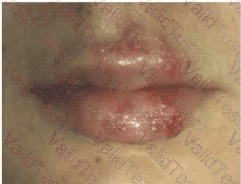
[Image shows grouped vesicular lesions on erythematous base affecting the lips—classic for herpes labialis (HSV-1).]
Which one of the following is the best advice?
A 24-year-old man presents to your clinic with a 6-month history of fatigue. On examination, he is pale. His BMI is 16, and his blood pressure is 92/58 mm Hg. Initial laboratory work shows the following:
Creatinine: 64 µmol/L (49–93)
Potassium: 3.0 mmol/L (3.5–5.1)
Sodium: 138 mmol/L (136–146)
TSH: 2.40 mIU/L (0.34–5.60)
CBC: Normal
Which one of the following is the best next step?
A 24-year-old woman presents with rapidly increasing lower leg pain. Less than 24 hours ago, she fell off her bicycle and had some minor abrasions. On examination, she is in severe pain and appears anxious. Local examination of her leg reveals mild discoloration with marked tenderness but no swelling in her calf. Which one of the following is the most likely diagnosis?
A 15-year-old boy is brought to the office by his father because he is having headaches. When alone, the boy appears withdrawn and admits to suicidal ideation. He shares that he is gay but does not want to tell his parents. He says that he faked the headaches so that one of his parents would make an appointment for him. Which one of the following is the best next step?
A 26-year-old man presents to your office with fever, chills, and malaise. Aside from an episode of dysuria 8 weeks ago, which spontaneously resolved, he has been healthy. On examination, his left wrist and right ankle are tender. There is a cluster of vesiculopustular lesions on his right hand. Which one of the following is the most likely diagnosis?


