Pre-Summer Special Limited Time 70% Discount Offer - Ends in 0d 00h 00m 00s - Coupon code: validbest

Pass the Netskope NCCSA NSK101 Questions and answers with ValidTests

Exam NSK101 All Questions
Exam NSK101 Premium Access

View all detail and faqs for the NSK101 exam

Viewing page 2 out of 4 pages
Viewing questions 11-20 out of questions
Questions # 11:

Click the Exhibit button.
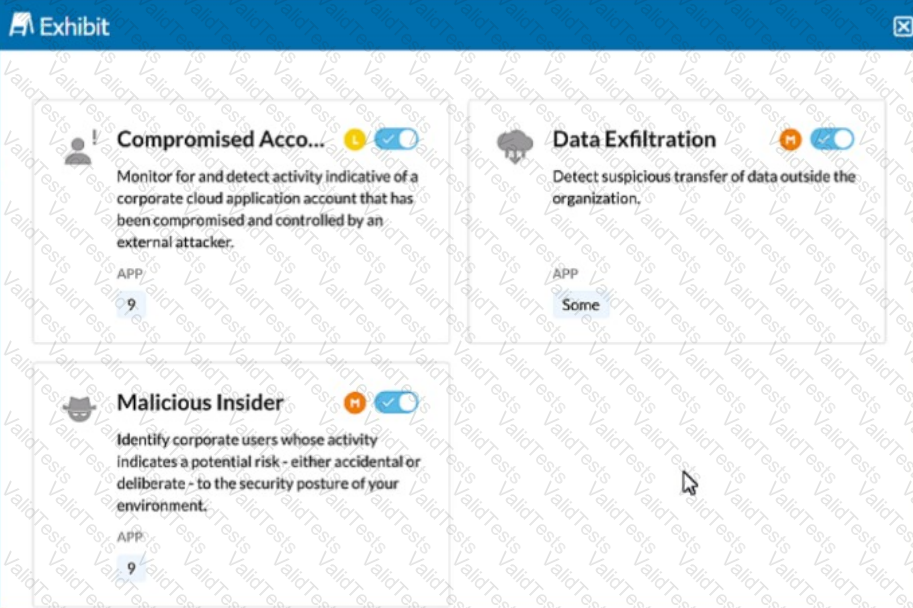
Question # 11

The exhibit shows security rules that are part of which component of the Netskope platform?

Options:

A.

Real-time Protection

B.

Advanced Malware Protection

C.

Security Posture

D.

Behavior Analytics

Expert Solution
Questions # 12:

Which networking function does a SASE solution provide above and beyond an SSE solution?

Options:

A.

Secure Web Gateway

B.

Cloud Access Security Broker

C.

Data Loss Prevention

D.

Software Defined Wide Area Network

Expert Solution
Questions # 13:

You are setting up a real-time threat protection policy for patient zero to block previously unseen files until a benign verdict is produced by the Netskope Threat Protection Service. In this scenario, which two policy parameters must you configure? (Choose two)

Options:

A.

block action

B.

CCL destination criterion

C.

file type activity constraint

D.

remediation profile

Expert Solution
Questions # 14:

A customer wants to detect misconfigurations in their AWS cloud instances.

In this scenario, which Netskope feature would you recommend to the customer?

Options:

A.

Netskope Secure Web Gateway (SWG)

B.

Netskope Cloud Security Posture Management (CSPM)

C.

Netskope Advanced DLP and Threat Protection

D.

Netskope SaaS Security Posture Management (SSPM)

Expert Solution
Questions # 15:

What are two valid use cases for the Cloud Confidence Index (CCI)? (Choose two.)

Options:

A.

To recategorize cloud applications in the database

B.

To delete cloud applications from the database

C.

To identify the activities that Netskope supports for cloud applications

D.

To compare similar cloud applications

Expert Solution
Questions # 16:

You need to block all users from uploading data files into risky collaboration applications. Which element must you configure within Netskope's CASB to accomplish this task?

Options:

A.

DLP Rule

B.

real-time policy

C.

DLP Profile

D.

block notification

Expert Solution
Questions # 17:

You have applied a DLP Profile to block all Personally Identifiable Information data uploads to Microsoft 365 OneDrive. DLP Alerts are not displayed and no OneDrive-related activities are displayed in the Skope IT App Events table.

In this scenario, what are two possible reasons for this issue? (Choose two.)

Options:

A.

The Cloud Storage category is in the Steering Configuration as an exception.

B.

The destination domain is excluded from decryption in the decryption policy.

C.

A Netskope POP is not in your local country and therefore DLP policies cannot be applied.

D.

DLP policies do not apply when using IPsec as a steering option.

Expert Solution
Questions # 18:

Why would you want to define an App Instance?

Options:

A.

to create an API Data Protection Policy for a personal Box instance

B.

to differentiate between an enterprise Google Drive instance vs. a personal Google Drive instance

C.

to enable the instance_id attribute in the advanced search field when using query mode

D.

to differentiate between an enterprise Google Drive instance vs. an enterprise Box instance

Expert Solution
Questions # 19:

When would an administrator need to use a tombstone file?

Options:

A.

You use a tombstone file when a policy causes a file download to be blocked.

B.

You use a tombstone file when a policy causes a publicly shared file to be encrypted.

C.

You use a tombstone file when the policy causes a file to be moved to quarantine.

D.

You use a tombstone file when a policy causes a file to be moved to legal hold.

Expert Solution
Questions # 20:

You are working with a large retail chain and have concerns about their customer data. You want to protect customer credit card data so that it is never exposed in transit or at rest. In this scenario, which regulatory compliance standard should be used to govern this data?

Options:

A.

SOC 3

B.

PCI-DSS

C.

AES-256

D.

ISO 27001

Expert Solution
Viewing page 2 out of 4 pages
Viewing questions 11-20 out of questions