Pre-Summer Special Limited Time 70% Discount Offer - Ends in 0d 00h 00m 00s - Coupon code: validbest

Pass the Netskope NCCSI NSK200 Questions and answers with ValidTests

Exam NSK200 All Questions
Exam NSK200 Premium Access

View all detail and faqs for the NSK200 exam

Viewing page 2 out of 3 pages
Viewing questions 11-20 out of questions
Questions # 11:

Review the exhibit.

add log-upload syslogng parserconfig set log-upload syslogng parserconfig 0

logsource <log-source>

You are asked to deploy a virtual appliance OPLP to accept syslog messages directly from the enterprise Palo Alto Networks firewall. You believe that you have configured the OPLP to accept the firewall logs, yet they are not appearing in Risk Insights. Referring to the exhibit, which parser name would be required to complete the new configuration?

Options:

A.

panw-syslog

B.

sfwder

C.

custom-csv

D.

squid

Expert Solution
Questions # 12:

Review the exhibit.

Question # 12

What is the purpose of the configuration page shown Ii the exhibit?

Options:

A.

to provision a Netskope client using SCCM

B.

to allow users to authenticate against the proxy

C.

to onboard Active Directory users to a Netskope tenant

D.

to enforce administrative role-based access

Expert Solution
Questions # 13:

After deploying the Netskope client to a number of devices, users report that the Client status indicates "Admin Disabled". User and gateway information is displayed correctly in the client configuration dialog

Why are clients installing in an "Admin Disabled" state in this scenario?

Options:

A.

All devices were previously disabled by the administrator.

B.

The user's identity is not synchronized to Netskope.

C.

The user's password was incorrect during enrollment.

D.

The user's account has no mail ID attribute In Active Directory.

Expert Solution
Questions # 14:

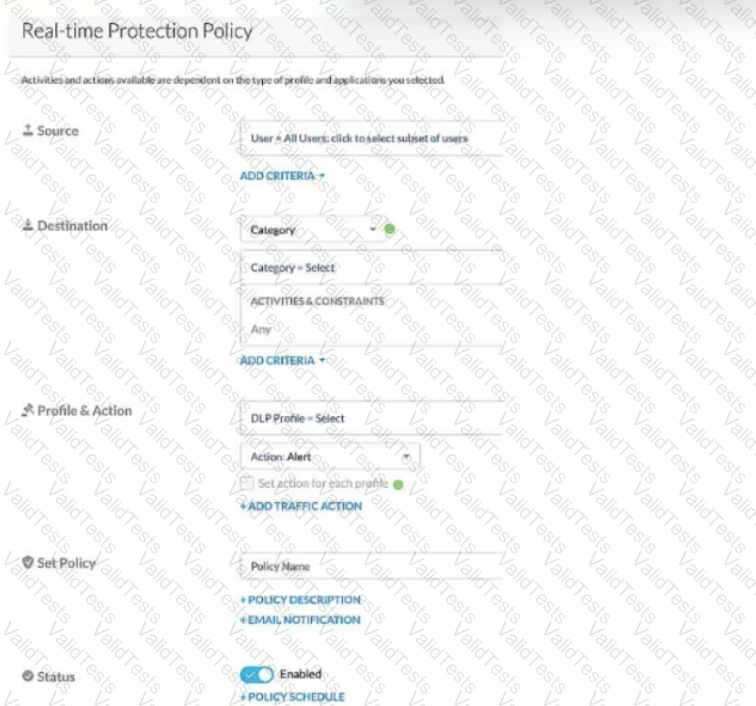
Review the exhibit.

Question # 14

Given the information shown below:

-for PCI data uploads, you want to provide no notification,

-for PHI data uploads, you want to allow users to proceed by clicking OK,

-for GDPR data uploads, you want to provide block notification,

-if none of the above matches, you want to provide no notification.

You want to reduce the number of policies by combining multiple DLP profiles Into one policy.

Referring to the exhibit, which two statements are true? (Choose two.)

Options:

A.

You must open a support ticket to enable the Advanced Policies feature.

B.

You must check the "set action for each profile" flag.

C.

You can have only one action if you use multiple DLP profiles in the same policy.

D.

You can apply a unique action to each profile In the same policy.

Expert Solution
Questions # 15:

Your company asks you to use Netskope to integrate with Endpoint Detection and Response (EDR) vendors such as Crowdstrike.

Which two requirements are needed for a successful integration and sharing of threat data? (Choose two.)

Options:

A.

Remediation profile

B.

Device classification

C.

API Client ID

D.

Custom log parser

Expert Solution
Questions # 16:

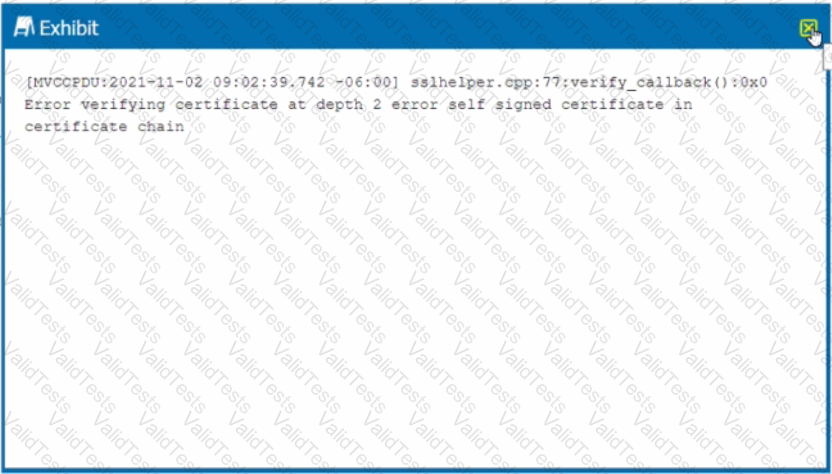
Review the exhibit.

Question # 16

While diagnosing an NPA connectivity issue, you notice an error message in the Netskope client logs.

Referring to the exhibit, what does this error represent?

Options:

A.

The Netskope client has been load-balanced to a different data center.

B.

The primary publisher is unavailable or cannot be reached.

C.

There Is an EDNS or LDNS resolution error.

D.

There Is an upstream device trying to intercept the NPA TLS connection.

Expert Solution
Questions # 17:

You are comparing the behavior of Netskope's Real-time Protection policies to API Data Protection policies. In this Instance, which statement is correct?

Options:

A.

All real-time policies are enforced, regardless of sequential order, while API policies are analyzed sequentially from top to bottom and stop once a policy Is matched.

B.

Both real-time and API policies are analyzed sequentially from top to bottom and stop once a policy Is matched.

C.

All API policies are enforced, regardless of sequential order, while real-time policies are analyzed sequentially from top to bottom and stop once a policy Is matched.

D.

Both real-time and API policies are all enforced, regardless of sequential order.

Expert Solution
Questions # 18:

You are currently migrating users away from a legacy proxy to the Netskope client in the company’s corporate offices. You have deployed the client to a pilot group; however, when the client attempts to connect to Netskope, it fails to establish a tunnel.

In this scenario, what would cause this problem?

Options:

A.

The legacy proxy is intercepting SSL/TLS traffic to Netskope.

B.

The corporate firewall is blocking UDP port 443 to Netskope.

C.

The corporate firewall is blocking the Netskope EPoT address.

D.

The client cannot reach dns.google for EDNS resolution.

Expert Solution
Questions # 19:

The director of IT asks for confirmation If your organization's Web traffic would be blocked when the Netskope client fails. In this situation, what would confirm the fail close status?

Options:

A.

Perform a right-click on the Netskope client icon using your mouse.

B.

Review the nsdebuglog.log.

C.

View Application events.

D.

Review user settings.

Expert Solution
Questions # 20:

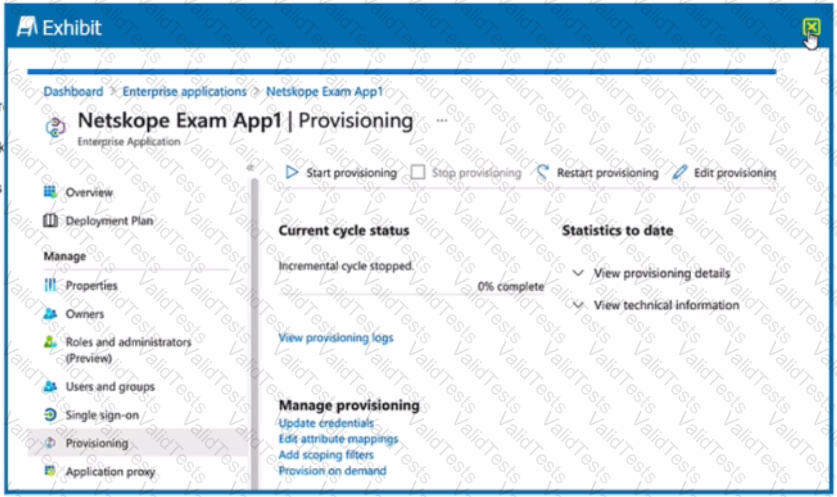
You created the Netskope application in your IdP for user provisioning and validated that the API Integration settings are correct and functional. However, you are not able to push the user groups from the IdP into your Netskope tenant.

Options:

A.

The IdP group contains active users, as well as one or more deactivated users.

B.

The IdP does not have Create User permissions.

C.

You do not have enough users assigned to the IdP group.

D.

You failed to push the IdP users before attempting to push the IdP groups.

Expert Solution
Viewing page 2 out of 3 pages
Viewing questions 11-20 out of questions