Pre-Summer Special Limited Time 70% Discount Offer - Ends in 0d 00h 00m 00s - Coupon code: validbest

Pass the Nokia SRC 4A0-101 Questions and answers with ValidTests

Exam 4A0-101 All Questions
Exam 4A0-101 Premium Access

View all detail and faqs for the 4A0-101 exam

Viewing page 8 out of 10 pages
Viewing questions 71-80 out of questions
Questions # 71:

If a Router originates a type 1 router LSA with the E bit set what types of areas can it belong to? Select all that apply.

Options:

A.

Not So Stubby Area

B.

Stub Area

C.

Backbone Area

D.

Standard Area

Expert Solution
Questions # 72:

What must be configured on the Alcatel-Lucent 7750 SR for RIP to advertise locally attached links?

Options:

A.

A policy statement within the router identifying what is to be advertised

B.

Access-lists denoting what is to be advertised

C.

Default metrics for each link

D.

A group and neighbor statement for each peer

Expert Solution
Questions # 73:

NSSA LSA packets are what type within an NSSA area, and are converted to what other type at the ABR?

Options:

A.

They are type 7 within the area and are not modified at the ABR

B.

They are type 5 within the area and converted to type 3 at the ABR

C.

They are type 5 within the area and are not modified at the ABR

D.

They are type 7 within the area and converted to type 5 at the ABR

Expert Solution
Questions # 74:

What best describes the type of packets used by OSPF routers to exchange updates on a pointto-point link?

Options:

A.

IP packets sent to an IP multicast address.

B.

Ethernet frames sent to an Ethernet multicast address.

C.

IP packets sent to an IP unicast address.

D.

UDP packets sent to an IP multicast address.

Expert Solution
Questions # 75:

The Alcatel-Lucent 7750 SR supports which two of the OSPF area types below?

Options:

A.

Not So Stubby Areas

B.

Level 1 Areas

C.

Stub Areas

D.

Partially Stubby Areas

Expert Solution
Questions # 76:

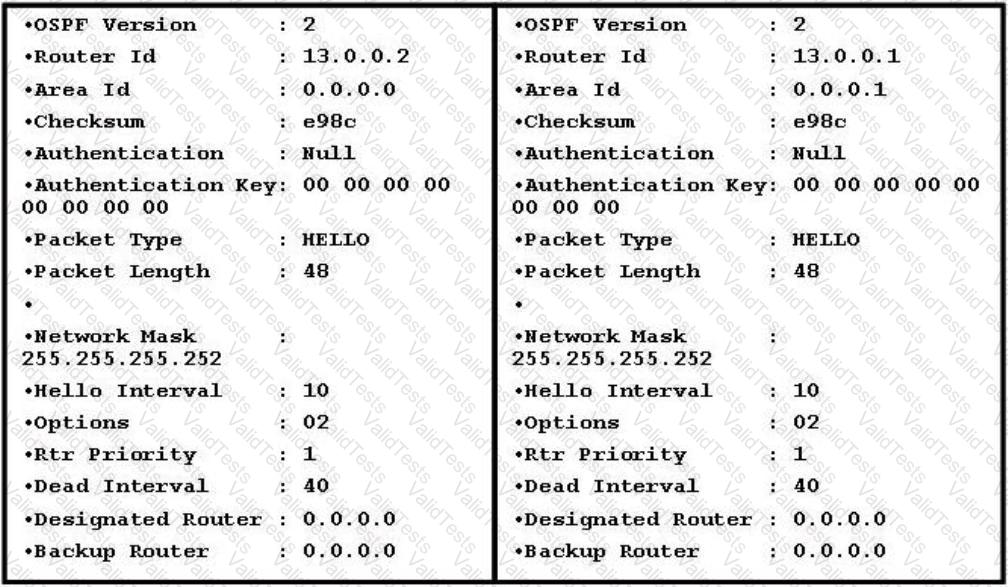
Click the exhibit button.

Question # 76

Two neighboring OSPF routers have exchanged the packets shown. What state is the adjacency in?

Options:

A.

Full; both routers are exchanging Helios to maintain the adjacency.

B.

The adjacency is down.

C.

The adjacency is in exstart state.

D.

The adjacency is in the exchange state.

Expert Solution
Questions # 77:

Which part of the NSAP address is used to indicate to the end system that a packet is to be processed by the router itself?

Options:

A.

AFI

B.

IDI

C.

HO-DSP

D.

NSEL

Expert Solution
Questions # 78:

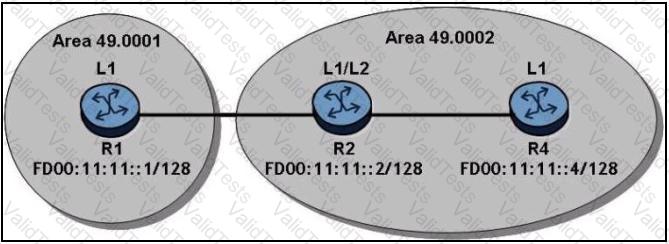
Refer to the exhibit below.

Question # 78

R1 distributes its loopbacks into IS-IS and globally routed addresses are configured as shown. How many routes will R4 have in its IPv6 route table?

Options:

A.

1

B.

2

C.

3

D.

4

E.

6

F.

7

Expert Solution
Questions # 79:

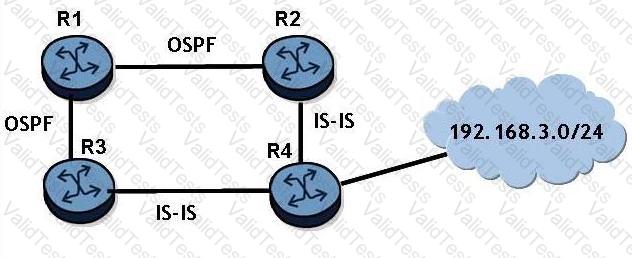
Click the exhibit button.

Question # 79

If router R2 redistributes the IS-IS route to 192.168.3.0/24 into OSPF, router R3 will receive two routes to 192.168.3.0/24. What will be the preference of these two routes? Assume that all IS-IS routers are L1/L2 capable and are in the same area. Choose two answers.

Options:

A.

The OSPF internal preference

B.

The IS-IS Level 1 internal preference

C.

The IS-IS Level 2 internal preference

D.

The OSPF external preference

E.

The IS-IS Level 2 external preference

F.

The IS-IS Level 1 external preference

Expert Solution
Questions # 80:

The exhibit shows a route to 2001:DB8:1:200::/56 in the IPv6 route table. How did the route get into the route table?
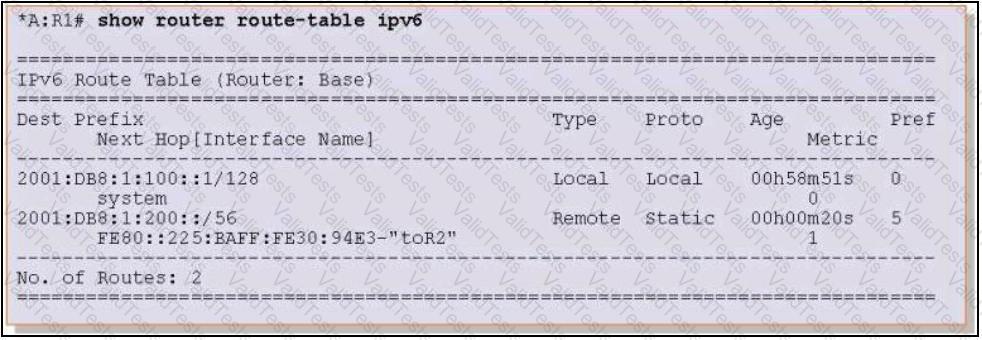

Question # 80

Options:

A.

Configure router ipv6 static-route 2001:DB8:1:200::/56 next-hop FE80::225:BAFF:FE30:94E3

B.

Configure router ipv6 static-route 2001:DB8:1:200::/56 next-hop FE80::225:BAFF:FE30:94E3-toR2

C.

Configure router static-route 2001:DB8:1:200::/56 next-hop FE80::225:BAFF:FE30:94E3

D.

Configure router static-route 2001:DB8:1:200::/56 next-hop FE80::225:BAFF:FE30:94E3-toR2

E.

The route was learned through a dynamic routing protocol.

Expert Solution
Viewing page 8 out of 10 pages
Viewing questions 71-80 out of questions