Pre-Summer Special Limited Time 70% Discount Offer - Ends in 0d 00h 00m 00s - Coupon code: validbest

Pass the Nokia SRC 4A0-101 Questions and answers with ValidTests

Exam 4A0-101 All Questions
Exam 4A0-101 Premium Access

View all detail and faqs for the 4A0-101 exam

Viewing page 9 out of 10 pages
Viewing questions 81-90 out of questions
Questions # 81:

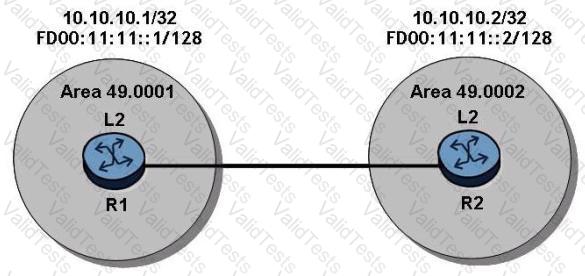
Refer to the exhibit below. The routers have an established IS-IS L2 adjacency on which IPv4 system addresses are exchanged. An operator successfully configures multi-topology IS-IS routing so that the IPv6 system addresses are also exchanged between routers. Which of the following statements best describes the number of IS-IS adjacencies and the number of LSPs in the LSDB of R1 AFTER IPv6 has been configured?
Question # 81

Options:

A.

R1 has one IS-IS adjacency and one LSP.

B.

R1 has one IS-IS adjacency and two LSPs.

C.

R1 has one IS-IS adjacency and four LSPs.

D.

R1 has two IS-IS-adjacencies and two LSPs

E.

R1 has two IS-IS adjacencies and four LSPs

Expert Solution
Questions # 82:

On which type of IS-IS router is summarization most likely to be configured?

Options:

A.

L1 routers

B.

L2 routers

C.

L1/L2 routers

D.

L1 and L2 routers

Expert Solution
Questions # 83:

Which of the following statements regarding IS-IS DIS is false?

Options:

A.

L1 and L2 routers elect separate DIS's.

B.

DIS uses multicast address 0180x200:0015 to communicate with other routers on the broadcast network.

C.

If a new router starts up in a LAN and has a higher interface priority, the new router preempts the original DIS and becomes the DIS.

D.

In broadcast multi-access networks, such as Ethernet, a single router is elected as the DIS. There is no backup DIS

Expert Solution
Questions # 84:

A router receives an OSPF database description packet from a neighbor that references an LSA, which is already in the router's LSDB. The sequence number in the DBD packet is lower than the sequence number of the LSA in the LSDB.

What action does the router take?

Options:

A.

The router sends a link-state update to its neighbor.

B.

The router sends a link-state acknowledgement to its neighbor.

C.

The router updates the information in its LSDB with the information received from its neighbor.

D.

The router sends a link-state request to its neighbor.

E.

The router takes no action.

Expert Solution
Questions # 85:

Click the exhibit button

Question # 85

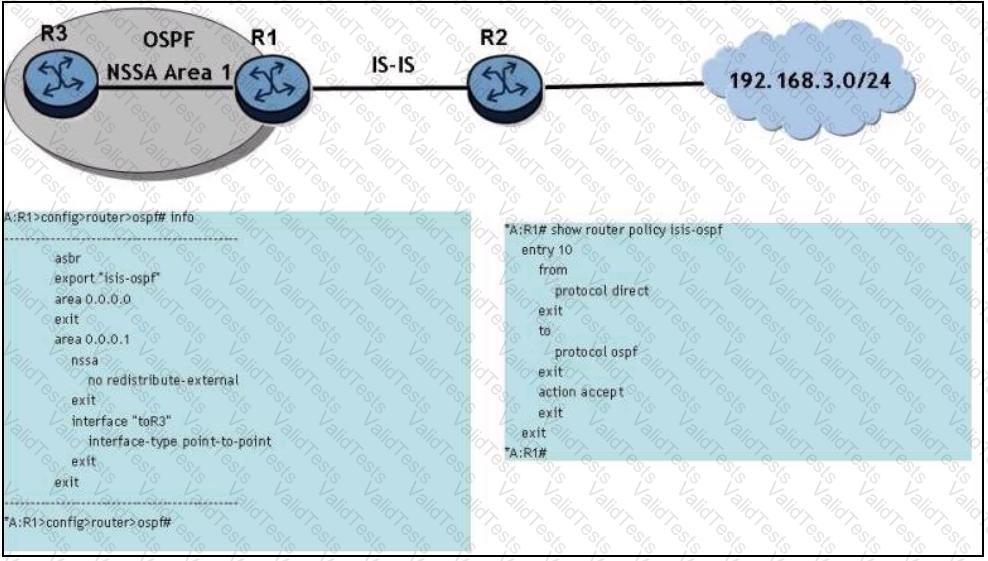
The 192 168 3.0/24 network is learned on router R1 via IS-IS Given the OSPF configuration shown, and assuming that the OSPF adjacency between routers R1 and R3 is up, why is the 192 168.3.0/24 route not in router R3's route table? (Choose two)

Options:

A.

The route policy should be applied as in import policy

B.

The no-redistribute-external command is used on router R1

C.

The route policy is incorrect. It should say "from protocol ISIS" rather than "from protocol direct".

D.

It is not possible to be an ASBR and an NSSA. The ASBR configuration should be removed.

E.

The interface between routers R1 and R3 needs to be in OSPF area 0 rather than OSPF area 1 because a backbone area must always exist.

Expert Solution
Questions # 86:

Which of the following statements are true? Choose two answers.

Options:

A.

Route redistribution is only needed if Internet access is a requirement.

B.

Route filtering is the process of attaching data path filters to router interfaces.

C.

Route filtering involves deciding whether to permit or deny certain routing updates from being accepted into, or distributed out of, the route-selection process.

D.

Redistribution is needed for exchanging routes from one routing protocol to another.

E.

OSPF routers that are redistributing routes must be configured as ABRs.

Expert Solution
Questions # 87:

An interface has a MAC address of 24-16-4d-16-b5-3d. What link-local address will be assigned to this interface?

Options:

A.

fe80::2416:4dff:fe16:b53d

B.

fe80::2616:4dff:fe16:b53d

C.

ff80::2416:4dff:fe 16:b53d

D.

ff80::2616:4dff:fe 16:b53d

E.

fd80::2416:4dff:fe16:b53d

Expert Solution
Questions # 88:

Which of the statements below best describes the operation of the IPv6 anycast address?

Options:

A.

A packet with a destination anycast address is sent to all nodes on the local link.

B.

A packet with a destination anycast address is sent to all nodes on the local network.

C.

A packet with a destination anycast address is sent to all nodes that have joined the anycast group.

D.

A packet with a destination anycast address is sent to the nearest node that is assigned the anycast address

E.

A packet with a destination anycast address is sent to all nodes that are assigned the anycast address.

Expert Solution
Questions # 89:

An interface is configured on a router for OSPF but the command "show router ospf neighbor" does not show any neighbors. Which of the following is NOT a possible cause?

Options:

A.

An OSPF database description packet has not been received from the neighbor.

B.

The interface facing the neighbor is down.

C.

The interface is included in a different area than the neighbor router.

D.

The router has not received a valid OSPF Hello packet from its neighbor.

Expert Solution
Questions # 90:

Click the exhibit button.

Question # 90

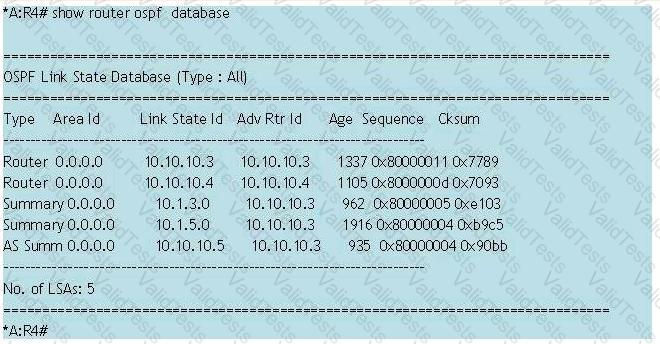
Assuming that the router ID of the router shown is 10.10.10.4, which of the following statements regarding the CLI output is true?

Options:

A.

The router with router ID 10.10.10.5 is an ASBR.

B.

The router with router ID 10.10.10.3 is an ASBR.

C.

The router with router ID 10.10.10.5 originated the AS summary LSA in its own area.

D.

The router with router ID 10.10.10.4 is in the same area as the router with router ID 10.10.10.5.

Expert Solution
Viewing page 9 out of 10 pages
Viewing questions 81-90 out of questions